
That figure comes from established estimating benchmarks, and it's the standard QuantiFlow builds towards in every NRM2-aligned takeoff it produces. Before you issue anything, label the estimate's accuracy band and write down the assumptions behind it. Skip that step, and disputes down the line become almost inevitable.
TL;DR:
- Tender quantities should be within a ±5% accuracy band to ensure reliable pricing and reduce disputes during project execution.
- Common errors such as omissions, incorrect scale, ambiguous scope, and lack of cross-checks account for most inaccurate takeoffs and are largely preventable.
- Implementing a multi-stage QA workflow, including traceability, independence checks, and sign-off with an explicit accuracy label, improves estimate reliability.
- Using AI to extract quantities from PDFs accelerates the process but must be validated by professionals to avoid missed scope or data gaps.
- Maintaining a detailed assumption log and clear change audit trail enhances traceability, helping prevent costly rework and re-pricing disputes later.
Table of Contents
- Why tender quantities accuracy matters for cost and programme risk
- What accuracy bands should you use at each project stage?
- What causes inaccurate tender quantities, and how do you stop them?
- Building a QA workflow that survives scrutiny
- How does model-based takeoff improve accuracy, and where does judgement still matter?
- Checklist: producing tender-ready quantities today
- What I've learned reviewing QuantiFlow's takeoff data
- Reduce tender quantity risk with an NRM2-aligned workflow
- Sources
Why tender quantities accuracy matters for cost and programme risk
A 2% takeoff error sounds trivial until you multiply it against a £4 million contract sum. On a project that size, that "small" error becomes an £80,000 problem, and it rarely surfaces until the contractor is on site pricing a variation. Research from Gray Quantity Surveyors shows this pattern repeatedly on commercial schemes: modest percentage errors translate into large absolute sums, and those sums erode margin, delay procurement, and fuel disputes between client and contractor.
Get the quantities wrong at tender and the consequences ripple outward fast:
- Contractors price against the wrong scope, so tender comparisons stop being genuinely comparable.
- Lead times on materials get miscalculated, pushing back the programme before work even starts.
- Variations claims multiply, because omitted or misquantified work has to be repriced mid-contract.
- Client trust erodes when budgets move after contracts are signed, not before.
Accurate quantities do the opposite. They protect your margin, give procurement teams a stable baseline for negotiation, and cut the number of contested variations to a fraction of what poorly measured tenders generate.
What accuracy bands should you use at each project stage?
Estimating accuracy isn't a single number, it's a moving target that tightens as design information matures. The industry benchmark, set out in AACE International's recommended practices, gives three clear bands:
| Project stage | Accuracy range | Typical estimate type |
|---|---|---|
| Concept | ±20% | ROM (rough order of magnitude) |
| Design development | ±10% | Budget estimate |
| Tender documentation | ±5% | Definitive estimate |
A ROM estimate at concept stage is deliberately loose. It's meant to test feasibility, not commit anyone to a number. A budget estimate at design development tightens things up once layouts and specifications are firming up, but there's still enough uncertainty to justify a healthy contingency.
That ±5% figure has a direct consequence for contingency setting. If your tender estimate genuinely sits within that band, contingency can shrink accordingly, and procurement can price with confidence rather than padding rates to cover uncertainty they can't quantify. State the band explicitly on the estimate cover sheet. Tenderers price differently when they know the numbers behind a submission are labelled ±5% rather than left ambiguous.
What causes inaccurate tender quantities, and how do you stop them?
Most quantity errors trace back to a handful of repeat offenders, and nearly all of them are avoidable with the right checks in place.
- Omissions from 2D drawings. Supports, penetrations, and interface details between trades are routinely left off 2D plans because they're implied rather than drawn. A duct run shown as a single line hides the hangers, fire collars, and structural penetrations that actually cost money.
- Scale and drawing quality problems. A drawing printed or exported at the wrong scale throws every linear and area measurement off by the same margin. Always verify the scale bar against a known dimension, and where possible, work from the original CAD or BIM file rather than a flattened PDF.
- Ambiguous scope and unstated assumptions. When a specification doesn't say whether excavation includes disposal, or whether a rate covers make-good, estimators guess, and guesses vary between teams. Log every assumption as you make it, issue RFIs the moment ambiguity appears rather than waiting for a pre-tender meeting, and standardise your measurement templates so the same categories get checked on every job.
- Insufficient cross-checking before issue. A single measurer, working alone, catches their own errors at a much lower rate than a second person reviewing independently.
Mitigating these causes doesn't require exotic tools, just discipline. Multi-person checks on high-value elements, comparison against historical rates for similar work, and a quick parametric sanity test (does this rate per square metre align with comparable projects?) catch the majority of errors before they reach a tender pack.
Pro Tip: Keep a running assumption log from the first takeoff, not just at sign-off. Retrofitting assumptions after the fact almost always misses the ones that mattered most.
Building a QA workflow that survives scrutiny
Accuracy isn't produced by a single measurement pass, it's the output of a workflow with built-in checks at each stage.
- Initial takeoff with full traceability. Every measured item should link back to a specific drawing reference or specification clause, so anyone reviewing the estimate can trace a quantity to its source in seconds.
- Maintain a live assumption log. Record exclusions, provisional sums, and judgement calls as they're made, not reconstructed from memory later.
- Run an independent cross-check. A second measurer, or a parametric reasonableness test against historical data for similar building types, catches errors the original measurer is structurally unlikely to spot themselves.
- Reconcile totals and analyse variance. Where the independent check diverges from the original by more than a few percent, investigate before signing off, don't average the two and move on.
- Sign off with an explicit accuracy label. State the band (±5% for tender documentation, wider for earlier stages) so everyone downstream understands the estimate's actual confidence level.
For packages carrying unusual uncertainty, ground conditions, heritage constraints, or novel construction methods, a single-point estimate understates the real risk. Structured estimation guidance recommends three-point estimating (optimistic, most likely, pessimistic) or Monte Carlo simulation for these packages, because it captures a range rather than a false sense of precision. Parametric and regression-based checks are useful here too, but only when the underlying data supports them. NASA's cost estimating guidance recommends a coefficient of variation below 20%, ideally under 10%, before trusting a regression-derived figure. Below that threshold, the model is telling you more about noise than about the actual project.
A QS reviewing bid documents should also check the tolerances and rounding rules specified in the tender documents themselves, since inconsistent rounding between the estimate and the bill of quantities is a common, entirely preventable source of dispute. Further detail on structuring this kind of QA sits in QuantiFlow's practical QA guide to takeoff errors.
How does model-based takeoff improve accuracy, and where does judgement still matter?
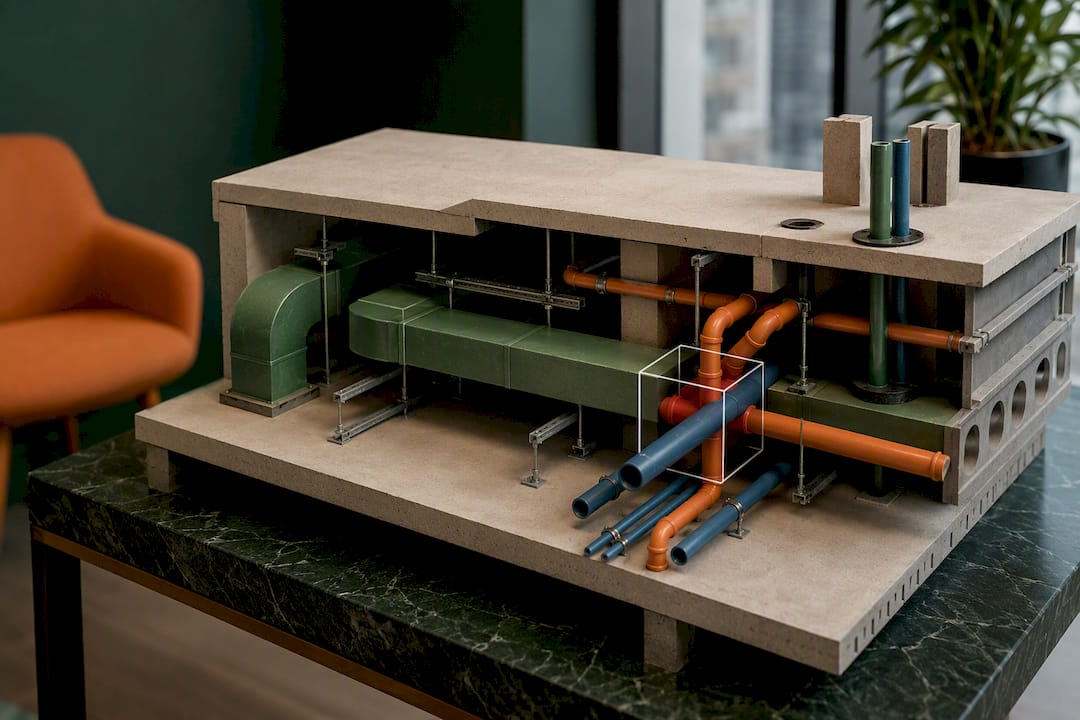
Working from a coordinated 3D model rather than flat 2D drawings changes what you actually see. A modelled duct run shows its supports, its penetrations through structure, and its clashes with other services before a single metre of pipework goes in. HKA's analysis of BIM and MEP modelling points to exactly this: implied work that 2D drawings routinely omit becomes visible and measurable once the model exists, which cuts the omission-driven disputes that plague tenders built on flat drawings alone.
AI-assisted takeoff tools extend this further by speeding up cross-referencing across drawing sets and flagging inconsistencies a human reviewer might miss on a tight deadline. Category tools that pull quantities directly from tender documents and automatically cross-check for contradictions between pages demonstrate how much manual reconciliation time this can remove from a QS's workload. But none of this works without model completeness and clean data. A model missing a service run produces a takeoff missing that run, with no warning that anything's absent.
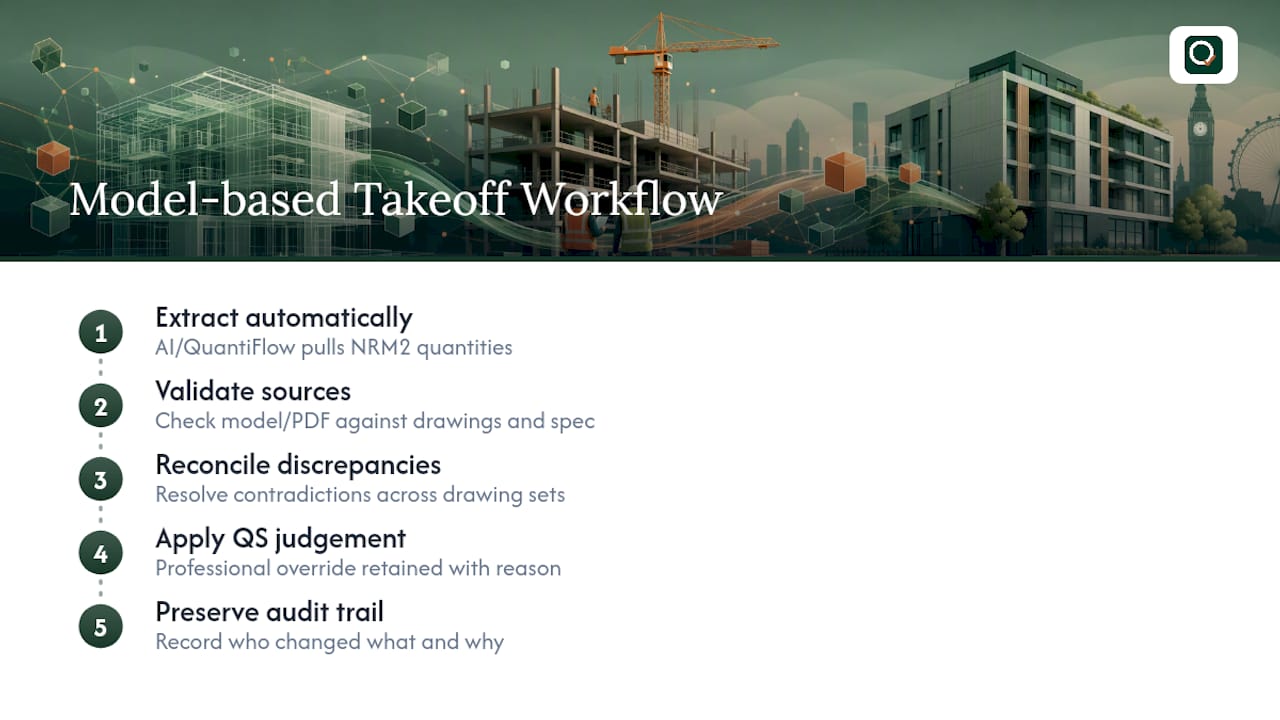
QuantiFlow's approach reflects this balance directly. It extracts NRM2-aligned quantities from PDF drawings using AI, cross-references items across drawing sets, and produces a structured, priceable takeoff, but every extracted quantity remains open to professional override, with a full audit trail recording who changed what and why. The workflow that works best follows a consistent pattern: extract automatically, validate against the source drawings and specification, reconcile any discrepancies, and preserve the QS's judgement as the final word.
Pro Tip: Treat AI-extracted quantities as a strong first draft, not a finished bill. The value is in the hours saved reaching that draft, not in skipping the professional check afterwards.
More detail on measuring directly from PDF drawings sits in QuantiFlow's guide to measuring PDF drawings for NRM2 takeoffs, and the broader shift from manual to model-based measurement is covered in this guide to the role of drawings in quantity measurement.
Checklist: producing tender-ready quantities today
Before a tender pack goes out, work through this sequence:
- Confirm drawings and specifications are complete enough to support a ±5% estimate.
- Capture assumptions and exclusions in a written log as measurement proceeds.
- Get a second person to confirm the takeoff, or run a parametric check against comparable projects.
- Label the estimate's accuracy band clearly on the cover documentation.
- Set contingency consistent with that labelled accuracy, not a flat percentage applied out of habit.
- Record the audit trail: who measured what, when, and against which drawing revision.
- Export a concise quantity summary for procurement and tendering contractors to work from.
Further background on setting realistic accuracy expectations by stage sits in QuantiFlow's guide to why architects use quantity calculations.
What I've learned reviewing QuantiFlow's takeoff data
The pattern that comes up again and again in QuantiFlow's blog and in practice is omission, not miscalculation. Teams rarely get the maths wrong on what they've measured. They miss what wasn't drawn clearly enough to measure in the first place, supports, penetrations, interface details, and that's exactly where repricing disputes originate months later. Traceability fixes more of this than any amount of double checking, because when every quantity links back to a drawing reference, disagreements become fact checks rather than arguments.
The temptation with automation is to treat the output as finished. Resist it. AI-assisted extraction is genuinely faster at surfacing what's on a drawing set, but it can't tell you whether a specification clause means something different from what it literally says. That's still a QS's call, every time.
— Michael
Reduce tender quantity risk with an NRM2-aligned workflow
Manual cross-checking against dense PDF drawing sets is where most tender quantity errors creep in, however careful the team. QuantiFlow closes that gap by generating NRM2-aligned takeoffs directly from architectural drawings, cross-referencing items automatically, and logging every change so nothing gets buried in a spreadsheet with no history.
Every extracted quantity stays open to override, with the reasoning recorded, so the QS's professional judgement remains the final word rather than the AI's. Exports drop straight into BoQ or Excel format, ready for procurement or issue to tenderers. It's built for SME quantity surveying practices, builders, and architects who need traceable, defensible quantities without spending days reconciling drawing sets by hand. If tender quantities accuracy is a recurring pain point on your projects, see how QuantiFlow's takeoff platform works and start a trial to test it against your next drawing set.
Sources
- Project cost estimation: techniques and examples
- The importance of accurate quantity take-offs: why even a 2% error matters