
NRM2 is the RICS standard for detailed measurement of building works, and it gives quantity surveyors a repeatable, auditable basis for pricing, tendering and change control. Every bill of quantities built to NRM2 rules can be compared line for line against another, which is precisely why it sits at the centre of UK cost management.
You will reach for NRM2 whenever you need to prepare a Bill of Quantities (BoQ), compare competing tenders on equal terms, or value a variation without an argument. RICS publishes the standard, and Quantiflow builds software around exactly this rulebook, because the entire commercial case for NRM2 rests on consistency.
Three things to do next:
- Confirm which RIBA stage your project has reached (NRM2 typically applies from Stage 4)
- Download the official RICS templates and appendices before you start measuring
- Begin your take-off against the correct work sections rather than a generic checklist
Key Takeaways
NRM2 works because it standardises how building works are measured and described, giving every party to a contract the same basis for pricing and change control.
| Point | Details |
|---|---|
| NRM2 sits after NRM1 | Apply NRM2 once design reaches roughly RIBA Stage 4, when there is enough detail to measure. |
| Structure follows three parts | Part 1 covers general rules, Part 2 detailed measurement, Part 3 the 41 tabulated work sections. |
| Descriptions carry the risk | A description missing location, quality, interface or inclusions invites disputed pricing later. |
| Reconciliation catches errors | Always check the NRM2 bill total against the NRM1 cost plan before issuing a tender pack. |
| Digital tools speed the process | Quantiflow applies AI-assisted extraction against NRM2 work sections while keeping QS override control at every stage. |
Table of Contents
- What does NRM2 cover and where does it sit in the NRM suite?
- Why does NRM2 matter for tender pricing and cost control?
- How do you apply NRM2 to a take-off and build a compliant BoQ?
- How should you write BoQ items: units, descriptions and classification?
- How does an NRM2 BoQ support tendering and post-contract control?
- What are the most common NRM2 mistakes and how do you catch them?
- Why was NRM2 introduced, and how has it evolved from NRM1?
- How does NRM2 compare with other measurement methods?
- What are NRM2's real benefits and limitations?
- What measurement rules and conventions are unique to NRM2?
- What does NRM2 look like in a real project?
- Rules of thumb from years of NRM2 practice
- Where Quantiflow fits when you need faster NRM2 take-offs
- Frequently asked questions
- Sources
What does NRM2 cover and where does it sit in the NRM suite?
NRM2 does not work alone. The New Rules of Measurement suite has three parts, and each serves a different stage of the cost management timeline. NRM1 handles order of cost estimates and elemental cost planning, typically before the design has firmed up. NRM2 takes over once there is enough information to measure in detail, commonly from RIBA Stage 4 onward. NRM3 then governs measurement for order of cost estimating and cost planning of maintenance works, a separate discipline entirely.
NRM2 itself breaks into three parts, plus appendices:
- Part 1 sets out general principles, definitions and the rules for producing bills of quantities.
- Part 2 gives the detailed measurement rules, covering how to treat each type of building work.
- Part 3 contains tabulated rules of measurement, organised into the 41 work sections that structure almost every BoQ produced in the UK.
The appendices (B to F) supply templates for preliminaries, pricing summaries and provisional sum schedules. Not every project needs all 41 sections. A small refurbishment might draw on ten or twelve, while a new-build commercial scheme could touch nearly every one. NRM2 is not a rigid classification system, but its indexing maps comfortably onto CAWS or Uniclass where a project's documentation demands it.
Why does NRM2 matter for tender pricing and cost control?
Inconsistent measurement is where tenders quietly go wrong. If one contractor measures a section using one set of assumptions and another uses a different basis, you are no longer comparing prices. You are comparing guesses. NRM2 removes that variable by fixing the units, the descriptions, and the inclusions before pricing even starts.
That consistency pays off in three concrete ways:
- Comparable tenders. Every bidder prices against the same measured quantities, so price differences reflect genuine commercial decisions rather than measurement discrepancies.
- Defensible variations. A properly measured NRM2 baseline gives you a fixed reference point, so when the design changes, you can isolate exactly what altered and value it fairly.
- Fewer final account disputes. Ambiguity in the original bill is the root cause of most late-stage arguments over what was, or was not, included in the contract sum.
Disputes over "deemed included" items, uncosted assumptions, and scope creep almost always trace back to a bill that was measured loosely in the first place. NRM2 will not stop every disagreement, but it removes the ones caused by sloppy description writing.
Pro Tip: Issue your tender pack with a short measurement basis note stating which NRM2 work sections were used and any deliberate exclusions. It takes five minutes and prevents a week of email arguments during tender return.
How do you apply NRM2 to a take-off and build a compliant BoQ?
Producing an NRM2-compliant BoQ follows a logical sequence, and skipping a step early tends to cost you time later at tender return.
- Confirm the measurement basis and design completeness. Check the drawings are issued for the intended purpose (tender, construction) and that you are not measuring against a design that will change before it goes out.
- Set up the BoQ structure. Choose the applicable work sections from the 41 available, in the order NRM2 sets out, and strip out any sections the project genuinely does not need.
- Measure against NRM2 rules. Apply the correct unit for each item type, follow the prescribed classification and description conventions, and keep working notes traceable back to a specific drawing reference.
- Handle preliminaries and sums correctly. Preliminaries get their own section using the RICS pricing schedule template; provisional sums and prime cost sums get flagged distinctly so bidders know exactly what is firm and what is an allowance.
- Reconcile and check. Cross-check your BoQ total against the NRM1 cost plan for the same elements, and run a QC pass before the document goes anywhere near a tender pack.
A few habits make this smoother in practice:
- Keep a running query log against drawing revisions, so you know which measured items need revisiting when a new issue arrives.
- Cross-reference structural, architectural and services drawings for the same element before finalising a quantity. Discrepancies between them are where omissions hide.
- Never measure directly from a printed PDF without confirming its scale and revision status. Measuring PDF drawings accurately depends entirely on working from the current issue.
- Build in time for a second pair of eyes. A self-checked BoQ is not a checked BoQ.
The reconciliation step matters more than most QSs give it credit for. If your NRM2 detailed measurement comes out significantly higher or lower than the NRM1 elemental cost plan for the same scope, that gap is telling you something, usually that either the cost plan was optimistic or your take-off has missed an element entirely. Chase the variance down before you issue, not after a contractor queries it.
How should you write BoQ items: units, descriptions and classification?
The quality of a bill of quantities lives or dies in its item descriptions. A quantity without context is just a number, and a vague description is an invitation for a contractor to price it however suits them.
Choosing the right unit. NRM2 prescribes units for each work section, and the unit you choose shapes how pricing risk gets allocated. Linear metres (m) work for skirtings, kerbs and pipework. Square metres (m²) suit finishes, roofing and cladding. Cubic metres (m³) apply to bulk excavation and concrete, where correctly applying the unit rules matters because a small measurement error compounds fast across volume. Number (nr) covers discrete items like doors, ironmongery sets or manholes. Getting the unit wrong does not just misstate quantity, it can shift risk onto the wrong party entirely.
Structuring the description. A well-written NRM2 description answers four questions in sequence: where is it (location), what standard does it meet (quality and specification), what does it connect to (interface with adjoining work), and what is explicitly included or excluded. Skip any one of these and you leave room for a contractor to price the item narrowly and claim the rest as a variation later.
Classification columns. NRM2's work sections operate on a rough three-level hierarchy: the work section itself (Level 1), the group within it (Level 2), and the specific item (Level 3). This indexing keeps large bills navigable and lets you map items to CAWS or Uniclass codes when a project's BIM or document management framework demands it.
Provisional sums, prime cost sums and contractor-designed work. Three categories deserve particular care because they are where scope ambiguity tends to hide:
- Provisional sums cover work that is not yet defined in enough detail to measure, and every provisional sum should carry a clear description of what it is for, so it cannot be raided for unrelated costs later.
- Prime cost sums apply to nominated suppliers or subcontractors where the value is known but the identity of the supplier is not yet fixed, and these need a stated allowance for profit and attendance.
- Contractor-designed work should be measured to whatever extent is known, with performance specifications attached rather than left as an open provisional sum, because an open sum for design work invites wildly inconsistent bids.
How does an NRM2 BoQ support tendering and post-contract control?
The BoQ you issue at tender is only half the job. What happens with it afterwards determines whether NRM2's consistency actually pays off.
At tender stage, issue the BoQ alongside a clear measurement basis statement, the drawings it was measured from (with revision numbers), and a note on how provisional sums should be treated in the tender return. Differing assumptions between bidders almost always trace back to one of these three being ambiguous or missing.
During tender levelling, check for:
- Rates that look suspiciously low against the average, often a sign of a "loaded" item elsewhere designed to recover margin during variations.
- Commercial qualifications attached to the return that quietly exclude or amend the measured scope.
- Preliminaries pricing that is disproportionate to the works value, a common tactic for improving cash flow at the client's expense.
Post-contract, the NRM2 baseline becomes your reference point for remeasurement and variation valuation. Every change gets measured against the same rules and the same work sections used at tender, so valuing a variation becomes a comparison exercise rather than a fresh negotiation. Keep a clear audit trail linking each measured item back to its instructing drawing revision. This is where document control discipline pays for itself at final account stage, when you need to prove exactly what changed and when.
Pro Tip: Log every variation against the specific NRM2 work section and item it amends, not just a generic description. It turns your final account into a traceable schedule instead of a reconstruction exercise six months after practical completion.
What are the most common NRM2 mistakes and how do you catch them?
Most NRM2 errors are not measurement mistakes. They are communication failures dressed up as numbers.
- Vague descriptions. Anything relying on "deemed included" without stating what is actually included invites the contractor to interpret it in their own favour.
- Provisional sum misuse. Sums used to disguise unresolved design decisions, rather than genuinely undefined work, tend to blow programme when the design finally lands.
- Overlooked sections. MEP (mechanical, electrical, plumbing) and external works are the two most commonly under-measured areas, usually because they sit on separate drawing sets that get reviewed last.
- Missing cross-checks. Failing to reconcile the BoQ total against the NRM1 cost plan lets significant errors slip through unnoticed until tender return.
A minimum peer-review checklist should confirm: every work section maps to an actual drawing reference, every provisional sum has a stated purpose, quantities reconcile against the cost plan within an agreed tolerance, and a second reviewer has actually opened the drawings rather than just the bill.
Why was NRM2 introduced, and how has it evolved from NRM1?
NRM2 replaced SMM7 in 2013, and the shift mattered more than a simple rebrand. SMM7 had served the industry since the 1980s, but it was designed for a construction sector with far less design complexity, less design-and-build procurement, and no expectation of digital collaboration. RICS built the NRM suite to close the gap between early-stage cost planning and detailed measurement, something SMM7 never addressed as a coherent system.
NRM1 came first, covering order of cost estimating and elemental cost planning, the stage where a project's viability gets tested before detailed design exists. NRM2 followed to handle what happens once the design has enough substance to measure properly, and NRM3 completed the suite by covering maintenance works, a category SMM7 barely touched.
The practical driver was consistency across the entire cost management lifecycle. Under SMM7, a QS working on an early cost plan and a QS producing the tender bill might use entirely different conventions, making it hard to track where a project's cost had actually drifted between stages. NRM2's 41 work sections gave the industry a shared, prescriptive language that carries through from RIBA Stage 4 into tendering and post-contract administration.
That evolution has not stopped. RICS has updated NRM2 since its original release, most recently with a 2021 edition, reflecting changes in procurement practice, sustainability reporting expectations, and the increasing use of digital take-off tools that did not exist when SMM7 was written.
How does NRM2 compare with other measurement methods?
NRM2 is not the only measurement framework in circulation, and understanding where it differs helps you judge when strict compliance matters most.
SMM7, its predecessor, is largely obsolete now but still surfaces on older framework contracts or legacy documentation. Its rules are less prescriptive about description structure, which is precisely the gap NRM2 closed.
POMI (the RICS Principles of Measurement, International) serves projects measured to international rather than UK conventions, useful where a UK-based QS is working on an overseas scheme or with an international contractor base. The underlying logic, measure consistently and describe fully, carries across, but the unit conventions and work section breakdowns differ from NRM2's UK focus.
Bespoke or informal measurement, common on smaller domestic or light commercial projects, skips a formal rulebook entirely in favour of a simplified schedule of works. This works fine at small scale where a single contractor prices the whole job, but it collapses the moment more than one bidder is involved, because there is no shared basis for comparison.
BIM-derived quantities, extracted directly from a 3D model, are increasingly common on larger schemes, but the quantities a model produces still need NRM2 conventions applied to make them usable in a priceable bill. A model can tell you how much concrete exists in a slab; it cannot tell you how to describe that item so three contractors price it the same way. NRM2 remains the layer that turns raw quantities into a commercially usable document, regardless of where those quantities originated.
What are NRM2's real benefits and limitations?
The benefit case for NRM2 is straightforward: it gives every party to a contract the same measurement language, and that consistency is what makes tender comparison and variation valuation possible in the first place. Bills produced to NRM2 rules are also easier to hand between firms, useful when a QS practice changes or a project moves between consultants mid-scheme.
The standard has real limitations too, and pretending otherwise does not help anyone. NRM2 is thorough, which means a full 41-section take-off on a complex scheme takes genuine time and expertise; there is no shortcut through the detailed measurement rules for someone unfamiliar with them. It also assumes a design has reached sufficient maturity, so applying it too early, before Stage 4 information exists, produces a bill full of provisional sums that defeats much of its purpose. And while NRM2 standardises measurement, it cannot standardise judgement: two competent QSs measuring the same drawings can still reach slightly different quantities if their interpretation of ambiguous design information differs.
None of this makes NRM2 optional for serious tender work. It makes it a tool that rewards proper training and careful application, not a form to fill in mechanically.
What measurement rules and conventions are unique to NRM2?
A handful of conventions distinguish NRM2 from looser measurement approaches, and missing them is where inexperienced take-offs usually go wrong.
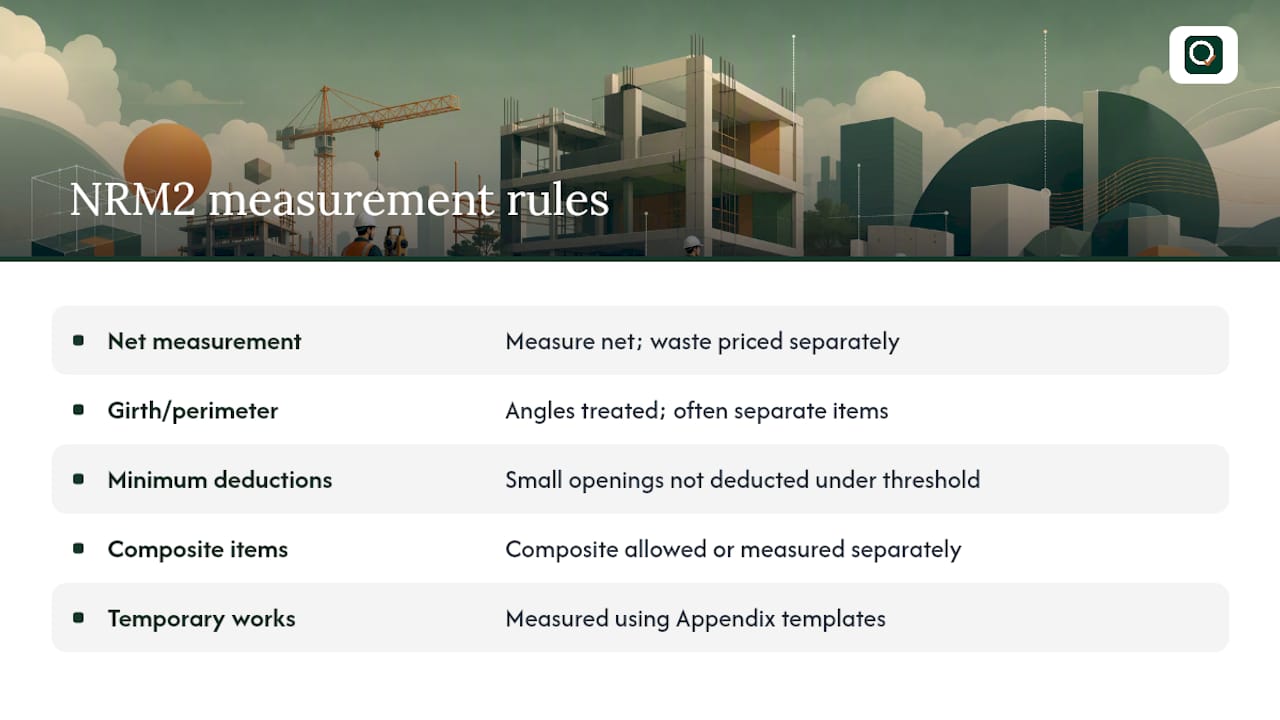
Net measurement as the default. NRM2 generally measures net quantities as fixed in position, with waste and laps addressed through pricing rather than added into the measured quantity itself. Get this backwards and you inflate every quantity in the bill.
Girth and perimeter rules for linear items. Sections covering skirtings, coping and edge trims specify how internal and external angles get treated, often requiring separate items rather than folding the extra length into the main run.
Minimum deduction thresholds. NRM2 sets thresholds below which openings in walls, floors or roofs are not deducted from the measured area, a rule that prevents small window and door openings from generating disproportionate administrative effort for negligible value.
Composite versus separate items. Certain work sections allow (or require) composite items that bundle several related operations into one measured line, while others insist on separate items for each distinct operation. Knowing which sections expect which approach is something that comes from familiarity with Part 3's tabulated rules rather than instinct.
Consistent treatment of temporary works. Preliminaries, site accommodation and temporary protection get measured and priced through Appendix templates rather than folded into the substantive work items, keeping the commercial risk visible rather than buried.
Each convention exists to remove a specific historical ambiguity, and each one only works if applied consistently across the whole bill, not selectively where convenient.
What does NRM2 look like in a real project?
Consider a mid-rise residential refurbishment with a new pitched roof, external wall insulation and internal reconfiguration. The QS working from RIBA Stage 4 drawings would draw on perhaps fifteen of the 41 work sections: demolition, structural alterations, roofing, external works, and several internal finishes sections among them.
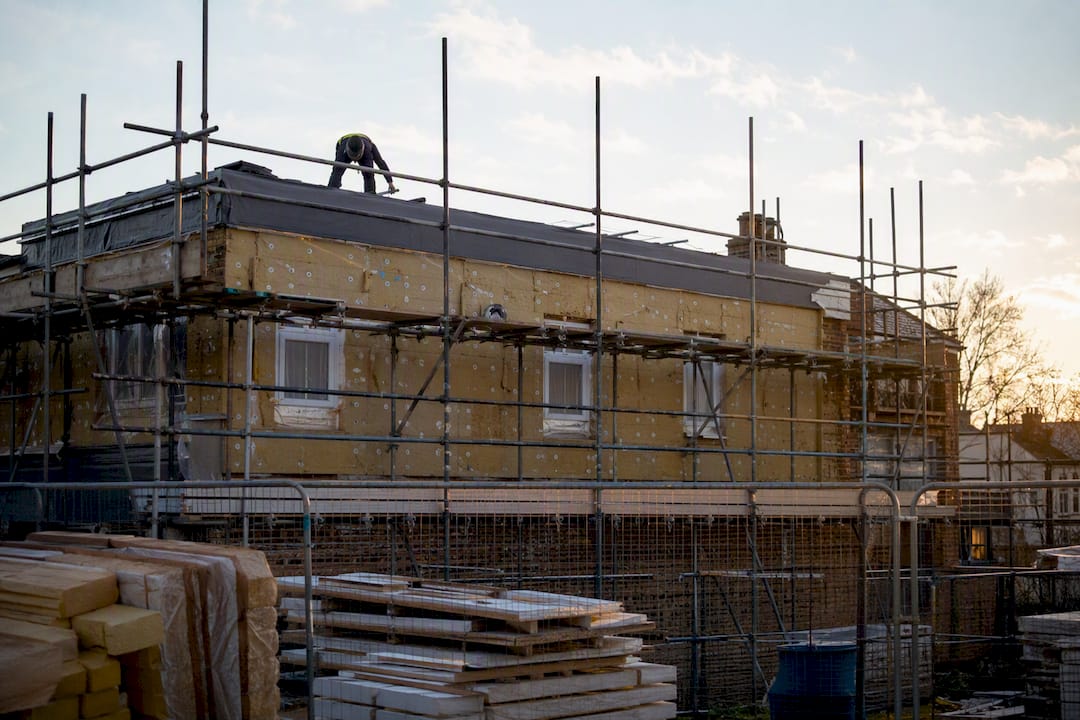
The roofing take-off alone illustrates NRM2's discipline in action. Roof coverings get measured in square metres net of any excluded areas, with separate items for ridge tiles, valleys and eaves detailing measured in linear metres. Insulation gets its own item with a specified U-value referenced directly in the description, so a contractor cannot substitute a cheaper product and claim compliance. Provisional sums appear only for genuinely undecided elements, such as a rainwater goods specification still pending client sign-off, never as a catch-all for sections the QS simply ran out of time to measure properly.
On a larger commercial new-build, the same logic scales up but the stakes rise with it. A structural frame measured loosely against outline drawings, rather than issued-for-construction information, can generate variance running into tens of thousands of pounds once the frame subcontractor's own detailed design is finalised. That is the pattern behind most large final account disputes: not fraud, not incompetence, just a measurement basis that was never quite tight enough at tender stage. NRM2 applied properly, with the reconciliation and QC steps built in rather than skipped under deadline pressure, is what closes that gap before it ever reaches a final account.
Rules of thumb from years of NRM2 practice
Every experienced QS develops shortcuts, and mine come down to three habits: never issue a bill without reconciling it against the cost plan, never let a provisional sum sit without a stated purpose, and always assume the drawing set has an inconsistency somewhere between disciplines. Catching that inconsistency before tender, not after, is what separates a smooth project from a contentious one. NRM2 gives you the framework; the discipline to apply it properly on every single item is what actually protects the final account.
Where Quantiflow fits when you need faster NRM2 take-offs
Quantiflow gets your take-offs from drawing to priceable bill faster than manual measurement, without asking you to hand over the judgement calls that make a bill defensible. The platform cross-references PDF architectural drawings using AI extraction, structures the output against NRM2 work sections, and applies a live UK rate library for pricing, while keeping every measured item traceable back to its source drawing.

It suits SME quantity surveying practices, small builders producing their own tender documentation, and architectural firms that need a priceable BoQ without commissioning a separate measurement exercise. You keep override control at every stage, so nothing gets locked in without your sign-off, and every revision logs to an audit trail. Pricing runs from Solo at £39 per month for individual practitioners, through Business at £149 per month for firms needing multi-role collaboration, up to custom Enterprise terms for larger operations with specific integration needs.
If your last tender pack took three days to measure and you are not entirely sure the reconciliation was watertight, visit Quantiflow to see how an NRM2-aligned take-off compares against your usual turnaround.
Frequently asked questions
What is NRM2 explained simply? NRM2 is the RICS rulebook for measuring building works in detail, covering how quantity surveyors classify, describe and quantify items so bills of quantities from different firms can be compared fairly.
When should you use NRM2 instead of NRM1? Use NRM1 for early cost planning before the design is fixed, and switch to NRM2 once the design reaches enough maturity for detailed measurement, typically around RIBA Stage 4.
How many work sections does NRM2 contain? NRM2 organises building works into 41 work sections, though most projects only draw on a subset relevant to their scope.
Is NRM2 a legal requirement on UK contracts? No. NRM2 is a professional standard published by RICS, not a statutory requirement, though many standard forms of contract and client procurement policies specify its use as good practice.
What software works well for NRM2 take-offs? Digital take-off platforms that structure output directly against NRM2 work sections, such as Quantiflow, help reduce transcription errors and keep an audit trail between drawings and measured quantities, alongside established on-screen measurement tools.
Sources
- RICS NRM: New Rules of Measurement
- NRM2 Explained: A Quantity Surveyor's Guide
- NRM2 Measurement Guide for QSs
- NRM2 - Designing Buildings
Note: RICS members can access some NRM2 guidance free through membership; the main NRM2 document itself is a paid RICS publication.