
For UK SME builders and quantity surveyors, the best estimating software is a cloud-based SaaS platform that combines NRM2-aligned BoQ generation, automated quantity takeoffs from PDF drawings, a live UK rate library, and audit-ready revision history. That combination addresses the three things that actually determine whether an estimate holds up: speed, accuracy, and governance.
- Speed: AI-assisted takeoffs from uploaded drawings eliminate manual re-entry and compress what once took days into hours.
- Accuracy: A live UK rate library tied directly to BoQ line items means your prices reflect current market conditions, not last quarter's spreadsheet.
- Governance: A logged revision history with role-based access gives you a traceable, defensible audit trail for procurement and QS review.
Pro Tip: Before committing to any platform, upload a real project file during the trial. Check that the BoQ export matches NRM2 line items, that rate updates apply automatically, and that every revision is logged with a timestamp and author attribution.
Table of Contents
- What UK builders must insist on in estimating software
- Why NRM2 alignment matters for UK estimators
- How do you choose the right estimating software for your firm?
- How Quantiflow meets UK SME needs
- What does implementation actually look like for a small team?
- Key takeaways
- The case for keeping the estimator in the loop
- Quantiflow: built for the way UK SMEs actually estimate
- Useful sources and further reading
What UK builders must insist on in estimating software
The construction estimating tools that genuinely move the needle for UK SMEs share five non-negotiable capabilities. Miss any one of them and you are either re-entering data manually, producing outputs a QS cannot use, or running blind on version control.
| Capability | Why it matters |
|---|---|
| Automated takeoff from PDFs with override controls | Eliminates manual measurement while preserving professional judgement at every stage |
| NRM2-aligned BoQ structure and export (PDF/Excel) | Outputs are immediately usable by UK QS teams and procurement without reformatting |
| Live UK rate library with regional factors | Prevents margin erosion from stale pricing across the bid lifecycle |
| Multi-role cloud collaboration with revision logs | Supports team working and produces an audit trail for tender and dispute resolution |
| Open export and integration options (Excel, API) | Connects estimating to accounting and project management without duplicate data entry |
Modern estimating workflows must combine automated quantity takeoffs, live pricing management, and structured BoQ generation as a connected ecosystem. Platforms that separate these functions force manual re-entry between steps, which is where errors compound. Open APIs and integrations to accounting or project management tools are now a standard expectation for mid-tier solutions used by SMEs scaling into project control workflows.
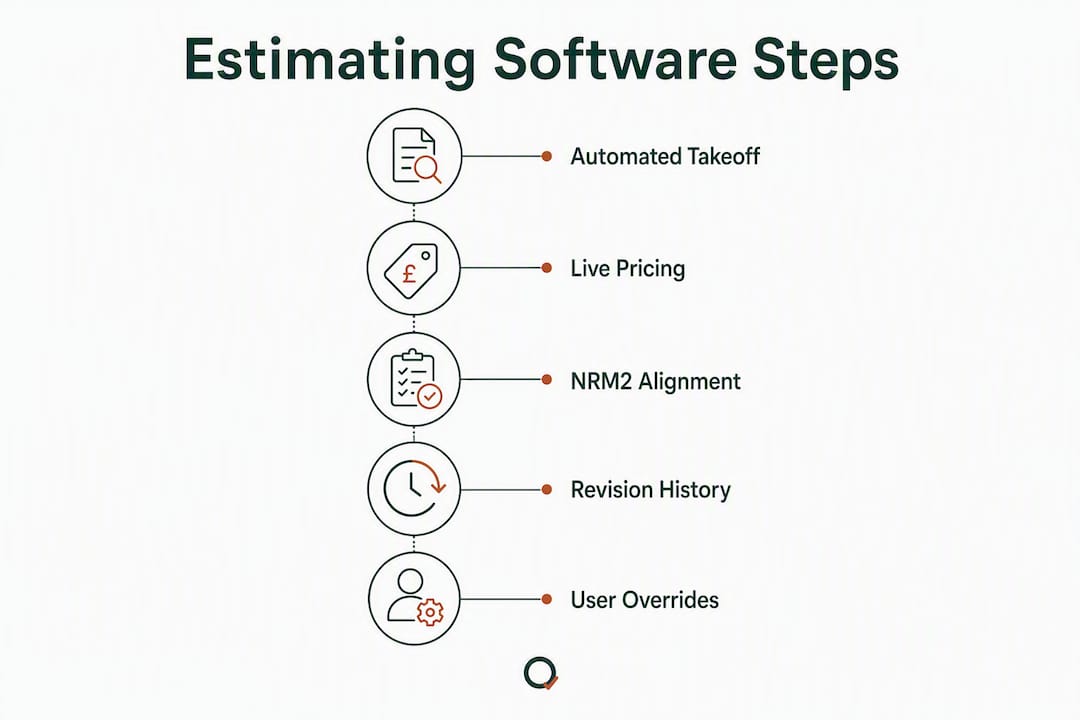
Spreadsheets remain common in smaller firms, but formula errors, broken links, and version conflicts are structural problems that no amount of discipline fully solves. Cloud platforms that treat takeoffs, rate libraries, and BoQs as a single connected repository remove those risks by design.
Why NRM2 alignment matters for UK estimators
NRM2 is the RICS measurement standard that governs how quantities are measured and presented in UK construction contracts. For UK estimators, it is not optional. QS teams, procurement managers, and many clients expect BoQ outputs that follow NRM2 measurement rules, and software that cannot produce them creates friction at every handover point.
The practical consequences of non-aligned software are concrete. A BoQ that does not follow NRM2 line-item structure requires manual reformatting before it reaches a QS or subcontractor, which adds time and introduces transcription risk. Measurement inconsistencies across trades make cost benchmarking unreliable and complicate scope definition when issuing subcontract packages.
Software should surface NRM2 alignment through structured BoQ templates, consistent measurement units per trade, and exports that map directly to NRM2 sections. When that structure is built into the platform rather than applied manually afterwards, internal review is faster, subcontractor scope is clearer, and cost benchmarking across projects becomes genuinely comparable. For a deeper look at how architects use quantity calculations within this framework, the Quantiflow blog covers the measurement-to-BoQ workflow in detail.
How do you choose the right estimating software for your firm?
A structured evaluation during the trial period will surface more than any vendor brochure. Work through these steps in order.
- Upload a representative PDF drawing from a live or recent project. If the platform cannot process your actual file types cleanly, the trial ends there.
- Run an automated takeoff and compare the output against a manual check on one trade. Note where the AI result differs and whether the override is straightforward.
- Generate a BoQ export in both PDF and Excel. Verify that line items map to NRM2 sections and that the structure is usable without reformatting.
- Check rate library access. Are UK rates live and regionally adjustable? How frequently are they updated, and by whom?
- Test revision logging. Make a change to a quantity or rate and confirm the platform records the author, timestamp, and previous value.
- Ask about security and data residency. UK SMEs handling client project data need clarity on where data is stored and how access is controlled.
Vendor questions worth asking directly: Does the platform support NRM2 BoQ templates natively? What is the update frequency for the UK rate library? Which accounting or project management systems does the API connect to? How are user roles and permissions managed across a team?
Red flags to watch for: locked rate databases you cannot edit or supplement; manual-only takeoff with no AI assistance; no revision history or audit log; opaque pricing with no published tiers; poor or absent UK rate coverage; no human override on AI-generated quantities.
On pricing, expect three broad tiers. A Solo tier suits a single estimator or sole trader, with a limited rate library and core takeoff functions. A Business tier adds team seats, live rate access, and integration options. Enterprise tiers offer custom seat counts, API access, and dedicated account management. Third-party buyer guides are useful for initial shortlisting, but they rarely validate NRM2 alignment in depth, so always confirm that in the demo itself.
Pro Tip: Ask the vendor to show you a revision history export during the demo, not just describe it. A platform that cannot produce a clean, exportable audit log during a sales call is unlikely to produce one when you need it for a dispute.
How Quantiflow meets UK SME needs
Quantiflow is built specifically for SME quantity surveyors, builders, and architects in the UK. Its AI cross-referencing engine processes PDF architectural drawings and produces NRM2-aligned takeoffs and BoQ outputs without requiring manual re-entry between stages.

The feature set maps directly to the non-negotiables above. Automated takeoffs include manual override controls at every measurement stage, so professional judgement stays central rather than being replaced. BoQ exports are structured to NRM2 and available in both PDF and Excel. The live UK rate library connects directly to BoQ line items, with regional labour and material factors available. Multi-role collaboration, revision logging, and author attribution are built into the platform rather than bolted on.
| Plan | Best for | Key features |
|---|---|---|
| Solo (£39/month) | Single estimator or sole trader | Core AI takeoff, NRM2 BoQ export, PDF/Excel output |
| Business (£149/month) | SME teams | Team seats, live UK rate library, integrations, audit logs |
| Enterprise (custom) | Larger firms | Custom seats, API access, dedicated account management |
A free trial is available, and Quantiflow's pricing tiers are published transparently. The revision history and author attribution features produce an exportable audit trail suitable for procurement review and QS sign-off. For context on how quantity surveying software benefits translate into practical outcomes for UK professionals, the Quantiflow blog covers the evidence in detail.
What does implementation actually look like for a small team?
A typical SME rollout delivers measurable time savings within 4–12 weeks when structured around a real pilot project. The timeline breaks into four phases.
- Trial (weeks 1–2): Upload a representative project file, run a takeoff, verify NRM2 BoQ export and rate library access.
- Pilot (weeks 2–6): Use the platform on a live or recent project alongside your existing process. Capture hours spent on takeoff and compare against the manual baseline.
- Team onboarding (weeks 4–8): Define role permissions, train estimators on override controls, and establish a naming and versioning convention for revision logs.
- Full rollout (up to week 12): Connect integrations to accounting or project management systems and retire parallel spreadsheet workflows.
| Phase | Duration | Key task |
|---|---|---|
| Trial | 1–2 weeks | Verify NRM2 output, rate access, revision logging |
| Pilot | 2–6 weeks | Run a real project, measure takeoff hours saved |
| Team onboarding | 2–6 weeks | Set permissions, validate AI outputs, establish workflows |
| Full rollout | Up to 12 weeks | Activate integrations, retire spreadsheets |
The ROI drivers are straightforward. Reduced takeoff hours free estimators for higher-value work. Fewer rework cycles come from having a single version of the BoQ that everyone works from. Quicker bid turnaround improves win rates. And integrated preconstruction workflows that connect estimating to contract and financials protect margin by minimising the assumptions that erode it downstream.
For onboarding, prepare an up-to-date price list before the pilot, select two or three representative project types, define who holds edit versus view permissions, and schedule a validation session where an experienced estimator reviews the AI takeoff output against their own judgement before sign-off.
Key takeaways
NRM2-aligned cloud estimating software with live UK rates and audit-ready revision history is the most defensible and efficient choice for UK SME builders in 2026.
| Point | Details |
|---|---|
| NRM2 alignment is non-negotiable | BoQ outputs must follow NRM2 structure to be usable by UK QS teams without reformatting. |
| Live rate library protects margin | Stale pricing is a leading cause of margin erosion; live UK rates tied to BoQ line items prevent it. |
| Override controls preserve judgement | AI takeoffs must allow human correction at every stage; platforms without override controls remove professional accountability. |
| Pilot before full rollout | Run a real project in the trial period and measure takeoff hours saved as the primary KPI. |
| Quantiflow covers all three | Solo (£39/month), Business (£149/month), and Enterprise tiers with NRM2 BoQ export, live rates, and audit logs. |
The case for keeping the estimator in the loop
There is a version of the AI estimating conversation that goes too far. The argument that automation should replace professional measurement entirely misunderstands what makes an estimate defensible. A quantity surveyor's value is not in counting bricks; it is in knowing which bricks matter, how the specification affects the count, and where the drawing is ambiguous. AI takeoff tools that do not allow override are not more accurate; they are less accountable.
The right model is one where the platform does the heavy lifting on extraction and cross-referencing, and the estimator validates, adjusts, and signs off. That is exactly what audit-ready revision history supports: not a record of what the AI produced, but a record of what the professional decided. For SME firms, that distinction matters in disputes, in procurement, and in the relationship with the client.
The balance between AI and QS professional judgement is not a philosophical question; it is a practical one with commercial consequences. Firms that get it right will produce faster, more defensible bids. Firms that hand the process entirely to automation will eventually produce a bid they cannot explain.
Quantiflow: built for the way UK SMEs actually estimate
Faster BoQ production without sacrificing the audit trail is what most SME estimating teams actually need, and that is precisely where Quantiflow delivers. Solo plans start at £39/month, Business at £149/month, and Enterprise pricing is available on request. Each tier includes NRM2-aligned BoQ export, AI-assisted takeoffs with override controls, and PDF/Excel output ready for procurement and QS review.
The free trial is the fastest way to validate whether the platform fits your workflow. Upload a real project file, run a takeoff, check the NRM2 BoQ export, and review the revision log. If those three outputs meet your standard, the rest of the evaluation is straightforward. Start your free trial at Quantiflow or contact the team for an Enterprise demonstration tailored to your firm's project types and team structure.
Useful sources and further reading
- RICS New Rules of Measurement (NRM2) — the authoritative standard governing measurement rules and BoQ structure for UK construction projects.
- Types of bills of quantities: a UK professional's guide — explains BoQ formats, measurement conventions, and export options relevant to NRM2-aligned estimating.
- How builders price a project: the 2026 UK guide — connects estimating outputs to procurement and costing practice for UK SME builders.
- Construction cost benchmarking methods: a 2026 UK guide — covers how to validate estimate assumptions against historical project data.
- Setting out quantities for residential projects: a UK guide — practical guidance on translating drawings into measured quantities for pilot project selection.