
Quantity calculations are the process of measuring every material, component, and resource required to build a design from architectural drawings. Architects use quantity calculations to translate creative intent into financially grounded plans, producing the data that drives procurement, budgeting, and cost control across the entire project lifecycle. The formal industry term for this process is quantity takeoff, and the structured output it generates is a Bill of Quantities (BoQ). Inaccurate quantity takeoffs cause budget overruns of 10–30% and trigger significant delays from material shortages or ordering errors. That single statistic explains why no serious architectural practice treats measurement as an afterthought.
Quantity calculations bridge design intent and financial feasibility, preventing the costly redesign cycles that erode client trust and project margins. In 2026, with digital BIM integration now standard practice on most commercial projects, architects who embed quantity takeoff into their design workflow gain a measurable advantage over those who rely on approximate estimates.
Why architects use quantity calculations for cost accuracy
The most direct benefit of quantity takeoff is budget accuracy. When you measure materials precisely from architectural drawings, you produce a BoQ that maps every line item to a unit rate. That structure transforms a rough cost plan into a document contractors can price with confidence.

Proactive quantity surveying and commercial management saves 15–25% on construction costs through value engineering and risk control. The mechanism is straightforward: when you know exactly how many square metres of cladding, cubic metres of concrete, or linear metres of steelwork a design requires, you can test alternatives before a single element is procured. Value engineering at drawing stage costs almost nothing. Value engineering on site costs a great deal.
Successful quantity calculations also map materials in relation to labour hours and indirect costs, not just raw material volumes. Relying solely on raw material counts without indirect costs leads to budgeting shortfalls of 12–18%. That gap is the difference between a project that completes within budget and one that requires emergency client funding.
| Method | Accuracy | Speed | Key risk |
|---|---|---|---|
| Manual scaling from paper drawings | Lower | Slow | Human error, inconsistent units |
| Digital PDF takeoff | Moderate | Moderate | Scale calibration errors |
| BIM-integrated automated takeoff | Highest | Fast | Model quality dependency |
Pro Tip: Always include a contingency line in your BoQ that reflects the complexity of the design. A straightforward residential extension warrants a different contingency allowance than a bespoke commercial fit-out.
How quantity calculations reduce project risk and prevent disputes
Quantity takeoffs function as a project's financial DNA for procurement and risk management. Every procurement decision, every subcontract package, and every variation instruction traces back to the original measured quantities. When that foundation is solid, commercial disputes become far less likely.
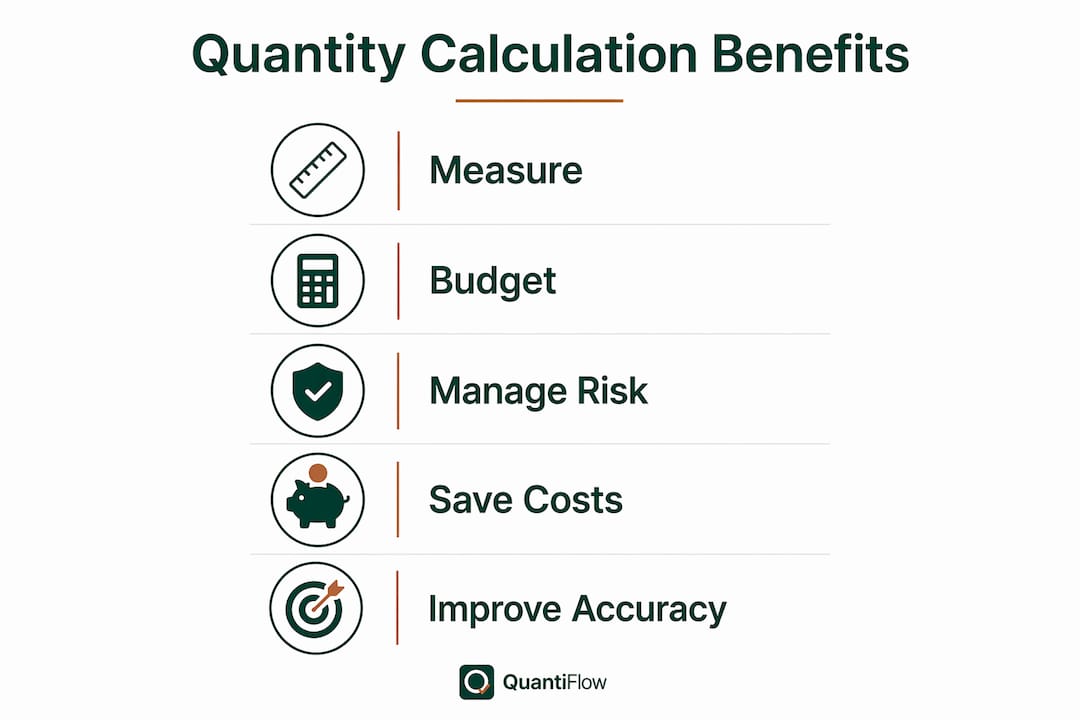
Quantity calculations are not static documents but active tools for contract administration and financial transparency. A BoQ produced at tender stage becomes the reference document for valuing interim payments, assessing variations, and resolving contractor claims. Without it, variation negotiation relies on competing estimates rather than agreed measured data.
Risks that accurate quantity calculations directly mitigate include:
- Procurement shortfalls. Under-measured quantities lead to emergency re-orders at premium rates.
- Contractor disputes. Ambiguous scope descriptions generate conflicting interpretations and claims.
- Design change costs. Unquantified design iterations accumulate hidden costs that surface late in the programme.
- Interim valuation errors. Inaccurate baseline quantities make it difficult to assess work completed against contract value.
- Final account disputes. Poorly documented original quantities create fertile ground for inflated final account submissions.
Continuous quantity management enables real-time cost monitoring and builds transparency between design teams and clients. Architects who treat quantity data as a live tool rather than a one-off deliverable maintain far greater control over project outcomes.
Pro Tip: Issue a revised BoQ extract at every design freeze milestone. It gives your client a clear, dated record of how design decisions affected the budget, which protects you commercially and builds trust.
How digital tools are changing architectural quantity takeoff
Manual scaling methods increase estimation errors by approximately 12% compared to digital BIM or vector-based workflows. That error margin is not trivial on a £2m project. Digital takeoff tools eliminate the scale calibration guesswork that makes manual methods unreliable.
The evolution of quantity takeoff technology follows a clear progression:
- Paper-based manual measurement. Architects or surveyors scale dimensions from printed drawings using a scale rule. Prone to cumulative error and very slow on complex projects.
- PDF digital takeoff. Quantities are measured directly from PDF drawings using calibrated on-screen tools. Faster and more consistent than manual scaling, but still reliant on the operator's judgement.
- BIM-integrated quantity extraction. Quantities are extracted directly from the building information model. Digital BIM-driven takeoffs reduce variance between estimated and actual costs significantly compared to manual measurements.
- AI-assisted automated takeoff. Platforms like Quantiflow cross-reference architectural drawings with AI to produce NRM2-aligned BoQ output, preserving the quantity surveyor's professional judgement while removing the manual extraction burden.
Virtual design and construction technologies transform quantity takeoffs into 3D digital twins, enhancing accuracy, reducing waste, and improving project transparency. For architects working on quantity surveying software benefits in 2026, this integration means quantity data flows directly into procurement schedules and cost reports without manual re-entry.
High-accuracy takeoffs in luxury construction reduce material waste by an average of 14% and prevent costly mistakes. On high-complexity projects where bespoke materials carry long lead times and high unit costs, that waste reduction translates directly into programme certainty and client satisfaction.
Quantity calculations across the full project lifecycle
Quantity calculations influence every stage of a project, not just the tender process. Architects who understand this use quantity data as a continuous decision-making tool rather than a one-time deliverable.
- Feasibility and early budget setting. Order-of-magnitude quantity estimates at concept stage allow you to test whether a design brief is financially viable before committing to detailed design. A residential quantity guide approach at this stage prevents abortive design work on schemes that cannot be built within the client's budget.
- Design development and value engineering. As the design develops, updated quantity data reveals the cost implications of material choices, structural systems, and specification decisions. Architects can test alternatives and present clients with costed options rather than surprises.
- Tendering and procurement. A complete, NRM2-aligned BoQ gives contractors a clear, consistent basis for pricing. It reduces tender queries, produces more comparable returns, and shortens the evaluation period.
- Construction phase cost monitoring. Quantity data underpins interim valuations, variation assessments, and cash flow forecasting. Architects administering contracts use the BoQ as the reference document for every commercial instruction.
- Post-construction reconciliation. Final account agreement is faster and less contentious when both parties work from the same measured baseline. Lessons learned from final account variances feed directly into more accurate estimates on future projects.
Cost engineering in construction at each of these stages depends on the quality of the underlying quantity data. Architects who invest in accurate measurement at the start of a project recover that investment many times over in reduced abortive work, fewer disputes, and stronger client relationships.
Key takeaways
Quantity calculations are the single most effective tool architects have for keeping design ambition and financial reality aligned throughout a project.
| Point | Details |
|---|---|
| Budget accuracy depends on measurement | Inaccurate takeoffs cause 10–30% budget overruns; precise BoQs prevent this. |
| Value engineering requires quantity data | Proactive quantity surveying saves 15–25% on costs through early design testing. |
| Digital methods outperform manual scaling | BIM-integrated takeoffs reduce cost variance significantly versus manual methods. |
| Quantity data is a live project tool | Continuous quantity management supports real-time cost monitoring and dispute prevention. |
| Every project stage needs quantity input | From feasibility through final account, quantity calculations drive every major financial decision. |
Quantity calculations: what 15 years of project work taught me
The architects I have seen struggle most with cost control share one habit: they treat quantity takeoff as something the quantity surveyor does after the design is finished. That sequencing is the root cause of most budget overruns I have witnessed on complex projects.
The most commercially effective architects I know treat quantity calculations as part of the design process itself. They run indicative takeoffs at concept stage, update them at every design freeze, and use the data to have informed conversations with clients about cost implications before those implications become crises. That approach is not about limiting design ambition. It is about protecting it. A design that survives value engineering is a stronger design.
The shift from manual to digital methods has changed the economics of this approach entirely. When a takeoff took two weeks to produce manually, running one at concept stage was impractical. When an AI-assisted platform can produce a structured BoQ from PDF drawings in a fraction of that time, there is no longer a credible reason to defer measurement. The architects who adopt this workflow in 2026 will find that their projects run more smoothly, their clients trust them more, and their professional exposure to commercial disputes falls sharply. The ones who do not will keep having the same difficult conversations about budget overruns that have always defined the gap between good and great practice.
— Michael
Quantiflow: AI-powered quantity takeoff for UK architects
Architects who want the accuracy of a full quantity surveyor's takeoff without the manual extraction burden now have a direct solution.

Quantiflow is a UK B2B SaaS platform that automates NRM2-aligned quantity takeoffs and Bills of Quantities directly from architectural drawings. Its AI cross-references your PDF drawings and produces structured, priceable BoQ output while preserving professional judgement at every stage. For architects managing cost tools for small practices or scaling up to enterprise projects, Quantiflow's plans start at £39/month. Visit Quantiflow's AI takeoff platform to see how it fits your workflow.
FAQ
What is a quantity takeoff in architecture?
A quantity takeoff is the process of measuring all materials, components, and resources required for a construction project from architectural drawings. The output is typically a Bill of Quantities, which contractors use to price the work.
How do quantity calculations help architects estimate costs?
Precise quantity data maps every material to a unit rate, producing a BoQ that contractors can price consistently. This reduces tender variability and gives architects a reliable baseline for budget management throughout the project.
Why do inaccurate quantity calculations cause budget overruns?
Inaccurate takeoffs cause overruns of 10–30% because under-measured quantities lead to emergency procurement, and omitted indirect costs create funding gaps that only surface during construction.
What is the difference between manual and digital quantity takeoff?
Manual scaling from drawings increases estimation errors by approximately 12% compared to digital BIM or vector-based methods. Digital and AI-assisted platforms produce faster, more consistent results with a traceable audit trail.
When should architects carry out quantity calculations?
Quantity calculations are most effective when carried out at every major design stage: feasibility, design development, tender, and construction. Early measurement prevents abortive design work; ongoing measurement supports cost monitoring and dispute prevention.