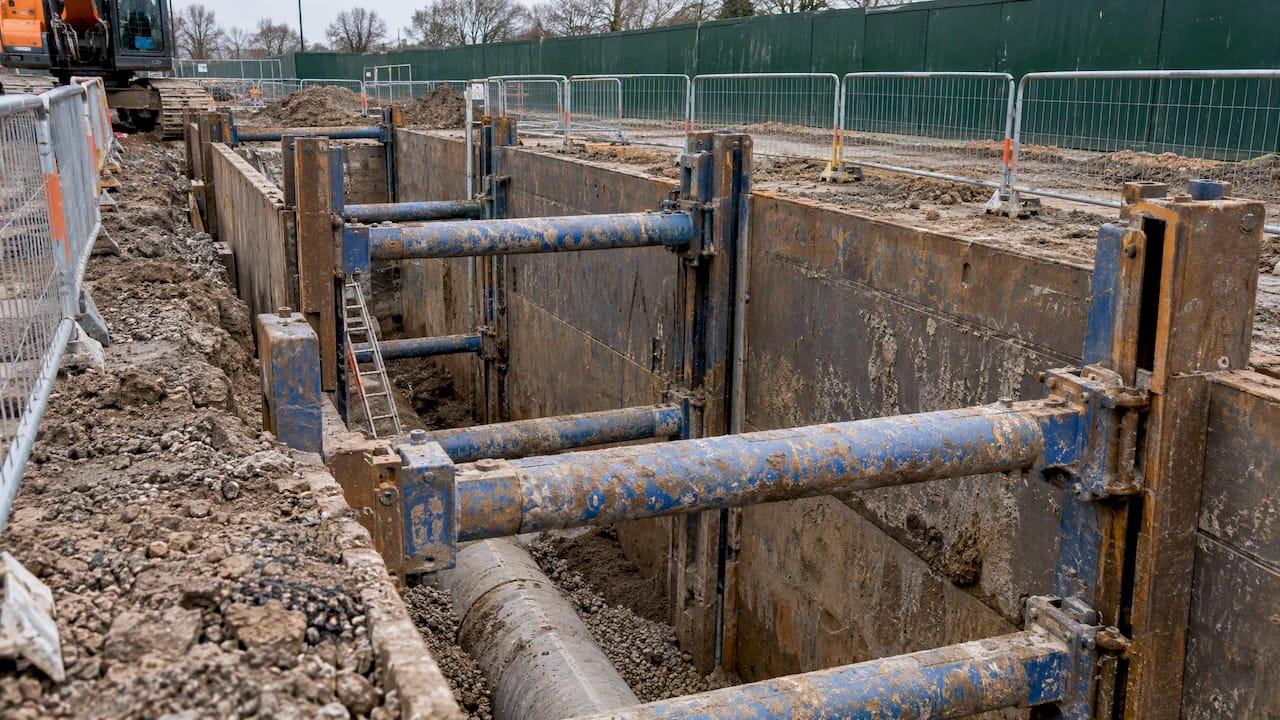
Temporary works quantities are best handled by separating what the work is from how long it stays: measure installation and removal as fixed activities, measure hire as weeks, and describe every item by nature, location, system and dimensions. NRM2, the RICS rules for detailed measurement of building works, gives the framework. The drawings, the temporary works register and the programme supply the facts to fill it. This guide walks through that routine for quantity surveyors, small builders and architects.
TL;DR
- Temporary works are the non-permanent work needed to build the permanent work: scaffolds, props, shoring, excavation support, falsework and formwork, among others.
- Under NRM2, measure net as fixed in position, pick a unit that suits the item, and keep erection and removal separate from time-related hire.
- Gather scaled drawings, ground information, sequencing and the temporary works register before you quantify, because the register is where design status and removal dates live.
- State assumptions in the preliminaries or the bill, and label uncertain quantities as provisional so they can be remeasured.
- Update quantities as the works change: weekly inspection cycles and design changes affect hire periods and valuations.
Table of Contents
- What counts as temporary works
- Which rules of measurement apply
- The NRM2 measurement rules that matter here
- A step-by-step routine for temporary works quantities
- Keeping quantities current as the works change
- Where temporary works quantities go wrong
- A note on drawings, models and software
- Where QuantiFlow fits
- FAQ
- Sources
What counts as temporary works
The Health and Safety Executive describes temporary works as the parts of a project needed to enable the permanent works to be built, usually removed after use. Its examples include access scaffolds, props, shoring, excavation support, falsework and formwork. Some items, such as haul-road foundations or crane and piling platforms, may end up incorporated into the permanent works, which matters when you decide where to bill them.
NRM2 uses a similar definition: non-permanent work or activity necessary for the completion of permanent construction work. The second edition took effect on 1 December 2021 and was reissued in October 2022. It then sorts temporary works into measurable categories. The common-user temporary works category covers support scaffolding and propping, crash decks, temporary protection to existing trees or vegetation, and floodlights. Access scaffolding has its own category, covering elevation scaffolding, structural scaffolding, birdcages, cantilever scaffolding, staircase platforms, primary loading platforms and travelling access platforms.
From a measurement point of view, the practical test is simple. If an item exists only so the permanent work can be built, and will be removed or made redundant afterwards, it belongs in your temporary works take-off. If it will remain, it is permanent work, however much it looks like temporary provision.

Short duration does not mean low importance
HSE is clear that temporary works need the same degree of care and attention in design and construction as permanent works. Inadequate design, selection or assembly can cause collapse, injury and delay. For a quantity surveyor, this has a direct pricing consequence: temporary works are not a percentage allowance to be dropped into the preliminaries without thought. A propped excavation or a structural scaffold has a design, a check category and an inspection regime, and each carries cost.
Enabling works are not the same as facilitating works
NRM1, which covers order-of-cost estimating and cost planning, notes that enabling works may include facilitating works, temporary works and new permanent works. It also warns that enabling works should not be confused with facilitating works. The distinction matters when a client asks why a cost plan carries a line for demolition or ground treatment separate from scaffolding and propping. Keep the categories apart from the start and the bill reads cleanly.
Which rules of measurement apply
The RICS new rules of measurement are a suite. NRM1 covers order-of-cost estimating and cost planning, NRM2 covers detailed measurement for building works, and NRM3 covers maintenance estimating. For tender-stage bills of quantities, NRM2 is the working document. For early estimates, NRM1 is.

NRM1 gives appropriate units for early estimates of facilitating and enabling-related work: site area, affected area in square metres, cubic metres, linear metres, time in weeks, enumerated number or itemised item, depending on the work. That is a useful reminder that no single unit suits all temporary works.
The NRM2 measurement rules that matter here
NRM2 sets general rules that apply to temporary works as to anything else. The ones that cause most trouble:
- Net as fixed in position. Measured work is measured net as fixed unless stated otherwise. Net quantities include additional material for laps, joints, seams and waste.
- Curved work is measured on the material centre line.
- Rounding. Dimensions are rounded to the nearest 10 mm. Non-tonnage quantities are normally stated to whole units, and tonnes to two decimal places.
- Units. Select item, number, metre, square metre, cubic metre, week or another suitable unit according to the work.
- Descriptions. State the nature of the item, its location, the material or system, and the relevant dimensions and conditions.
- Bespoke rules. If you depart from the standard rules or make an assumption, say so in the preliminaries or the bill.
That last point is where small firms often lose money. A bill that says only 'scaffolding, item' leaves everyone free to argue later about whether it covered the loading bay, the lift shaft or the hoist tower.
A step-by-step routine for temporary works quantities
1. Gather the right information
NRM2 requires drawn information to describe the building assembly and the temporary works, at a suitable scale. It identifies general-arrangement, component, schematic and record drawings as relevant types. Its guidance on information also points to specifications, site constraints, access, phasing and sequencing, ground and groundwater information, services, loads, preferred construction and dismantling methods, the programme and residual risks.
In practice, ask for:
- site plans and plan, section and elevation drawings for each phase;
- any temporary works design briefs already issued;
- ground investigation and groundwater data if excavation support is involved;
- the contractor's proposed sequence and programme.
If the drawings disagree with each other, resolve that before measuring. Our guide to finding, recording and resolving drawing discrepancies sets out how to log the query so the take-off has a traceable basis.
2. Build the item list from the register
A temporary works register is the list of all identified temporary works items on the project. It is not a quantity surveyor's document, but it is the best checklist you have. CITB publishes an example register that records, for each item, the item number, title and description, design-brief issue date, implementation-risk class, design-check category, design and approval dates, RAMS review, pre-use inspection, and permit to load and permit to unload or removal details.
For measurement, the useful columns are the description, the design-check category and the removal status. An item with a high check category usually implies independent design and checking cost, and an item without a removal date has an open-ended hire period. Ask the Temporary Works Coordinator for the current register at tender stage and again at each valuation.
3. Measure from the drawings
Take the physical quantities in the units that suit each item:
| Item | Typical unit | Notes |
|---|---|---|
| Elevation scaffold | m² of elevation | State height band, and whether sheeted or with netting |
| Birdcage or structural scaffold | m² or m³, or item | Describe area, height and loading |
| Staircase or loading platform | Number | One per platform, with description |
| Propping to openings | Number or item | Give span, location and support system |
| Excavation support | m of length, or m² of face | State depth and ground conditions |
| Temporary protection to trees | Number or m | Locate on the site plan |
| Floodlights | Number | Linked to hire in weeks |
Treat this as a guide to the type of unit rather than a prescription. NRM2 leaves you to choose the unit that fits the work, and the choice should follow how the work will be priced and varied.
External temporary provision, such as hoardings, haul roads and protection, is usually measured from the site plan rather than from building drawings. Our guide to measuring external works quantities from site plans covers that part of the take-off.
If site security forms part of the temporary provision, such as hoarding, lighting, CCTV or access control, price it alongside other site establishment items. Guidance on site theft prevention measures helps you describe what is actually specified.
4. Separate fixed activities from time-related hire
This is the step that most changes the accuracy of a bill. NRM2 treats installation, initial checks, alterations, dismantling and removal as fixed-charge activities, and hire as a time-related quantity, normally in weeks.
A worked example, using illustrative figures only. A scaffold to one elevation might be described as:
- Erect, initially inspect and dismantle independent tied scaffold to rear elevation, 12 m high by 30 m long: 360 m², fixed charge.
- Hire of the same scaffold: weeks, based on the programme stated in the preliminaries.
- Alterations to accommodate window openings and loading bay: item, fixed charge.
Splitting it this way means an extension to the programme changes only the hire line. It does not reopen the whole price for erection and removal.
5. State the programme assumptions
Hire weeks come from the programme, so record where they came from. If the contractor's programme is not yet fixed, state the assumed duration, the phase it relates to and the start trigger. Put it in the preliminaries or in the item description itself.
6. Label uncertain quantities
Some temporary works cannot be measured reliably at tender stage: ground support in unknown conditions, for example, or propping to existing structures not yet opened up. RICS guidance on interim valuations says prices in the bill of quantities should be used to value properly executed work, and that provisional quantities should be measured regularly during construction so they remain current for valuations and for checking contractor submissions.
The lesson is to label an uncertain quantity as provisional and plan to remeasure it, rather than present a precise-looking number that nobody can support.
Keeping quantities current as the works change
Temporary works are among the items most likely to change after the bill is issued. Two sets of guidance help you keep the quantities aligned with what is on site.
The Federation of Access and Scaffolding Industries (FASET) publishes guidance based on BS 5975:2019. It says the Temporary Works Coordinator should ensure there is a register, design brief, design check, design-and-check certificate, inspection and test plan, inspections and tests, change advice to designers and permits to load or proceed where required. A change to a temporary works item should go to the coordinator and the designer before it is implemented, which gives you a natural trigger to revisit the quantity.
The House Builders Federation's January 2025 guidance says the temporary works implementation plan should cover erection or assembly, use, unloading and dismantling, including inspections, checks, hold points, permits and certification. It also says temporary works should be checked before first use and at regular intervals not exceeding one week thereafter, and that dismantling should follow the specified sequence once the supported structure is self-supporting or the relevant condition has been reached.
For measurement this means three things:
- Weekly inspections are a recurring cost for items such as scaffolds, so check whether they sit inside your hire rate or are priced separately, and say which.
- Dismantling is tied to a condition, such as concrete reaching strength, and not simply to a date, so hire can run longer than the programme suggests.
- Every design change should leave a trace: a revised register entry, a revised quantity and a note of why.
Our eight-step audit-ready take-off workflow shows how to keep that trail in a form that survives a query months later.
Where temporary works quantities go wrong
Lumping everything into one item. A single preliminaries sum for temporary works hides the scaffold, the propping and the excavation support, so a variation on one cannot be priced against anything.
Confusing facilitating, enabling and temporary works. As NRM1 warns, these are different categories. Mixing them produces a cost plan that cannot be reconciled with the bill.
Measuring permanent-looking items as temporary. A haul-road foundation or piling platform that is left in place may belong in the permanent works. Check the specification.
Ignoring the register. If the register lists an item that the bill does not, one of them is wrong.
Forgetting that checks cost money. Design, independent check, inspection and permits are real activities. Whether they are priced in the item rate or separately, the description should say which.
Treating short duration as low risk. The HSE position is that design and construction care applies in full. The measurement should reflect an engineered item, not a placeholder.
A note on drawings, models and software
Temporary works rarely appear fully drawn in the architect's package. Scaffold layouts, propping schemes and excavation support are often designed by specialists, so the take-off combines the architect's drawings with the temporary works designer's. That makes cross-referencing between documents the main source of error. Our articles on the role of drawings in quantity measurement and on BIM quantity extraction cover how to treat each source and where its limits lie.
Any tool that drafts quantities needs the same discipline as a manual take-off. Every draft should be reviewed by the surveyor against the drawings, as set out in our piece on why UK QSs must audit every automated draft.
Where QuantiFlow fits
QuantiFlow is in development. It reads construction drawings and produces a draft Bill of Quantities for a quantity surveyor to review and sign off. The surveyor stays responsible for the descriptions, the units, the hire periods and the assumptions described above. You can find out more on the QuantiFlow site.

FAQ
What is classed as temporary works in a bill of quantities?
Anything non-permanent that is needed to complete the permanent work, such as access scaffolding, propping, shoring, excavation support, falsework and formwork. NRM2 defines it as non-permanent work or activity necessary for the completion of permanent construction work. Items that remain in place, such as some haul-road foundations, may count as permanent works instead.
What units should I use for temporary works?
Use whichever unit suits the item: number, metre, square metre, cubic metre, item or week. NRM2 leaves the choice to you, provided the description is clear. Hire is normally measured in weeks, while erection and removal are fixed-charge activities.
Which standard method of measurement applies?
NRM2 applies to detailed measurement of building works and is the document for tender-stage bills. NRM1 applies to early-stage estimating and cost planning, and it lists suitable units for enabling-related work. Both are RICS publications, with editions effective from 1 December 2021 and reissued in October 2022.
How do I deal with temporary works quantities that are not yet known?
Label them as provisional, state the assumption behind them and plan to remeasure on site. RICS guidance on interim valuations supports regular measurement of provisional quantities so valuations stay current. That is more defensible than a precise-looking figure with no basis.
Sources
- HSE: Temporary works (TW) FAQs
- RICS: NRM2 detailed measurement for building works, 2nd edition
- RICS: NRM1 order of cost estimating and cost planning, 3rd edition
- RICS: NRM2 detailed measurement for building works, 1st edition
- RICS: Interim valuations and payment
- isurv: Standard methods of measurement downloads
- FASET: Temporary Works, Revision 6
- CITB: example temporary works register
- HBF: Temporary Works Guidance, January 2025
Recommended
- Brickwork quantities: a practical method for accurate ordering
- Concrete quantity takeoff: a practical guide for UK estimators
- Setting out quantities for residential projects: a UK guide
- Concrete Reinforcement Quantities: A Take-Off Method for QSs
This article is for general information only and is not professional, legal or commercial advice. Quantity surveying decisions should be taken by a qualified professional with reference to the specific project, drawings and contract in question. Content is produced with AI assistance and reviewed before publication. QuantiFlow Ltd accepts no liability for reliance on it.