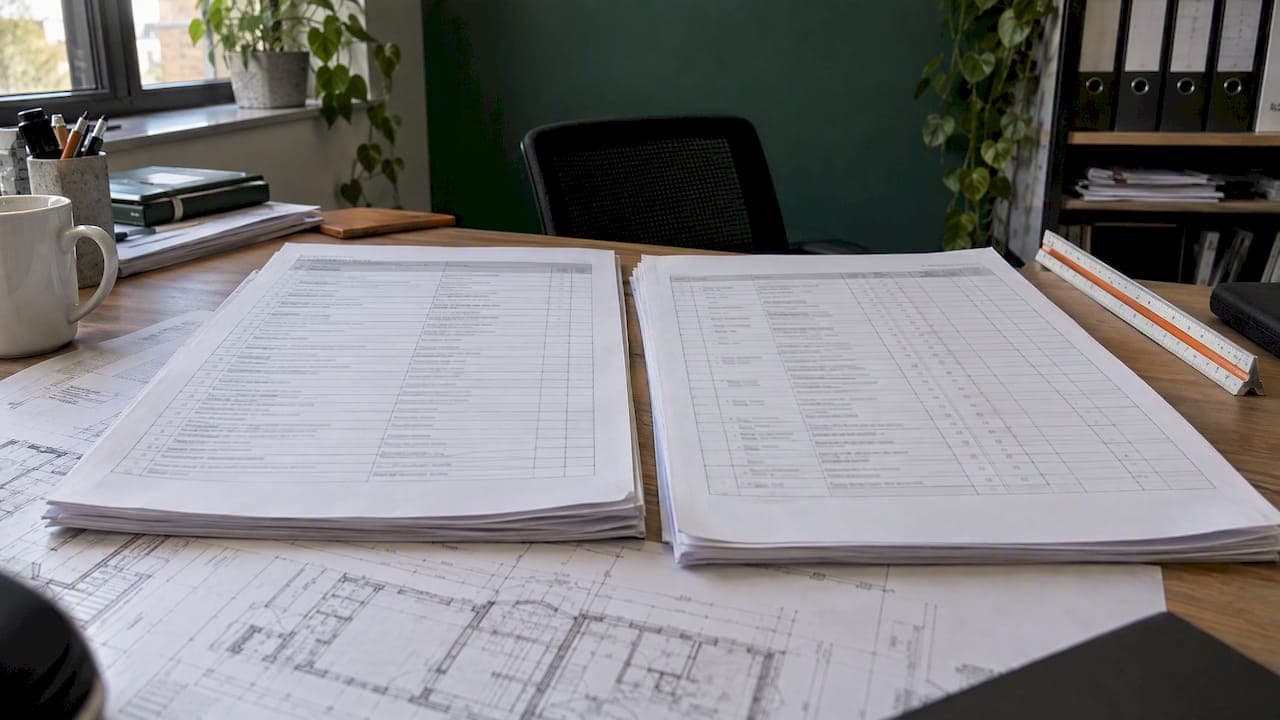
A schedule of works describes the work to be done, usually by element or trade, and may carry no quantities at all. A bill of quantities (BoQ) lists the same work with firm, measured quantities in a standard format, so every tenderer prices an identical scope. Which one you issue depends on the size and complexity of the job, the contract form and the procurement route. This guide sets out the differences and the point at which each document stops being the right tool.
TL;DR
- A schedule of works is a list of the work required, organised by element or trade. It may be quantified or unquantified.
- A BoQ gives detailed item descriptions and firm quantities, measured to a recognised standard such as NRM2, so tenders can be compared like for like.
- Small residential and refurbishment jobs on a lump sum contract often only need a schedule of works. Larger, more complex or remeasurable work usually justifies a BoQ.
- Match the document to the contract and procurement route first. Then check it against the drawings and specification before it goes out.
- A take-off is the measuring stage that feeds a BoQ. It is not the same document.
Table of Contents
- What a schedule of works is
- What a bill of quantities is
- Schedule of works vs BoQ: side by side
- How each affects pricing and tendering
- The contract form decides a lot
- When a schedule of works is the better choice
- When a BoQ is the better choice
- Related terms that get mixed up
- Preparing and checking the document
- How to decide: a short checklist
- Where drafting tools fit
- FAQ
- Sources
What a schedule of works is
A schedule of works is a list of the work a project needs, typically grouped by element or trade. It might read: strip out existing kitchen, form new opening in the rear wall, replaster, rewire, decorate. One UK surveying practice describes it as a list that may be quantified or unquantified.
The unquantified version is the common one. Another UK practice explains that a schedule of works breaks the work into sections in less detail than a BoQ and gives no quantities for specific items. The contractor reads the drawings and specification, measures what they need and prices the job as a whole.
That has three practical consequences:
- The contractor carries the measurement risk. If they misread the drawings, the price is theirs to defend.
- Tenders can differ in scope. Each contractor may allow for different amounts of work.
- It is quick to prepare. A competent QS, architect or contract administrator can write one from the drawings and specification without a full measure.
A schedule of works can also be used later in the job. The same practice notes it can be used to value works during the project, typically by allocating the lump sum across its headings.
What a bill of quantities is
The RICS New Rules of Measurement 2 (NRM2) define a BQ as a list of items giving detailed identifying descriptions and firm quantities of the work in a contract. The second edition took effect on 1 December 2021 and was reissued in October 2022.
Each item has a description written to a set convention, a unit and a quantity. Because the measurement rules are published, everyone reads an item the same way. A tenderer prices the quantities as given and the total follows from their rates.
NRM2 says the same document also provides a coordinated list of items, descriptions and quantities that supports accurate tendering and gives a basis for valuing interim payments and varied work. That second use matters on site, where a variation can be valued against the rates the contractor already submitted.
How a BoQ is organised
NRM2 notes that a BQ typically comprises these sections:
- form of tender
- summary
- preliminaries
- measured works
- non-measurable works
- provisional sums
- contractor-designed works
- risks
- credits
- dayworks
- annexes
That structure is much more than a list of trades. A BoQ also carries the commercial framework of the job: what is priced as a fixed quantity, what is a provisional sum and what the contractor must design.
Who produces it and when
According to NRM2, a BQ is generally produced at the Contractor Engagement stage of the RIBA Plan of Work by the client's quantity surveyor or cost manager. In design and build contracts it may be produced by the main or works package contractor. The same standard provides measurement rules for preparing BQs and quantified schedules of works, giving a uniform basis for measuring and describing building works.
Schedule of works vs BoQ: side by side
| Feature | Schedule of works | Bill of quantities |
|---|---|---|
| Quantities | Often none; sometimes quantified | Firm, measured quantities for every item |
| Detail | Work headed by element or trade | Item-level descriptions to a measurement standard |
| Who measures | The tendering contractor | The QS or cost manager preparing the document |
| Measurement risk | Mostly with the contractor | Mostly with the client, through remeasurement or adjustment |
| Tender comparison | Harder, as scopes may differ | Straightforward, as everyone prices the same quantities |
| Variations | Valued by agreement or against the lump sum | Valued against rates in the priced BoQ |
| Preparation effort | Low | Higher, as a full measure is needed |
| Typical fit | Smaller residential and refurbishment work | Larger, more complex or remeasured work |
The difference comes down to who takes the measurement risk and how much preparation the client wants to fund before tender.
How each affects pricing and tendering
A BoQ breaks a project into exact quantities in a recognised format for tenderers to price. It can also support cost control and variation management. Every tenderer starts from the same numbers, so the difference between tenders is rates, preliminaries and risk allowances, not a difference in what was measured.
With an unquantified schedule of works, each contractor builds their own measure. Accurate tendering, as the same estimating guidance puts it, depends on a clearly defined scope, consistent measurement and a pricing document suited to the procurement route. Without those, competing tenders may price different scopes. That is the usual reason a low tender turns into a claim for extras.
A practical test when reading returned tenders: if the spread between prices is wide and you cannot explain it from rates, look at scope first. On a schedule of works the cause is often an item one contractor allowed for and another did not.
The contract form decides a lot
The document must sit comfortably with the contract. Two examples from UK practice show why.
Lump sum small works: JCT Minor Works
The JCT Minor Works Building Contract 2011 is predicated on a lump sum offer based on drawings, a specification and/or work schedules, without detailed measurements. A schedule of works is therefore built into the thinking of that contract. The same guidance says the form is not suitable for complex works. It also says that where an employer wants to control the selection of specialist subcontractors, a direct contract with the chosen specialist may be better.
If the job is outgrowing that description, the document is usually the first sign. When a schedule of works needs dozens of clarifications before it can be priced, the project is probably asking for measured quantities.
Remeasurement: NEC4 Option B
NEC4 Engineering and Construction Contract Option B works differently. As the CECA NEC4 bulletin on pricing and payment (May 2025) explains, the contract is remeasurement-based rather than a fixed-price lump sum, and the Contractor is paid for the actual quantity of work completed. That structure only makes sense with a priced bill of quantities as its backbone.
The same bulletin also notes that information in the Bill of Quantities is not Scope or Site Information. The Scope describes the works, so the BoQ should not be relied on to say what must be built. This is worth remembering when you write item descriptions: they price work, they do not replace the specification.
When a schedule of works is the better choice
A schedule of works is usually proportionate on smaller residential or refurbishment projects where a full BQ is not required, as one UK estimating guide notes. NBS guidance on pricing small works goes a step further: for simple small works, the cost of preparing a BQ is not usually justified when that level of detail is not required. Drawings and a written description should be comprehensive enough to price the work.
A schedule of works tends to suit a job when:
- the scope is modest and clearly drawn
- the contract is a lump sum with little expected change
- the client wants a few quotations quickly
- the cost of measuring would be a noticeable share of the cost of the work
- the contractors invited are used to pricing from drawings
Refurbishment is where schedules of works are most common, and also where they most often go wrong. Strip-out items need careful wording because the extent of removal and the handling of hazardous materials change the price. A guide on interior demolition versus abatement shows why the two should be described as separate items rather than lumped under one heading. Its examples come from Ontario, so UK work should be scoped against UK regulations and the relevant survey, but the principle of separating them in the description holds.
Making a schedule of works safer
If you issue an unquantified schedule of works, tighten it:
- Number every item and group items by element or trade in the same order as the specification.
- State what is included. "Replace window" should say whether making good, scaffold access and disposal are in the item.
- Cross-reference drawing numbers and specification clauses.
- Use provisional sums only for work that genuinely cannot be defined, and say what they cover.
- Ask tenderers to list assumptions and exclusions in a standard form, so you can compare them.
When a BoQ is the better choice
A bill of quantities earns its cost when:
- the project is larger or more complex, with many trades and interfaces
- several contractors will tender competitively and the client wants a like-for-like comparison
- the contract is remeasured, as under NEC4 Option B
- the client expects variations and wants a pre-priced basis to value them
- interim payments will be valued against measured items
The common thread is that the client, not the contractor, takes the job of measuring. In return, tenderers price less risk and tender comparisons become simpler.
A middle route: the quantified schedule of works
The two documents are not a strict binary. As noted above, NRM2 gives rules for both BQs and quantified schedules of works. A quantified schedule gives the main quantities, often only for the measurable, high-value or high-risk items, with the remainder described in general terms. It can be a sensible compromise on mid-sized projects: tenderers see key quantities and the client avoids a full measure.
The risk is a mixed message. If some items are quantified and others not, state plainly whether the quantities are firm, whether they will be remeasured and who is responsible for errors.
Related terms that get mixed up
Searchers who compare these two documents often run into three more. They are different things.
Quantity take-off. The take-off is the measuring process: working through drawings and recording dimensions and counts. A BoQ organises those quantities into described, structured items, ready to price. A take-off can exist without ever becoming a BoQ, for example as an internal estimating exercise.
Materials schedule. A materials schedule lists products and quantities, such as door types, ironmongery or finishes, usually for ordering or specification. It does not describe work operations or labour, and it is not a pricing document in the way a BoQ is.
Schedule of values. A schedule of values, more common in US-style contracts, allocates a contract sum across work categories so that progress payments can be valued. In UK practice it is closer to a priced schedule of works or a contract sum analysis than to a measured BoQ.
If you remember one distinction, make it this: a take-off measures, a BoQ presents measured work for pricing and a schedule of works describes the work and leaves the measuring to someone else.

Preparing and checking the document
Whichever document you issue, the checks are similar.
- Confirm the information stage. Check that the drawings and specification are complete enough for the document you intend to issue. Measuring from incomplete design builds in later change.
- Pick the measurement standard and say so. For building work in the UK, NRM2 is the usual basis for a BoQ. State it in the preambles.
- Reconcile drawings and specification. Conflicts between the two are the most common source of tender queries. Resolve them before issue rather than in clarifications.
- Check descriptions item by item. A description should let a contractor price the work without guessing.
- Record assumptions. List what you assumed on levels, access, existing conditions and provisional work.
- Revise deliberately. When a drawing changes, remeasure affected items and keep a record of what moved. Our guide to remeasuring after revisions sets out a workable routine.
For more on the measurement rules themselves, see NRM2 explained, the practical NRM2 takeoff rules and the guide to common NRM2 measurement mistakes. If you build a BoQ for a domestic job, the house extension takeoff checks show the stages in practice.
How to decide: a short checklist
Ask these questions in order:
- What contract form is planned? Remeasurement forms point to a BoQ. Minor works lump sum forms point to a schedule of works.
- How complete is the design? Thin information favours a schedule with provisional sums or a delay to tender. Full information makes a BoQ feasible.
- How many contractors will compete? More tenderers mean more value in identical quantities.
- How likely is change? The more variations expected, the more useful pre-priced measured rates become.
- What does preparation cost against the job value? If the measure costs more than the risk it removes, use a schedule of works.
One UK practice sums it up neatly: the choice depends on the project's nature and procurement route, and using one of the two helps match expectations with the tenders received.
Where drafting tools fit
Measuring from PDF drawings is the slow part of producing a BoQ. QuantiFlow, which is in development, is designed to read construction drawings and produce a draft Bill of Quantities for a quantity surveyor to review and sign off. The judgement on what to include, how to describe it and whether the draft is right stays with you. You can read more at QuantiFlow.

If you want to see how PDF measurement works in practice, our guide on how to measure PDF drawings for NRM2 takeoffs covers the method whichever tool you use.
FAQ
Is a schedule of works the same as a specification?
No. A specification sets out the quality of materials and workmanship. A schedule of works lists the work to be done, usually by element or trade. They are read together, and the schedule should cross-refer to the specification clauses that apply.
Can a contractor price a job from a schedule of works alone?
Only when the drawings and specification are comprehensive enough to price the work. The schedule names the work, but the contractor still needs the drawings and specification to measure it and allow for it. If those are thin, expect assumptions, exclusions and variable tenders.
Does a BoQ replace the drawings and specification?
No. Under NEC4 Option B, for example, the Bill of Quantities is not Scope or Site Information, and the Scope describes the works. The BoQ is a pricing document that sits alongside the design information.
Which is cheaper to prepare?
A schedule of works is quicker to write because it does not need a full measure. That does not make the project cheaper overall. If the missing quantities lead to disputed scope or extras, the saving can disappear, which is why the choice should follow the contract and the level of risk.
Does NRM2 apply to schedules of works?
Partly. NRM2 provides rules for preparing BQs and quantified schedules of works. An unquantified schedule has nothing to measure, but you can still use NRM2 headings and descriptions to keep the document consistent.
Sources
- RICS, New rules of measurement (NRM2), 2nd edition, reissued October 2022
- Derek Gough, Schedule of Work or Bill of Quantities
- Quentessential Surveying, Construction Estimating and Tendering: 7 Key Questions
- CECA NEC4 Bulletin, Pricing and Payment under Main Option B, May 2025
- JCT Minor Works Building Contract 2011, Guidance Notes
- NBS, Pricing specifications and drawings for small works
- Interior demolition vs abatement
Recommended
- How construction contracts use BoQ: a UK professional's guide
- Provisional sums in BoQ: a practical guide for QSs
- Types of bills of quantities: a UK professional's guide
- Seven BoQ Review Steps for UK QSs, Tied to Standards and Contracts
This article is for general information only and is not professional, legal or commercial advice. Quantity surveying decisions should be taken by a qualified professional with reference to the specific project, drawings and contract in question. Content is produced with AI assistance and reviewed before publication. QuantiFlow Ltd accepts no liability for reliance on it.