
A provisional sum is an allowance included in the contract sum for work that cannot be sufficiently described, designed, or quantified at tender stage. In US construction practice, the same concept is typically called an allowance and appears in AIA and ConsensusDocs contract forms rather than in a formal Bill of Quantities. The practical implications are immediate:
- Pricing: contractors must carry the provisional sum or allowance at face value in their tender; they cannot substitute their own estimate.
- Tender comparison: each tenderer may price attendance and preliminaries differently, making like-for-like comparison unreliable unless the BoQ specifies the basis.
- Contract administration: every provisional sum must be formally instructed, valued, and reconciled in the final account before the contract sum is adjusted.
Key takeaways
Provisional sums in a BoQ are contractually binding allowances that must be formally instructed, valued, and reconciled in the final account — getting the label, the attendance basis, and the valuation mechanism right at tender stage prevents the majority of final account disputes.
| Point | Details |
|---|---|
| Defined vs undefined matters | Defined provisional sums require the contractor to include prelims; undefined sums leave that risk with the employer. |
| US equivalent is "allowance" | AIA A201 and ConsensusDocs 200 both use allowances adjusted by Change Order once actual costs are known. |
| Attendance must be explicit | State in every BoQ note whether attendance and prelims are inside or outside the provisional sum figure. |
| Reconcile as a variation | Omit 100% of the provisional allowance and add the instructed cost as a variation to keep the final account clean. |
| Quantiflow for BoQ production | Quantiflow automates NRM2-aligned takeoffs and flags provisional sum interfaces, keeping tender documents consistent and auditable. |
Table of Contents
- What provisional sums in a BoQ actually mean for your contracts
- Defined, undefined, or allowance: how to choose the right label
- How to present provisional sums and allowances in a BoQ
- How to price and calculate provisional sums: a worked example
- Contract administration: instructing and valuing provisional work
- Risks and a practical checklist for quantity surveyors
- Sample clause wording and BoQ note templates
- What experienced QSs actually do with provisional sums
- Quantiflow makes BoQ production and provisional sum tracking faster
- Sources
What provisional sums in a BoQ actually mean for your contracts
A provisional sum is contractually distinct from an employer's contingency (which sits outside the contract sum) and from a prime cost (PC) sum. Where a contingency is a client-side reserve, a provisional sum is a named allowance within the priced document that the contractor carries and the contract administrator later instructs.
RICS NRM2 draws a clear line between defined and undefined provisional sums. A defined provisional sum carries enough scope, quantity, and fixing information for the tenderer to price programme and preliminary impacts. An undefined provisional sum does not, so the employer retains the risk of any programme or prelim consequences when the work is eventually instructed.
In US practice, the allowance is the functional equivalent. AIA A201-2017 (General Conditions) and ConsensusDocs 200 both permit allowances within the contract sum, with the contract sum adjusted upward or downward once actual costs are known. Neither form uses the defined/undefined distinction explicitly, but the practical risk allocation is similar: if the allowance description is vague, the contractor's prelim exposure is unresolved until instruction.
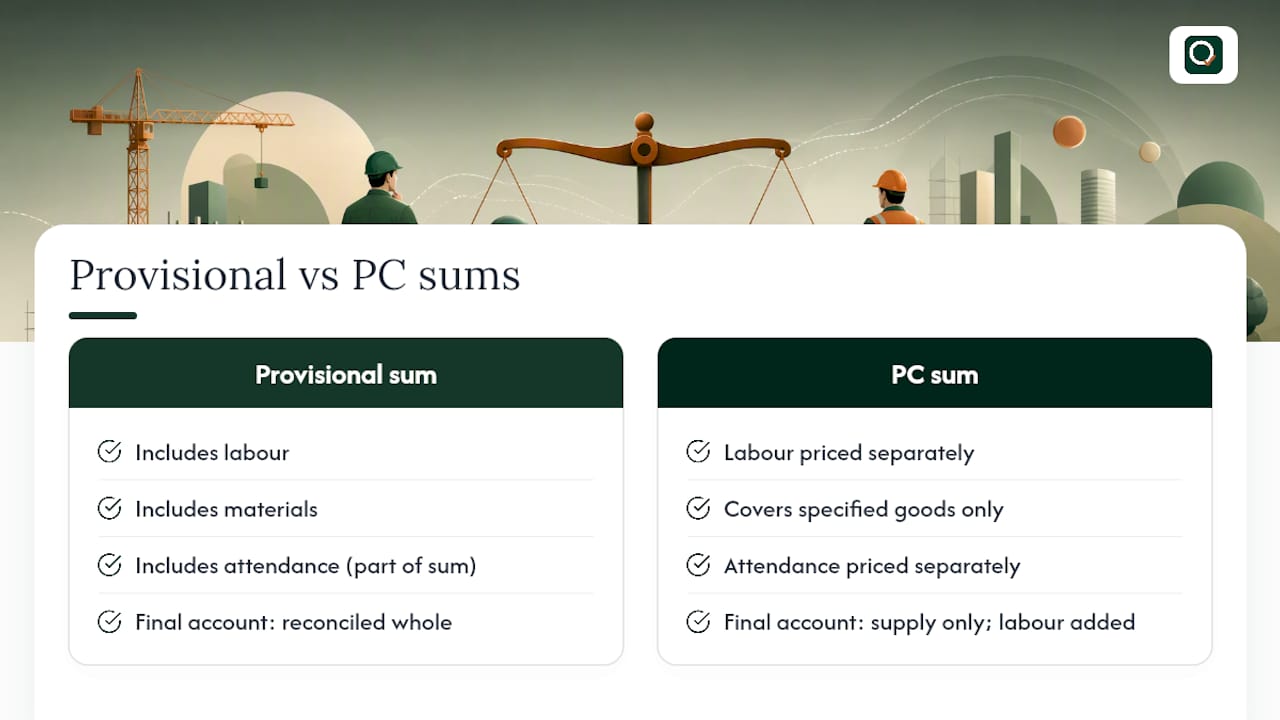
A provisional sum covers both labour and materials, whereas a PC sum typically covers specified goods only, with labour priced separately by the contractor. That distinction matters at final account: a provisional sum is reconciled as a whole, while a PC sum is reconciled on the supply cost alone, with the contractor's labour rate applied on top. Understanding provisional sums vs PC sums prevents double-counting and missed attendance claims.
Defined, undefined, or allowance: how to choose the right label
The choice of label directly affects who carries risk, so getting it right at BoQ stage saves disputes later.
Defined provisional sums apply when you can state:
- The nature and location of the work (e.g., "Form new electrical distribution board to Level 2 plant room")
- An approximate quantity or scope (e.g., "Allow for approximately 20 linear metres of containment")
- Any known constraints on access, sequence, or fixings
- The interface with other measured work in the BoQ
When those four conditions are met, the tenderer is expected to include programme time and associated preliminaries. If they do not, the risk stays with them.
Undefined provisional sums are appropriate when the design is genuinely incomplete and you cannot responsibly state scope or quantity. Common examples include allowances for statutory services found on site, landscaping where the final design is outstanding, and elements that cannot be measured until site investigation is complete. Here, the employer carries programme and prelim risk when the instruction eventually arrives.
When to use an allowance or alternative treatment instead:
- Use a provisional quantity (approximate quantity) when the item is measurable but the quantity is uncertain; the rate is fixed and only the quantity adjusts.
- Use a prime cost sum when you are nominating a supplier or specialist and want to ring-fence the supply cost while the contractor prices attendance separately.
- Use an excluded trade or employer-direct contract when the work is genuinely outside the main contractor's scope.
Pro Tip: If you cannot write at least two of the four defined-sum conditions above, default to undefined. Mislabelling an undefined item as defined shifts prelim risk to the contractor unfairly and invites a compensation event or variation claim.
How to present provisional sums and allowances in a BoQ
Consistent presentation is what makes tender comparison reliable. Failing to interrogate provisional sums and attendance makes tender comparisons unreliable because each contractor prices uncertainty differently. The fix is a standardised line format and clear BoQ notes.
A well-formed provisional sum line in a BoQ contains five elements:
- Item reference (e.g., "C/PS/01")
- Description — state whether defined or undefined, describe the scope, and cross-reference the relevant drawing or specification clause
- Quantity/statement — either a lump sum statement ("Provisional Sum") or an approximate quantity with unit
- Sum — the allowance figure carried into the contract sum
- Adjustment basis — a note stating how the item will be valued when instructed (e.g., "To be valued by remeasurement at the rates and prices in the Schedule of Rates")
Placement in the BoQ: provisional sums work best in a dedicated schedule at the back of the BoQ, cross-referenced from the relevant trade section. Burying them within trade sections risks them being missed during tender normalisation. For US cost plans and estimates, a separate allowances schedule within the Guaranteed Maximum Price (GMP) or contract sum analysis serves the same purpose. For further context on BoQ formats and where provisional items typically sit, the structure of the document itself matters as much as the line wording.
Formatting tips:
- State attendance assumptions explicitly: "Contractor to include for attendance, temporary services, and access scaffolding."
- Set an information request date: "Employer to issue design information by [date] to allow instruction without programme impact."
- Note the prelims basis: "Preliminaries are included in the provisional sum allowance" or "Preliminaries to be assessed separately on instruction."
How to price and calculate provisional sums: a worked example
Pricing a provisional sum is a four-step process.
- Establish scope — gather all available design information and confirm whether the item is defined or undefined.
- Confirm attendance and prelims — decide whether these are included in the allowance or priced separately, and document that decision in the BoQ notes.
- Set the allowance figure — use a cost plan rate, a specialist quotation, or a schedule of rates benchmark. Practitioner guidance suggests keeping provisional sums below roughly 10% of the contract value to limit comparability problems and outturn risk.
- Choose the valuation route — remeasurement at BoQ rates, a replacement quotation, or cost-plus mark-up. State this in the BoQ before tender.
Worked example: specialist drainage investigation
A commercial fit-out project includes an undefined provisional sum for drainage investigation works. The QS sets the allowance at $25,000 based on a preliminary specialist estimate. The contractor carries this figure in the tender. On instruction, the specialist submits a quotation of $31,500 including attendance and prelims.
| Stage | Item | Amount |
|---|---|---|
| Tender BoQ | Provisional sum (undefined) | $25,000 |
| Contractor attendance (carried separately) | Attendance on specialist | $25,000 |
| Instruction issued | Specialist quotation accepted | $31,500 |
| Deduct original allowance | Omit provisional sum | ($25,000) |
| Net change order value | Addition to contract sum | $8,000 |
| Revised contract sum impact | Provisional sum + net change | $31,500 |
The $8,000 change order is processed through the standard variation or change order mechanism. Treating the provisional sum as a variation for final account reconciliation simplifies bookkeeping: omit 100% of the provisional allowance and add the instructed cost as a variation, keeping the audit trail clean.
Contract administration: instructing and valuing provisional work
Clear administration is what separates a clean final account from a disputed one. The steps below apply whether you are working under JCT, AIA, or ConsensusDocs.
- Issue a formal instruction before any provisional work begins. Under JCT, this is an Architect's/Contract Administrator's Instruction (AI). Under AIA A201, it is a Construction Change Directive or Change Order. Never allow a contractor to proceed on a provisional sum without written instruction. 2. Agree the valuation method at instruction stage, not at final account. Options are: (a) accepted quotation, (b) remeasurement at BoQ or schedule rates, or (c) cost-plus an agreed mark-up percentage.
- Record attendance and prelims contemporaneously. Ask the contractor to submit a breakdown of attendance costs with the quotation or daywork sheets.
- Process the change order by omitting the original provisional allowance and adding the instructed value. Under AIA, this adjustment appears in the Change Order log and flows into the updated contract sum.
- Reconcile in the final account by confirming every provisional sum has been either instructed and valued, or formally omitted. Clear BoQ notes reduce disputes at final account by setting valuation expectations from the outset.
Note that NEC contracts generally avoid provisional sums and handle uncertainty through compensation events instead, which is worth flagging when advising clients who use NEC internationally. For document control and audit trails across BoQ revisions, a structured approach to version management prevents reconciliation errors at final account.
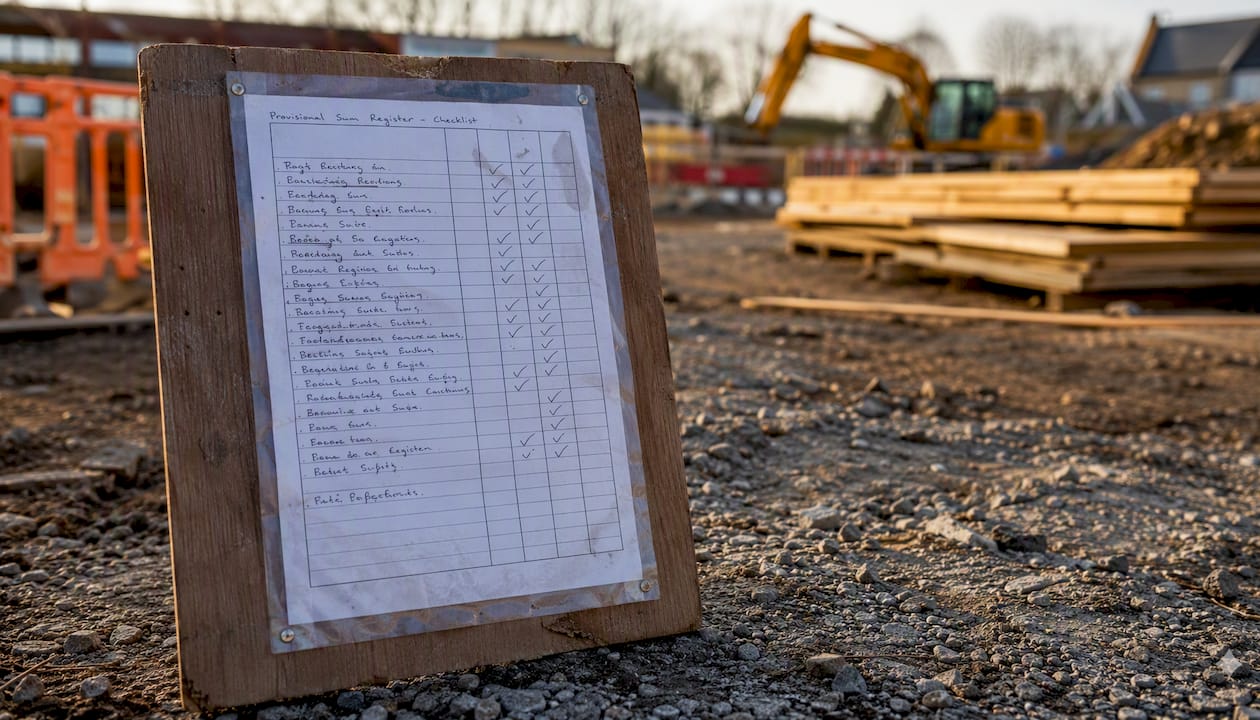
Pro Tip: Keep a provisional sum register from day one: list each item, its allowance, the instruction date, the valuation method agreed, and the final instructed value. A one-page register updated monthly is the single most effective tool for avoiding final account disputes on provisional items.
Risks and a practical checklist for quantity surveyors
Provisional sums carry specific risks that compound when left unmanaged. The most common are:
- Inconsistent attendance pricing — one tenderer includes attendance in the provisional sum, another prices it separately, making the tender comparison misleading.
- Nil rates — a contractor enters zero against attendance or prelims, then claims these costs at final account as an extra.
- Buried scope shifts — a provisional sum description is broad enough for the contractor to argue that instructed work falls outside it, triggering an additional variation claim.
- Optimistic allowances — the provisional sum figure is set too low at tender, creating a predictable cost overrun that damages client trust.
- Contractor risk-shifting — undefined provisional sums are used where defined ones would be appropriate, shifting prelim risk to the employer without transparency.
Tender normalisation checklist:
- List every provisional sum and allowance in a separate schedule before issuing tender documents.
- Confirm whether attendance and prelims are included in each allowance or priced separately, and state this in the BoQ notes.
- Set an information request date for each item and include it in the tender documents.
- On receipt of tenders, extract all provisional sums into a comparison matrix and check that each tenderer has carried the same figure.
- Flag any nil rates against attendance or prelims and seek clarification before tender acceptance.
- Confirm the valuation mechanism for each item (remeasurement, quotation, cost-plus) and record it in the contract documents.
- Check that the total of provisional sums does not represent an uncomfortably high proportion of the contract value.
Normalising preliminaries and attendance assumptions when comparing tenders, and flagging nil rates or cross-references to other BoQ lines, is the standard mitigation for hidden risk in provisional sum pricing.
Sample clause wording and BoQ note templates
The following wording is provided as a drafting aid only and is not legal advice. Always have contract clauses reviewed by a qualified construction lawyer before use.
Defined provisional sum — BoQ note:
Undefined provisional sum — BoQ note:
US allowance clause (AIA/ConsensusDocs context):
Adaptation notes:
- For AIA A201 workflows, replace "formal instruction" with "Change Order" or "Construction Change Directive" and reference the relevant article of the General Conditions.
- For ConsensusDocs 200, confirm that the allowance adjustment mechanism in Section 3 aligns with the wording above.
- Always state whether contractor overhead and profit are included in the allowance figure or applied on top; this single point causes more disputes than any other.
Practical contract commentary confirms that clear BoQ notes setting out the valuation basis from the outset are the most effective way to reduce final account disputes on provisional items.
What experienced QSs actually do with provisional sums
The textbook treatment of provisional sums is clear enough. What the textbooks understate is the judgement call that sits behind every labelling decision.
In practice, the temptation is to reach for an undefined provisional sum whenever the design is incomplete, because it feels safer: the employer carries the prelim risk, and the QS avoids committing to a scope that might change. The problem is that overusing undefined sums inflates the employer's risk exposure and makes the tender comparison almost meaningless.
The more disciplined approach is to convert provisional sums into priced variations or approximate quantities as soon as enough design information exists, even mid-tender. If a specialist quotation arrives during the tender period, substitute it. If a site investigation report lands, remeasure the drainage item and price it properly. The provisional sum should be a last resort, not a default.
The documentation habit that saves the most disputes is simple: write the reason for each provisional sum into the BoQ note at the time you create it. "Insufficient design information at [date]" is a contemporaneous record that protects both the QS and the employer if the contractor later argues the scope was knowable. A note written six months later carries far less weight.
Quantiflow makes BoQ production and provisional sum tracking faster
Producing a BoQ with well-labelled provisional sums and consistent attendance notes takes time, especially when drawings are still evolving. Quantiflow automates NRM2-aligned quantity takeoffs directly from PDF architectural drawings, cross-references drawing sets to flag where provisional sum items interface with measured work, and produces structured BoQ output that preserves your professional judgement at every stage.

For SME quantity surveyors and builders who need traceable, auditable BoQs without the manual overhead, Quantiflow's live rate library and export to PDF or Excel mean your provisional sum schedules are consistent, priced, and ready for tender from day one. Plans start at £39/month. Start your free trial at Quantiflow and see how much faster a clean, provisional-sum-ready BoQ can be produced.
Sources
The following references are worth consulting alongside this guide for definitions, contract form notes, and deeper reading on provisional sums and allowances.
- Provisional sum meaning in UK Law - Glossary - LexisNexis UK
- Bill of Quantities Explained: How to Read a Priced BoQ | Rate QS Insights
- QS: The Difference Between Provisional & Prime Cost Sums
- Provisional Sums - Back to Basics
- What Does 'Provisional Sum' Mean in Your Contract?
This article provides general information for construction professionals and is not a substitute for legal or professional advice. Confirm contract clause wording and valuation mechanisms with a qualified construction lawyer or contract specialist before use.