
A BoQ review verifies that every measured item is traceable to the drawings or specification and compliant with the chosen measurement standard, so the bill is auditable for tendering or cost control. The outcome is a sign-off-ready document built against standards such as NRM 2 and contract forms including NEC4, with a drafting tool such as QuantiFlow sometimes used to produce the first version for review.
TL;DR:
- Use NRM 2 for building works and CESMM4 for civil engineering, then verify the bill’s codification against the applicable measurement rules.
- Record a drawing reference and revision on every line, retain calculations linked to its line ID, and check exclusions in quantities taken from BIM.
- Under NEC4, validate defined and disallowed costs progressively and flag potential compensation events early; JCT reviews emphasize firm quantities and preliminaries.
- Reject provisional sums that lack a trigger condition or defined scope, and hold the bill until unresolved discrepancies are logged and corrected.
- Before sign off, prepare a Task Report covering scope, methodology, findings, and recommendations, with annotated drawings and calculation workbooks for queried quantities.
Table of Contents
- Why standards and contract form shape the review
- Step-by-step BoQ review checklist
- Validating quantities against drawings and BIM models
- Contract-specific checks and procurement considerations
- Documentation and audit trail to produce
- Common pitfalls and red flags
- Quick check summary for sign-off
- How QuantiFlow fits into a BoQ review workflow
- FAQ
- Sources
Why standards and contract form shape the review
NRM 2, published by RICS, sets the detailed rules for measuring building works and defines what information a bill of quantities must contain. Under the RIBA stages, a BoQ is typically produced at Stage G, Tender Documentation, which means the review sits at a point where errors are expensive to fix later.
Contract form changes what you prioritise. NEC4 calls for progressive review of defined and disallowed costs rather than a single audit at final account stage, as ICE guidance sets out, while JCT and other lump-sum arrangements place more weight on firm quantities and a fixed pricing document. For civil engineering works, CESMM remains the accepted measurement basis rather than NRM 2.
- NRM 2 governs building works measurement and BoQ composition.
- NEC4 requires ongoing cost validation rather than a one-off final check.
- CESMM4 applies to civil engineering BoQs, not building works.
Step-by-step BoQ review checklist
A structured sequence keeps the review consistent across projects and makes gaps easier to spot before they reach tender.
- Confirm the document set. Check drawing revisions, the specification and employer's requirements are all the current versions before opening the bill.
- Check codification. Verify the work breakdown structure maps correctly to NRM 2 (or CESMM4 for civils), so items sit under the right classification and section.
- Review each line item. Confirm the measurement basis, unit, drawing reference and the calculation behind the quantity are all stated and traceable.
- Check preliminaries and the pricing schedule. Confirm preliminaries are itemised per NRM 2 guidance and that the pricing document matches the agreed format.
- Scrutinise provisional sums. Confirm each sum states its trigger condition and scope, not just a lump figure.
- Record variations. Note how the contract treats each change: as a compensation event, a variation instruction or otherwise.
- Prepare the Task Report. Document findings, recommendations and supporting references ahead of sign-off.
Line-level checks are where most tender risk hides. A quantity with no drawing reference or no visible calculation cannot be defended if a contractor challenges it later, so this step deserves more time than the checklist format suggests. Takeoff rules aligned to NRM 2 help keep this consistent across a project, particularly where several surveyors have contributed measurements.
Provisional sums are a common weak point. A sum with no stated trigger condition leaves the contract exposed to dispute about whether, and when, it should be released, so treat an undefined provisional sum as incomplete rather than acceptable.
Pro Tip: Keep a running log of every query raised during the review, even minor ones, so the Task Report writes itself at the end rather than becoming a reconstruction exercise.
Validating quantities against drawings and BIM models

Every BoQ line needs a drawing reference and revision number recorded against it, not just a quantity. This single habit does more to make a bill defensible than any other check, because it lets anyone trace a figure back to its source without needing to ask the author.
Where quantities come from a federated BIM model, check the model's assumptions before accepting its output: confirm which disciplines fed into it, what geometry was excluded, and whether any zones were modelled at a lower level of detail than the rest, following four Revit to CGI workflows for UK studios. Guidance on linking BoQ lines to drawing revisions sets out a workable format for this.
- Record drawing reference and revision on every line, not just at bill level.
- Check the origin of BIM-derived geometry and any stated exclusions.
- Retain supporting calculations in a format that links directly to the BoQ line ID.
- Export for audit as annotated PDF or Excel with visible line IDs, not a flattened summary.
Public procurement documents frequently state that measured quantities are not guaranteed by the employer, which places the burden of verification squarely on the reviewing surveyor rather than the contract itself, as seen in procurement notices that require explicit assurance activity around measured quantities.
Contract-specific checks and procurement considerations
The review emphasis shifts with the procurement route.
- NEC4: validate costs progressively against defined and disallowed cost categories, and flag anything that looks like a compensation event early rather than at final account.
- JCT and traditional procurement: confirm firm quantities, check preliminaries pricing in detail, and note how contractor-designed portions are treated separately from measured work.
- Design-and-build: confirm who holds responsibility for quantification, since RICS guidance notes that employer's requirements rather than a full BoQ sometimes govern these contracts.
- Public sector: expect a defined Task Report format and a stated proportion of assurance reviews across the contract term, as set out in Task Report requirements.
Documentation and audit trail to produce
The Task Report is the anchor document. At minimum it should record the task number, the reviewer's contact details, the scope reviewed, the methodology applied, the findings and the recommendations arising.
- Attach marked-up drawings showing exactly where each flagged item sits.
- Include the calculation workbook behind any measured quantity that was queried or corrected.
- Maintain a revision log and a separate change register for anything amended after the first draft.
- Apply consistent file naming and version control, so a later reviewer can reconstruct the sequence of changes without guesswork.
Document control practice built around these conventions keeps the audit trail intact even when several people touch the same bill over time.
Common pitfalls and red flags
A handful of recurring issues account for most tender risk found during review.
- Drawing revisions referenced on a BoQ line no longer match the current issue.
- Provisional sums with no trigger condition, or a scope too vague to assess.
- Measurement methods that are inconsistent between sections, with no calculation retained.
- A work breakdown structure that no longer aligns with the stated measurement standard.
Any one of these is enough reason to hold a bill back from issue until resolved, since each one shifts commercial risk onto whoever discovers it at tender or construction stage instead of at review.
Quick check summary for sign-off
| Check | What to confirm |
|---|---|
| Drawing references | Every line cites a drawing and revision number |
| Measurement standard | Codification matches NRM 2 or CESMM4 as applicable |
| Provisional sums | Each sum states a trigger condition and scope |
| Supporting calculations | Retained and linked to the BoQ line ID |
| Task Report | Findings, methodology and recommendations recorded |
| Outstanding issues | Logged in the change register before sign-off |
Where any row above is unresolved, hold the bill and return it with specific queries rather than signing off with caveats attached.
How QuantiFlow fits into a BoQ review workflow
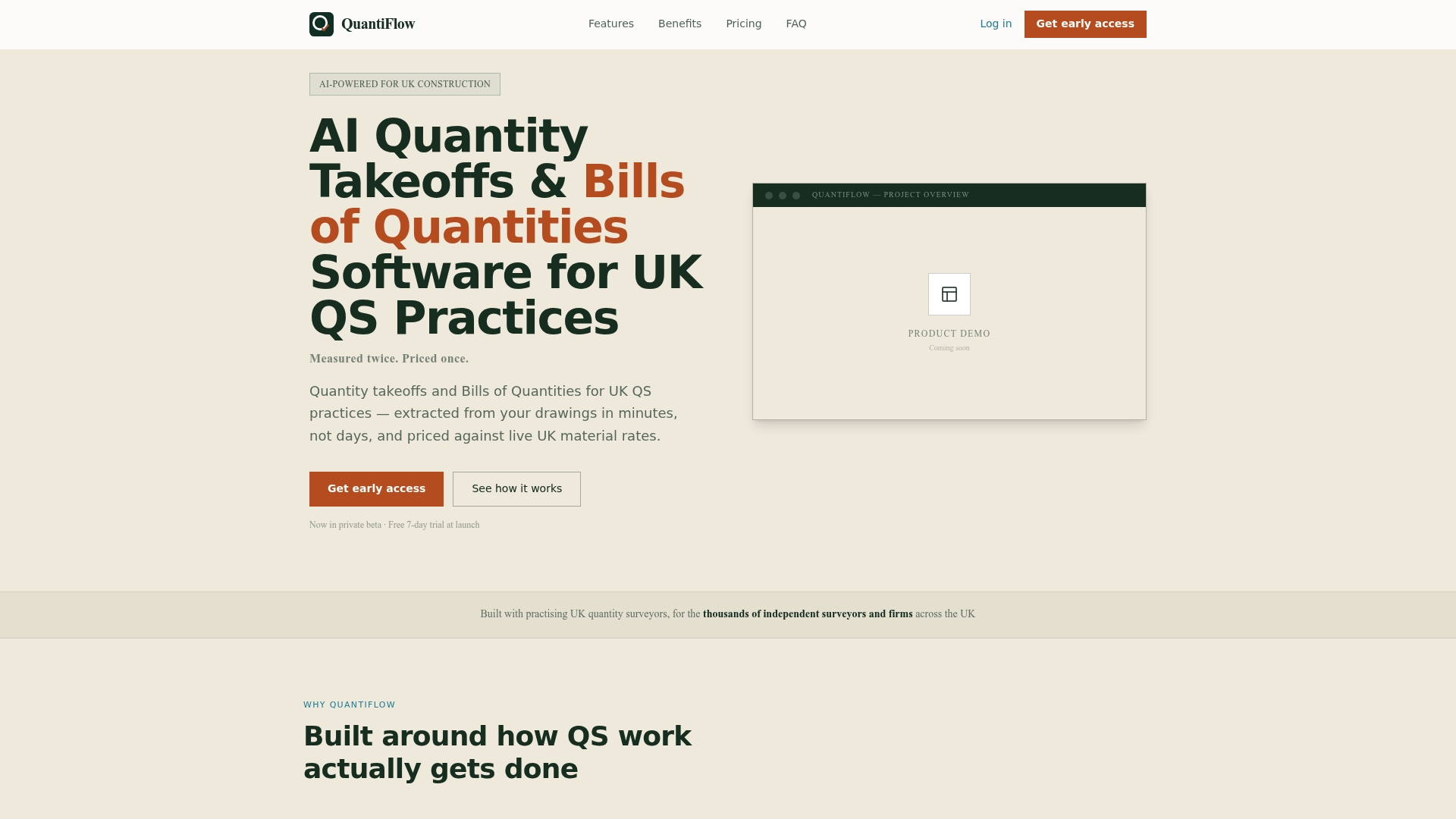
We built QuantiFlow to read construction drawings and produce a draft Bill of Quantities for a quantity surveyor to review and sign off. It remains in development, and the review steps set out in this guide still apply in full to anything it drafts: codification checks, line-level traceability, provisional sum scrutiny and a Task Report before issue.
For a surveyor who wants a starting draft rather than a blank bill, our Solo, Business and Enterprise plans are available to try. Automated drafting with human sign-off works best as a first pass that shortens the time to a reviewable document, not as a replacement for the checks above.
- Solo: a monthly subscription option
- Business: a monthly subscription option
- Enterprise: pricing available on request
FAQ
What is the main purpose of a BoQ review?
A BoQ review confirms that every measured item is traceable to the drawings and specification and complies with the applicable measurement standard. The result is a bill that can be issued for tender or used for cost control with confidence in its figures.
Which standard should I check a BoQ against?
Building works are checked against NRM 2, while civil engineering works are checked against CESMM4. Confirm which standard applies before starting the line-level review, since codification rules differ between them.
How does NEC4 change the review process?
NEC4 requires progressive validation of defined and disallowed costs rather than a single check at final account, according to ICE guidance. This means flagging potential compensation events as they arise instead of waiting until the end of the contract.
What should a Task Report include?
A Task Report should record the task number, reviewer contact details, the scope reviewed, the methodology applied, and the findings and recommendations, following the fields set out in public-sector QS task documentation. It should be supported by annexes such as marked-up drawings and calculation workbooks.
Can a tool like QuantiFlow replace the review process?
No. QuantiFlow reads construction drawings and produces a draft Bill of Quantities for a quantity surveyor to review and sign off, and remains in development. The checks covering traceability, codification and provisional sums still need to be carried out by the reviewing surveyor.
Sources
- NRM2 detailed measurement for building works (RICS / practice information)
- Professional QS task report requirements (Contracts Finder attachment)
- Changes in NEC4 works contracts (ICE guidance)
- NRM guidance and templates (RICS)
Recommended
- How construction contracts use BoQ: a UK professional's guide
- 6 Fields to Standardize BoQ Items for UK QSs with NRM2 and Uniclass
- Provisional sums in BoQ: a practical guide for QSs
- BoQ pricing for UK quantity surveyors: practical guide
This article is for general information only and is not professional, legal or commercial advice. Quantity surveying decisions should be taken by a qualified professional with reference to the specific project, drawings and contract in question. Content is produced with AI assistance and reviewed before publication. QuantiFlow Ltd accepts no liability for reliance on it.