
A Bill of Quantities is the financial backbone of any traditionally procured UK construction contract. It lists every measured item of work, with quantities and space for unit rates, so that all tendering contractors price an identical scope. Once signed into contract, that priced BoQ governs variation valuation, interim payments, and the final account. Understanding how construction contracts use BoQ means understanding the full project lifecycle, from RIBA Stage 4 drawings through to final reconciliation.
The core elements of a BoQ are:
- Measured quantities — work items described and quantified to NRM2 standards
- Unit rates — left blank at tender for contractors to complete
- Preliminaries — site establishment, management, and time-related costs
- Provisional sums — allowances for undefined or specialist works
- Preamble — the contractual rules governing measurement and pricing
This structure creates a level playing field at tender, then serves as the live commercial reference throughout construction.
Table of Contents
- How construction contracts use BoQ: creation at design stage
- How the BoQ drives fair tendering and bid comparison
- Using the BoQ for financial control during construction
- Common pitfalls in BoQ management you should avoid
- How BoQ supports budget reliability and procurement fairness
- Key takeaways
How construction contracts use BoQ: creation at design stage
The BoQ is produced by the quantity surveyor at RIBA Stage 4, once the technical design is sufficiently complete to allow accurate measurement. The QS works from drawings and specifications, applying NRM2 measurement rules to produce standardised item descriptions and calculated quantities. That standardisation is what makes a BoQ prepared by one QS fully priceable by any contractor in the UK.
The document mirrors the physical construction sequence:
- Substructure — excavation, foundations, ground slabs
- Superstructure — frame, upper floors, roof
- Internal finishes — walls, floors, ceilings
- Services — mechanical, electrical, plumbing
- External works — drainage, landscaping, hard standings
Each section contains line items with a description, unit of measurement, quantity, and a blank rate column. The preamble sits at the front, setting out the measurement rules and pricing framework that bind both parties. Preliminaries follow, covering site-wide costs that cannot be attributed to a single work item. Provisional sums appear where design is incomplete or specialist works cannot yet be fully defined, though they carry tendering implications: undefined provisional sums make direct bid comparison harder because each contractor prices the uncertainty differently.
Pro Tip: Keep item descriptions self-contained. A contractor should be able to price any line item without referring back to the QS. Ambiguous descriptions are where scope gaps and disputes begin.
How the BoQ drives fair tendering and bid comparison
The completed BoQ, with quantities and descriptions but no rates, goes out as part of the tender package. Contractors insert their unit rates, calculate line-item totals, and return the priced BoQ as a core tender document. Because every bidder prices the same measured quantities, the client can compare tenders directly rather than reconciling different scopes.
Tender levelling is where the real analytical work happens. A mathematically correct BoQ can still be commercially non-comparable if a contractor has qualified their submission, adjusted programme assumptions, or shifted risk into provisional sums. Skilled QS teams examine:
- Unit rate anomalies — unusually low rates on high-uncertainty items, or front-loaded rates on early-trade packages
- Preliminaries assumptions — programme duration, phasing, logistics inclusions
- Provisional sum treatment — whether attendance, overhead and profit, and design fees are included or excluded
- Qualifications and exclusions — scope carve-outs that make a low headline figure misleading
Once the contract is awarded, the priced BoQ becomes a contract document under JCT, sitting within the defined hierarchy of contract documents. The rates are binding for all future variation valuations, which is why anomalous rates identified at tender must be resolved before award, not after.
Using the BoQ for financial control during construction
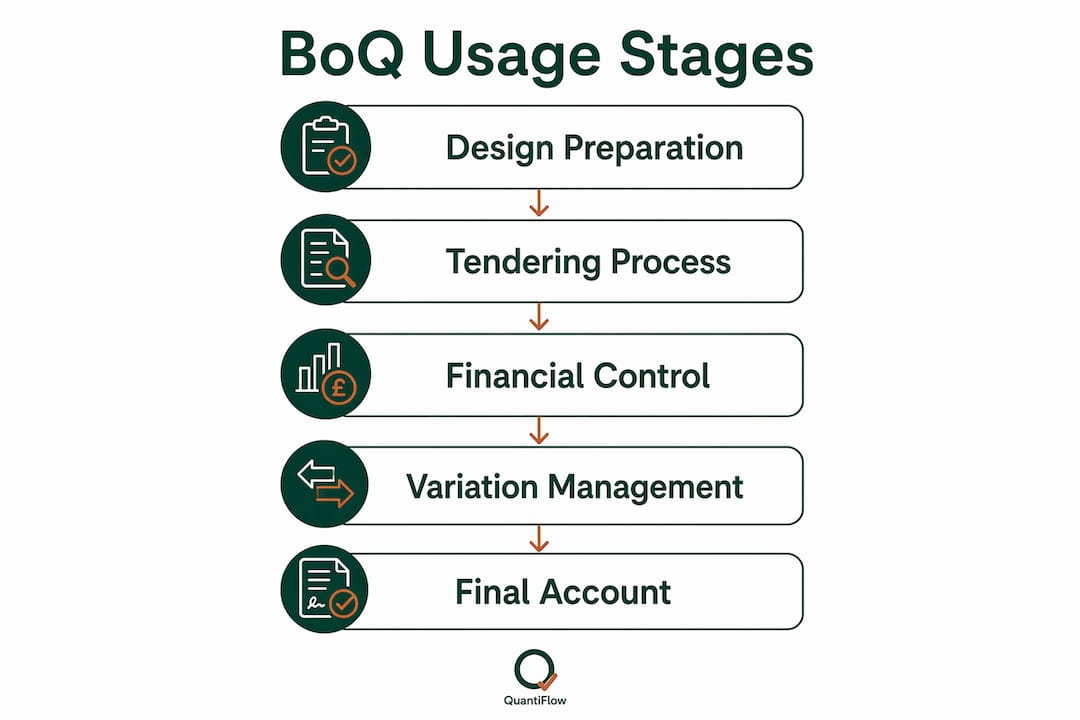
During the construction phase, the BoQ shifts from a tendering tool to a live financial instrument. Its three primary functions are variation valuation, interim payment assessment, and final account preparation.

Variation valuation relies directly on BoQ rates. When a design change, omission, or addition arises, the QS applies the relevant contract rates to the measured change. If brickwork was tendered at £85/m², that rate applies to any additional brickwork instructed as a variation. This removes subjectivity from change management and reduces the scope for dispute.
Interim payments are assessed by the QS measuring the percentage of each BoQ line item completed on site. Tying payments to verified quantities completed rather than subjective progress estimates gives the client confidence and the contractor a transparent basis for their application. It also makes the payment certificate defensible if challenged.
Provisional sums require active management throughout the project. Each sum must be tracked, instructed formally, and adjusted against actual costs. Sums that drift without formal instruction are a reliable route to budget overrun. Keeping a live register of provisional sum status, with clear records of what has been instructed and at what value, is standard practice on well-run contracts.
At project end, the BoQ forms the starting point for the final account: contract sum, plus variations, plus provisional sum adjustments, minus omissions. A well-maintained BoQ makes final account settlement faster and less contentious.
Common pitfalls in BoQ management you should avoid
Even experienced teams make avoidable errors with BoQs. These are the ones that cause the most commercial damage.
Confusing measured and approximate BoQs. A measured BoQ fixes quantities and forms the core contract document under JCT with quantities. An approximate BoQ allows for remeasurement post-contract, which shifts risk and increases the potential for dispute. Treating an approximate BoQ as if it were fixed is a common and costly mistake.
Underestimating the preamble and preliminaries. These sections carry significant legal and commercial weight. A mismatch between the preamble's measurement rules and how items are actually described in the bills is a common cause of disputes. Preliminaries pricing can also be manipulated to front-load cash flow or mask profit allocation, so scrutiny here is always warranted.
Inadequate tender levelling. Accepting the lowest headline figure without reconciling qualifications, programme assumptions, and provisional sum treatment is how clients end up with a contractor whose outturn cost bears no resemblance to their tender sum.
Treating the BoQ as an accounting sheet. A priced BoQ reveals how a contractor has interpreted scope, where they have carried risk, and what their commercial strategy looks like post-contract. Using it only to track spend misses most of its value.
Neglecting provisional sum detail. Vague provisional sums with no clarity on attendance, overhead and profit, or valuation mechanism create comparability problems at tender and budget exposure during construction.
Pro Tip: Issue written clarifications for every material qualification or exclusion before contract award. Tie each clarification to a specific BoQ reference so it can be incorporated cleanly into the contract documents.
How BoQ supports budget reliability and procurement fairness
The BoQ's role in preventing lowest-tender bias is one of its most underappreciated functions. In traditional UK procurement, consistent measured quantities strip out the scope exclusions that allow contractors to submit artificially low bids. Every tenderer prices the same work, so price differences reflect genuine rate differences, not hidden scope gaps.
This consistency also supports project cash flow forecasting. By linking progress to measured BoQ items, the client can anticipate expenditure at each stage of the programme. For contractors, the same structure supports resource and procurement planning across construction supply chain commitments.
The BoQ also serves as the primary reference document in dispute resolution. When disagreements arise over scope, quantities, or pricing, the BoQ provides a clear, contractually binding record of what was agreed. Historical BoQs from completed projects become benchmarking data for future procurement, improving cost planning accuracy over time.
Quantiflow automates NRM2-aligned quantity takeoffs directly from architectural drawings, turning dense PDF sets into structured, priceable BoQ output. The platform cross-references drawings to catch measurement gaps before they reach tender, preserving the QS's professional judgement while removing the manual measurement burden. Plans run from Solo at £39/month to Business at £149/month, with Enterprise available for larger teams. Learn how cost plans evolve to BoQ in practice, or explore the full range of BoQ types and their contractual uses.

Ready to produce NRM2-compliant BoQs faster and with greater accuracy? Start with Quantiflow and see what measured twice, priced once actually looks like in practice.
Key takeaways
A BoQ is only as reliable as the measurement standard and active management behind it; NRM2 alignment, rigorous tender levelling, and disciplined provisional sum tracking are what separate a well-run contract from a disputed one.
| Point | Details |
|---|---|
| BoQ creation follows NRM2 | QS measures quantities at RIBA Stage 4 using NRM2 rules to produce a standardised, priceable document. |
| Tender levelling is non-optional | Reconcile qualifications, programme assumptions, and provisional sum treatment before comparing headline figures. |
| BoQ rates bind post-contract | Unit rates entered at tender govern all variation valuations throughout the construction phase. |
| Provisional sums need active management | Track, instruct, and adjust every provisional sum formally to prevent uncontrolled budget exposure. |
| Preamble and preliminaries carry legal weight | Misalignment in these sections is a leading cause of valuation disputes and contractual ambiguity. |