
The most costly BoQ errors share one trait: they cannot be traced back to a drawing. Quantities without a verifiable source, vague or incomplete item descriptions, and uncontrolled drawing revisions cause more disputes and re-measures than any pricing mistake. The fix isn't complicated. Enforce drawing-linked quantities on every line, then run an independent verification and sign-off gate before anything reaches tender. What follows covers the full error list, the QA workflow that catches them, where technology genuinely helps, and a pre-issue checklist you can run today.
TL;DR:
- Enforcing drawing-linked quantities and running an independent verification before tender can significantly reduce common mistakes like outdated drawings and incorrect takeoffs.
- Automated measurement tools improve efficiency but must be paired with human judgment to handle scope ambiguities, final descriptions, and site-specific conditions.
- A structured verification workflow and a pre-issue checklist, including drawing revision checks and assumption logging, prevent errors from reaching tender submissions.
- Regular stakeholder communication and proper change management are critical to catching scope overlaps and updates early, avoiding costly variation claims later.
Table of Contents
- Common BoQ errors to avoid and how to fix each one
- Verification, QA and audit workflows that catch errors before tender
- Where automation helps and where judgement still has to win
- A pre-issue checklist for BoQ quality assurance
- Site conditions and inadequate site investigation
- Common causes of BoQ errors and how to identify them
- Impact of BoQ errors on project budget and timeline
- Best practices for BoQ preparation and verification
- Why stakeholder communication prevents BoQ errors before they start
- Author perspective: when to favour manual judgement over automation
- Sources
Common BoQ errors to avoid and how to fix each one
Every quantity surveyor has seen a BoQ come apart at tender stage because of a mistake that a second pair of eyes would have caught. The QuantitySurveyingCoach guidance on common BoQ mistakes lists inaccurate takeoffs, inconsistent formatting, missing items and weak peer review as the recurring culprits, and that matches what shows up in dispute files across the industry. Here's the ranked list, with the immediate fix for each.
- Incorrect quantity takeoffs. Measurements drift when they aren't checked against the drawing they came from. Verify every takeoff against its source drawing and run an independent cross-check on high-value items.
- Missing items and duplicate entries. Gaps and repeats both distort the tender price. Work from a scope checklist for every trade, and use duplicate-detection logic rather than a manual scan of a 40-page spreadsheet.
- Outdated drawings and poor revision control. Pricing against superseded drawings is one of the most preventable errors on this list. Centralise drawings in one repository, stamp every revision, and remeasure the moment a drawing changes.
- Vague item descriptions. RICS guidance is blunt about this: incomplete descriptions are a leading cause of incomparable bids and change orders later in the build. Write full, measurable descriptions in NRM2 phrasing, not shorthand a subcontractor has to guess at.
- Wrong units of measurement. Mixing m² and m, or linear metres and number, ruins comparability between bidders. Standardise units across the document and build a unit check into peer review.
- Ignoring MEP and discipline coordination. Mechanical and electrical scope gets missed when it's bolted on late. Bring MEP into the takeoff early and set clear scope boundaries between trades.
- Ignoring wastage and temporary works. Base quantities without wastage allowances or a temporary works section underprice the job before it starts.
- Arithmetic and spreadsheet formula errors. A single broken formula can silently corrupt every downstream total. Validate formulas, lock master spreadsheets, or move to purpose-built software.
- Failure to trace quantities to drawings. As Buildxact's guidance puts it, a quantity that can't be verified against a plan shouldn't be in a firm BoQ at all. Add a drawing reference column and make it mandatory.
- Using outdated rates and skipping contingency. Stale supplier rates and no documented contingency turn a solid BoQ into a budget overrun. Refresh rates before pricing and log every assumption in writing.
Pro Tip: Add three fields to every BoQ line, not just the description and quantity: the drawing reference, the measurement method (e.g. "measured from floor plan A102 Rev C"), and the reviewer's initials with a date. That triple-check catches more errors than a second full remeasure.
Verification, QA and audit workflows that catch errors before tender
A BoQ needs a defensible paper trail as much as it needs an accurate number, and that means running verification as a sequence rather than a single final check. The order matters: drawing revision check first, then measurement cross-check, then a written log of assumptions and exclusions, then independent review, then sign-off. Skip a step and the error usually resurfaces at valuation stage, not before.
Document control underpins the whole sequence. Keep drawings in one single-source store, stamp every revision the moment it lands, and trigger a remeasure automatically when a drawing changes rather than waiting for someone to notice. A structured review procedure with a clear audit trail is standard good practice precisely because it catches errors before they become contractual disputes.
A minimal peer-review checklist should cover:
- Every quantity traces to a stamped, current drawing revision.
- Descriptions are complete and measurable, not abbreviated.
- Units are consistent across the document and against the rate library.
- Assumptions, exclusions and contingency are logged, not implied.
- A named reviewer, separate from the original measurer, has signed off.
Ambiguous quantities, unusual site conditions or anything that can't be resolved from the drawing set should be escalated to site verification or a specialist estimator rather than guessed at and buried in a footnote.
Pro Tip: Assign each gate to a named role, not a task. The measurer owns the takeoff, a second QS owns the review, and the commercial lead owns final sign-off. Diffusing that accountability across "the team" is how errors slip through unnoticed.
Where automation helps and where judgement still has to win
Automation is genuinely good at the repetitive, mechanical parts of takeoff work: measuring the same wall type across forty sheets, cross-referencing a floor plan against a schedule, flagging when a drawing revision changes a previously measured quantity, and keeping an audit log of who changed what and when. BIM and centralised drawing workflows reduce manual measurement error largely because they remove that repetitive burden and give everyone a single source of truth.
What automation should never do is make the judgement calls. Ambiguous scope, exclusions, final wording of descriptions and the assumptions underpinning a price all need a qualified professional's sign-off. This is the model Quantiflow is built around: the platform automates NRM2-aligned takeoffs and cross-references drawings automatically, but every output stays editable, and the QS retains sign-off at the key stages rather than the software finalising anything on its own. That distinction, between automating repetition and replacing judgement, is worth checking before adopting any tool.
When evaluating software for takeoff and BoQ work, run it against a short checklist:
- Does every generated quantity carry a traceable drawing reference?
- Can outputs be edited and overridden, or are they locked?
- Is there a genuine audit trail, not just a version number?
- How does it handle drawing revisions and change detection?
- What export formats does it support, and what does it cost at your team size?
Controlled automation, paired with human sign-off, cuts repetitive measurement time without removing the professional accountability a BoQ depends on.
A pre-issue checklist for BoQ quality assurance
Run this as the last gate before anything goes to tender. It's short by design; a checklist people skip because it's too long defeats the purpose.
- Confirm you're working from the latest drawing revision. Owner: measurer. Timing: before takeoff starts, not after.
- Trace every quantity back to a specific drawing reference. Owner: measurer.
- Check units and descriptions for consistency and completeness. Owner: reviewer.
- Refresh market rates against current supplier and subcontractor pricing. Owner: commercial lead.
- Confirm wastage allowances and a temporary works section are included. Owner: measurer.
- Run independent peer review and formal sign-off. Owner: reviewer, separate from the measurer.
- Log assumptions, exclusions and contingency in writing. Owner: commercial lead.
Contingency allowances vary by project risk and procurement route, but they need to be documented explicitly rather than folded silently into a base rate. BoqCalc's pricing guidance recommends building in allowances for risk rather than assuming the base quantities alone will hold.
| Checklist gate | Owner | When |
|---|---|---|
| Drawing revision check | Measurer | Before takeoff |
| Quantity to drawing trace | Measurer | During takeoff |
| Unit and description review | Reviewer | Before pricing |
| Rate refresh | Commercial lead | Before pricing |
| Wastage and temporary works | Measurer | During takeoff |
| Peer review and sign-off | Reviewer | Before issue |
| Assumptions and contingency log | Commercial lead | Before issue |
Site conditions and inadequate site investigation
A BoQ measured entirely off drawings, with no reference to what's actually on site, is a common source of errors that only surfaces once work starts. Ground conditions, existing services, access constraints and demolition scope often differ from what a drawing set implies, especially on refurbishment or infill projects where as-built records are thin.

Inadequate site investigation shows up later as variations and claims, not as a rejected tender. A borehole survey that missed a made-ground pocket, or a site visit that skipped checking for buried services, turns into an extra-over claim once excavation starts. The BoQ should carry a clear statement of what site information the quantities are based on, and flag where that information is provisional.
Where site investigation is limited or incomplete, state that explicitly in the assumptions section rather than pricing as if full information exists. A contingency line tied specifically to site risk, distinct from the general contingency, gives the client a realistic picture of exposure rather than a false sense of certainty in the base price.
Common causes of BoQ errors and how to identify them
Most BoQ errors trace back to a small number of root causes: time pressure at tender deadline, disconnected drawing sets across disciplines, manual transcription between measurement and pricing, and a peer-review step that gets skipped when the programme tightens. None of these are exotic. They're the same pressures every QS team works under, which is exactly why they recur.
Identifying them early comes down to pattern recognition more than forensic investigation. If duplicate items keep appearing in the same trade section, the checklist used for that trade probably needs revising. If unit mismatches cluster around one discipline's drawings, that discipline's output format is likely the problem, not the measurer. Consistent errors point to a process gap; scattered, one-off errors usually point to a training gap.
A useful diagnostic is to audit the last three BoQs a team produced and tag every correction made at review stage by cause, not just by line item. Patterns emerge quickly: most firms find a small number of causes account for the majority of corrections, which tells you exactly where to focus QA effort rather than tightening review everywhere equally.
Impact of BoQ errors on project budget and timeline
BoQ errors rarely stay contained to the document they started in. A missed quantity or an untraced measurement surfaces as a variation once construction begins, and variations cost more to resolve mid-build than they would have to catch at tender. The contractual role of the BoQ means an error in the document doesn't just distort the price, it can shift the interpretation of scope under the contract itself.
Timeline impact follows the same pattern. A drawing revision that wasn't reflected in the BoQ triggers a remeasure mid-programme, which delays procurement decisions that depend on confirmed quantities. Budget impact compounds because the change order process itself carries administrative cost on top of the corrected price, and disputes over who bears that cost can stall a valuation cycle for weeks.
The practical lesson is that BoQ accuracy is a programme risk, not just a pricing exercise. Every error caught at review stage is one that never reaches a site instruction, a variation order, or a commercial dispute later in the build.
Best practices for BoQ preparation and verification
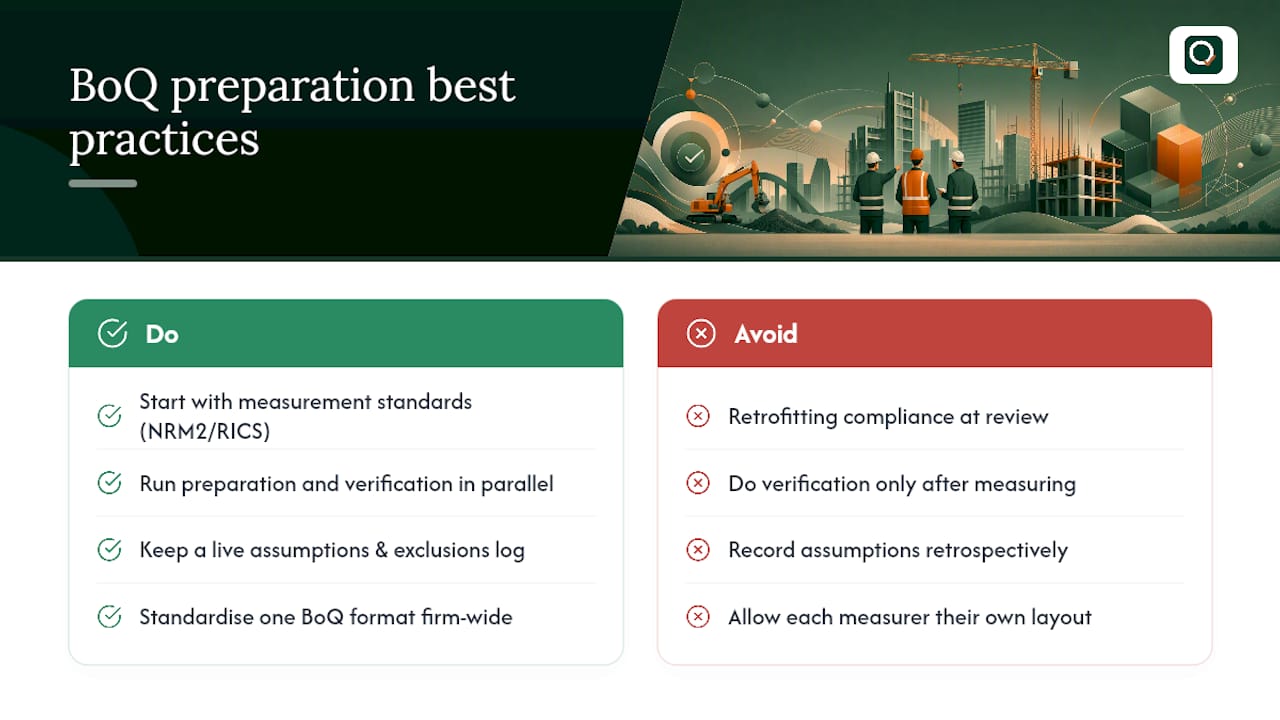
Solid BoQ preparation starts with the measurement standard, not the spreadsheet. Working to NRM2 conventions and RICS-aligned description standards from the first line, rather than retrofitting compliance at review stage, saves rework and keeps descriptions comparable across bidders.
Preparation and verification work best as parallel disciplines rather than sequential ones. Build the drawing reference and measurement method into every line as you measure, not as an afterthought during review. Keep a live assumptions and exclusions log open throughout the takeoff instead of writing it retrospectively once pricing is underway, since assumptions made early are easy to forget by the time the document is finished.
Standardising on one BoQ format across a firm, rather than letting each measurer default to their own layout, makes peer review faster and reduces the chance that a reviewer misses something because the structure is unfamiliar. Combine that with a work-breakdown structure that ties quantities to drawing references from the outset, and most of the verification work becomes a matter of confirming links rather than reconstructing them after the fact.
Why stakeholder communication prevents BoQ errors before they start
A striking number of BoQ errors trace back to a conversation that didn't happen rather than a measurement mistake. An architect issues a revised drawing without flagging which sections changed. A subcontractor assumes a scope boundary that the QS assumed differently. An MEP consultant's drawings arrive in a different format to the structural set, and nobody reconciles the overlap before pricing starts.
Regular, structured touchpoints between the QS, architect, MEP consultants and the commercial lead catch these gaps early, when they're a five-minute conversation rather than a formal variation. This matters most at the boundary between disciplines, where scope ambiguity is most likely and where architects rely on accurate quantity calculations to keep design and pricing aligned.
Procurement route shapes this too. A design-build arrangement changes who owns which risk and how early the BoQ needs to reflect design decisions, compared with a traditional design-bid-build sequence. Getting that communication structure right at the start of a project prevents more errors than any amount of review after the drawings are finalised.
Author perspective: when to favour manual judgement over automation
Automation earns its place on repetitive measurement work. It doesn't earn a free pass on judgement calls, and treating it as if it does is where I'd push back hardest against the current enthusiasm for AI takeoff tools.
Novel construction details, ambiguous scope boundaries between trades, and unusual temporary works arrangements all need a human to interpret them properly. When a QS overrides an automated output, that override should be logged with a reason, not just accepted silently. That log becomes the audit trail that protects the practice if the quantity is ever challenged later.
— Michael
Sources
- Royal Institution of Chartered Surveyors (RICS)
- Buildxact US — Bill of Quantities: what it is and how to prepare one
- BoqCalc — BOQ price guide
- QuantitySurveyingCoach — common mistakes in BoQ preparation