
When a drawing revision lands, three moves fix the problem: log the change, overlay the old and new drawings to isolate exactly what moved, then update only the affected quantities and record the delta. That last step, the recorded difference between old and new measurement, is what turns a scramble into an audit trail. Instead of rebuilding a Bill of Quantities from scratch, you touch only what changed and keep timestamps, user IDs, and before/after figures against every revised item.
This works because it aligns with how NRM2 and SMM measurement rules already expect quantities to be traceable to a specific drawing and revision. Visual comparison techniques built on OpenCV can isolate geometric changes automatically, and platforms like Quantiflow apply that same logic to NRM2-aligned takeoffs, letting the quantity surveyor verify rather than remeasure everything.
- Log the notification and flag the affected drawing numbers.
- Overlay old and new drawings to isolate the actual change.
- Remeasure only the delta and record it against the revision.
Key Takeaways
Auditable drawing revision control works because it isolates only what changed, records the delta with a timestamp and verification, and never forces a full takeoff rebuild.
| Point | Details |
|---|---|
| Follow the three steps | Log the notification, overlay to isolate the change, then remeasure and record only the delta. |
| Tag every quantity | Attach drawing ID and revision letter to each measured item so nothing loses traceability. |
| Keep quantities clean | Store net measurements separately from waste and pricing logic to avoid contaminated figures. |
| Verify, don't just accept | Every AI-suggested delta needs a logged verification record showing who checked it and why. |
| Consider a purpose-built platform | Quantiflow combines cloud storage, visual-diff-assisted deltas, and NRM2-aligned exports for SME QS teams. |
Table of Contents
- Why drawing revision control is the weak link in quantity takeoffs
- Practical three-step revision-control workflow you can use today
- Minimal SME-friendly technical architecture that supports the workflow
- Day-to-day rules that keep updates small, auditable and defensible
- Typical failure modes when revisions arrive and quick fixes
- A ten- to twenty-minute readiness audit you can run now
- Change notification workflows and communication protocols to alert relevant stakeholders promptly
- Automation should assist and preserve QS professional judgment
- How Quantiflow implements the pattern described
- Sources
Why drawing revision control is the weak link in quantity takeoffs
Most revision failures aren't caused by the drawing change itself. They're caused by how the original takeoff was organised. When quantities aren't tied to a specific drawing and revision letter, a QS has no reliable way to know what's still valid and what needs checking, so the safest option becomes remeasuring everything. That's expensive, slow, and it's how contaminated estimates creep in: waste allowances and pricing logic get baked into what should be a clean net quantity, and nobody can unpick them later.
A single revision cloud on one drawing often triggers changes across structural, MEP, and finishes sections simultaneously, and the hardest part is mapping those downstream consequences, not the headline change itself. Decentralised files make this worse: if revised drawings circulate by email or messaging apps rather than through a single versioned store, someone inevitably prices off the wrong sketch.
Pro Tip: Treat "which drawing, which revision" as a mandatory field on every measured item, not an optional note. It costs seconds now and saves hours during a final account dispute.
Any system claiming to manage this properly should give you:
- Timestamped revision logs with no manual editing after the fact.
- A hard link between revision ID and drawing ID for every measured item.
- Delta records showing the mathematical difference, not just a new total.
- Measurement rules aligned to SMM/NRM2 conventions for any automated suggestion.
Practical three-step revision-control workflow you can use today
The workflow below scales from a single-partner practice to a ten-person QS team. It also maps directly onto a documented pre-tender revision management approach built around exactly this three-step structure.
- Log the notification. The moment a revised drawing arrives, update your revision register: drawing number, old revision letter, new revision letter, date received, and who flagged it. Schedule a review slot within the day if the project is live.
- Overlay and compare. Run an automated visual diff between the previous and current drawing. OpenCV-based comparison tools highlight geometric differences (moved walls, resized openings, added elements) far faster than eyeballing two PDFs side by side. This step's entire job is to stop you remeasuring anything that hasn't actually changed.
- Remeasure the delta. For each flagged area, calculate the actual difference and record it as a standalone delta line, referencing the original measurement rather than overwriting it. Tag the new figure with the revision letter and a timestamp.
The decision point sits between steps two and three. An AI-assisted diff can suggest a delta, but the QS inspects the highlighted areas and either confirms the suggestion or overrides it. Either way, that verification gets logged, who checked it, when, and why it was accepted or changed.
A structured three-step process, log notification, overlay compare, update affected quantities and record the delta, creates an auditable trail and avoids rebuilding the whole takeoff from zero every time a drawing moves.
Pro Tip: Keep deltas in a separate working paper column from your pricing sheet. Net quantities stay clean, waste and allowances get applied downstream, and you can always see exactly what the drawing change added or removed, unclouded by markup.
Minimal SME-friendly technical architecture that supports the workflow
You don't need a full BIM suite to run this properly. A hybrid architecture combining cloud storage, visual comparison, and a rule-based suggestion engine is genuinely feasible for small QS firms, and it's considerably cheaper than enterprise document management.
Four components do the job:
- Cloud versioned storage for drawings and working papers, so there's one source of truth rather than five inboxes with five different "final" versions.
- Automated visual comparison, OpenCV-based or equivalent, to isolate what's actually changed between revisions.
- A rule-based quantity suggestion module aligned to SMM/NRM2 conventions, producing draft deltas for review rather than final figures.
- Export and archival to Excel or PDF, with audit metadata attached, so tender records stand up to scrutiny months later.
Cloud storage matters more than teams tend to assume. It's not just convenient. It's the mechanism that stops someone quoting off a superseded drawing, because there's only one current version and a clear history behind it.
When choosing tools, check for PDF and DWG support, the ability to preserve revision IDs through the workflow, exportable comparison reports (visual diff plus a delta table), and proper user access controls so junior staff can't overwrite verified figures.
Pro Tip: Store major and minor versions in a predictable folder pattern, such as Drawing_Number/RevLetter/Date, and tag every quantity line to that exact drawing and revision. Six months later, when a dispute surfaces, you'll find the answer in seconds rather than hours.
Day-to-day rules that keep updates small, auditable and defensible
Discipline matters more than software here. A few habits keep revision control workable long after the initial setup enthusiasm fades.
Keep the takeoff clean: net quantities only, with waste allowances and pricing logic applied later in a separate sheet. This isn't pedantry. Treating the takeoff as a stable, unpriced base is what makes it resilient when the next revision arrives, because you're never trying to strip markup back out of a contaminated figure.
- Tag every measured item with drawing ID, revision letter, and a short calculation trace (grid reference, formula used).
- Group quantities by trade, phase, and system deliberately, so one revision only touches the groups it actually affects.
- Assign clear ownership: who flags the QS when a revision lands, who updates the register, who signs off the verified delta.
- Working papers should carry a transparent calculation and revision reference for every quantity, not just a final number.
Pro Tip: Record every override, not just the accepted deltas. If a QS rejects an AI-suggested figure, note why. That single line often settles a final account argument months later without anyone needing to reconstruct the reasoning from memory.
Typical failure modes when revisions arrive and quick fixes
Four mistakes account for most of the pain teams report.
- No revision ID on the quantity. Fix: make drawing number plus revision letter a mandatory field before any figure gets entered.
- Remeasuring the whole drawing instead of the delta. Fix: run the overlay comparison first, then measure only what's flagged.
- Quantities contaminated with waste or pricing. Fix: keep net measurements in one sheet, pricing derived from them in another.
- The document register and the working papers drift apart. Fix: a weekly cross-check, backed by automatic notifications whenever a QS-relevant drawing changes.
Each of these is cheap to fix early and expensive to unpick once a project is three revisions deep.
A ten- to twenty-minute readiness audit you can run now
Score your current setup honestly against six checks:
- Drawings and working papers sit in centralised, versioned storage.
- A revision register exists and gets updated the same day a drawing arrives.
- You have access to a visual-diff tool, even a basic overlay comparison.
- Every quantity is tagged with a drawing number and revision letter.
- Register and working papers get cross-checked at least weekly.
- You can export a comparison report showing both the visual diff and a delta table.
Score five or six: you're close to fully auditable, focus on tightening export formats. Score three or four: prioritise the revision register and tagging discipline first, they're the cheapest fixes. Score two or fewer: start with centralised storage before anything else, nothing downstream works without it.
Piloting the minimal stack on a small project typically takes only days to get running. Embedding it as habit across a whole team, so tagging and cross-checks happen without reminders, usually takes two to six weeks.
Change notification workflows and communication protocols to alert relevant stakeholders promptly
A revision control system is only as good as the speed at which the right people find out about it. Architects issue a revised drawing; if the QS doesn't hear about it for four days, the whole point of an auditable delta process collapses before it starts.
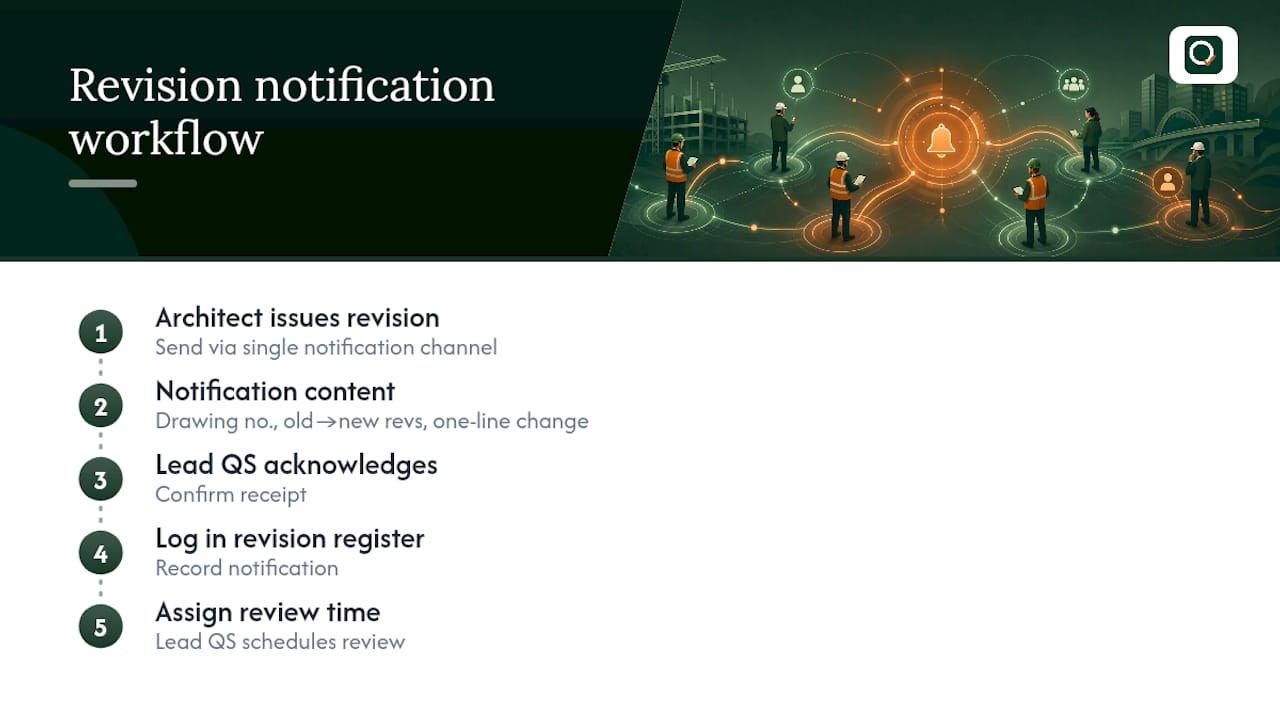
Set up a single notification channel, not five. Whether that's an automated email trigger from your document store, a shared revision log with edit alerts, or a project management tool integration, the requirement is the same: one place, one format, no exceptions. Every revision notification should carry the drawing number, old and new revision letters, a one-line description of what changed, and who issued it.
Ownership matters as much as speed. Nominate one person, typically the lead QS on the project, as the point of confirmation: they acknowledge receipt, log the notification in the revision register, and assign review time. Without a named owner, notifications sit unread in shared inboxes.

This is also where collaboration between architects and QS teams tends to break down in practice, because architects issue revisions on their own schedule, not the QS's. Building a short standard protocol, issue, acknowledge, log, review, into your project setup from day one removes the guesswork every time a drawing changes.
Automation should assist and preserve QS professional judgment
Automation earns its place here by removing repetitive remeasurement, not by replacing the person checking the work. The QS role shifts from manually redrawing quantities to verifying AI-suggested deltas, confirming or overriding them based on site knowledge no algorithm has access to.
Every accepted delta needs a verification record: who checked it, when, and why. That record is what makes tender figures defensible six months later, and it's what turns individual project experience into institutional knowledge rather than something that leaves the firm when someone does.
How Quantiflow implements the pattern described
Quantiflow gives you the architecture this article describes, without needing to stitch together separate storage, comparison, and export tools yourself. Drawings and working papers live in one versioned cloud store, AI cross-referencing highlights what's changed between revisions, and suggested quantity deltas stay aligned to NRM2 measurement rules, ready for you to confirm or override.
Every accepted change carries its verification record automatically, so your revision history and audit trail build themselves as you work rather than as a separate task at the end of the week. Finalised BoQs export straight to Excel or PDF, formatted for tender submission. If you're currently rebuilding takeoffs by hand every time a drawing revision lands, start a Quantiflow trial and see how much of that work the platform can take off your desk before your next deadline.
Sources
- Cloud-Based System for Pre-Tender Drawing Revision Management (IJRISS, 2026)
- Cloud-Based System for Pre-Tender Drawing Revision Management