
A quantity-changing addendum is a formal, numbered revision to the tender documents that alters a bid item's measured quantity before award. The moment one lands, acknowledge it, attach it to your bid form, and log the change against your original take-off. This guide walks through a worked example, a processing checklist, and copy-ready templates so your bid stays defensible.
TL;DR:
- Quantity changes must be carefully tracked across the schedule of items, bid form, and drawings, with each adjustment documented and cross-referenced.
- Addenda issued late or in emergencies require quick assessment, validation, and potential re-pricing, often using parametric adjustments for efficiency.
- Maintain a master revision log and detailed reconciliation records to ensure audit readiness and prevent errors during multiple addenda updates.
- When large or critical quantities are affected, a full remeasure is preferable, while proportional changes under tight deadlines may justify parametric scaling.
- Clear communication with subcontractors and clients, including bid extensions when necessary, safeguards the bid’s scope accuracy under time pressure.
Table of Contents
- What is a tender addendum, and when should one be issued?
- How addenda change bid quantities: mechanics and documentation
- Step-by-step: processing an addendum during bidding
- How to adjust your estimate when quantities change
- Annotated sample addendum: a worked example
- Checklist and quick templates for busy bidders
- How audit-ready workflows cut addendum risk
- What actually matters when quantities change late
- Where QuantiFlow fits into this process
- Sources
What is a tender addendum, and when should one be issued?
A tender addendum is a formal correction or clarification issued during the bidding period. Once executed, it becomes part of the tender documents themselves, not a side note. That matters legally: if a dispute arises after award, the addendum carries the same contractual weight as the original drawings and specification. Understanding tender addendums in this way, as binding instruments rather than administrative housekeeping, changes how seriously a QS team should treat them.
Contracting authorities issue addenda for a narrow set of legitimate reasons. Getting familiar with the common triggers helps you anticipate what's coming rather than react to it blind:
- Drafting errors or omissions spotted after the tender was advertised
- Bidder questions during the query period that expose an ambiguity needing a formal answer
- Design changes from the architect or engineer, often driven by a late client instruction
- Quantity corrections where a measured item was miscounted, mis-scaled, or duplicated across drawing sheets
- Wage determination or schedule updates, common on publicly funded work
Timing splits addenda into three practical categories. Routine addenda arrive with reasonable notice, often a week or more before the submission deadline, and cause little disruption. Late addenda arrive close to the deadline and usually justify a short extension. Emergency addenda are issued in the final day or two before letting; some agencies formally label them as such, and post-advertisement guidance notes that failing to acknowledge one in writing can, in extreme cases, result in withdrawal from the letting altogether.
State Department of Transportation manuals are useful reference points here because they formalise what many private-sector clients handle informally. TXDOT's addendum process requires a documented need assessment and a formal request before anything reaches bidders, and any addendum issued after advertising must follow a standing procedure and go to every bidder simultaneously.
How addenda change bid quantities: mechanics and documentation
Quantity changes surface in three places, and a QS who checks only one of them is taking a real risk. The Schedule of Items (SOI) is the primary record. The revised bid or proposal form carries the updated figures the client expects priced. The plan sheets may also be reissued with amended quantity tables, particularly on measured-quantity contracts where drawings drive the take-off.
Follow this sequence when a quantity-changing addendum lands on your desk:
- Locate the SOI change entry first. Public-sector addenda typically show the old and new figures side by side, for example changing a bid item from a previous lower quantity to a larger updated quantity, as documented in one published addendum changing bid quantities. Treat that notation, old quantity → new quantity, as the canonical record of what changed.
- Check for added or deleted line items. A quantity addendum sometimes introduces a wholly new item code rather than adjusting an existing one; missing a new line is far costlier than misreading a revised figure.
- Cross-reference item codes and descriptions, not just quantities. Two similarly worded items with different codes are not the same line, and pricing the wrong one against a revised quantity produces a bid that looks complete but is not.
- Trace plan-sheet references back to the SOI. If a revised drawing sheet shows a changed quantity table, confirm the drawing number matches the one cited in the addendum text; sheets get renumbered between issues more often than you'd expect.
- Complete the acknowledgement block and physically attach the addendum to your bid form. Public-sector guidance is explicit that addenda must be numbered consecutively, distributed to every plan holder, and acknowledged in writing. Bids have been rejected purely for a missing signature on this block, regardless of pricing accuracy.
Get comfortable with adjusting bid quantities as a discrete, repeatable action rather than a one-off correction, because on most projects it happens more than once before letting closes.
Step-by-step: processing an addendum during bidding
Treat every addendum as a four-stage workflow, whether it lands on day one of the tender period or the afternoon before submission.
Stage 1: Receipt and logging. Date-stamp the addendum the moment it arrives, assign it a unique identifier in your own tracking sheet (not just the client's addendum number), and note who on the team needs to see it. A distribution list matters more than it sounds: on a live tender, the person estimating groundworks and the person estimating M&E often need the same document but flag different risks in it.
Stage 2: Scope-impact assessment. Mark up the affected drawings and colour-code changes by trade. This is where a lot of teams cut corners under deadline pressure, and it's exactly where errors creep in. A quantity change to one bid item frequently has knock-on effects, a revised excavation volume changes disposal costs and possibly temporary works, even when the addendum only mentions one line.
Stage 3: Quantity reconciliation. Build a before/after table on each trade worksheet, then roll it up into a project-level summary. This is your evidence trail if anyone questions the final bid figure later.
Stage 4: Pricing impact review. Set a threshold, commonly a percentage of contract value, above which a quantity change triggers mandatory management sign-off before the estimator adjusts the price. For late addenda arriving on bid day, agree a rapid-review protocol in advance so nobody is improvising under pressure.
- Log the addendum with date, number, and distribution
- Mark up drawings by trade with colour-coded change flags
- Reconcile quantities in a before/after table, trade level and project level
- Apply your pricing-review threshold and route high-impact changes to a second reviewer
- File the decision trail, including who approved the final adjustment
Pro Tip: Keep a single master revision log across the whole tender period, not a fresh note for each addendum. When quantity changes stack, three or four addenda deep, a consolidated log is the only way to see the cumulative effect on a single bid item.
Recordkeeping here isn't bureaucratic box-ticking. Post-award reconciliation and audit queries almost always ask how a specific quantity was arrived at, and a documented decision trail is the difference between a five-minute answer and a week of digging through emails.
How to adjust your estimate when quantities change
The core decision is whether to run a full retakeoff or apply a parametric adjustment, and that choice should be driven by time available and scale of change, not habit.
A full reprice is the right call when a quantity change is large relative to the item's value, when it affects a critical-path trade, or when there's genuinely enough time before submission to redo the measurement properly. A parametric adjustment, scaling the price by the same proportion the quantity changed, is the pragmatic answer when time is short and the change is proportionate rather than structural.
- Use full reprice for changes affecting more than roughly 15% of a trade's contract value where time permits
- Use parametric adjustment for proportionate changes under tight bid-day deadlines
- Escalate to a second reviewer whenever a parametric adjustment covers a structural or safety-critical item
- Document which method was used and why, directly on the trade worksheet
Analysis of estimating QA reviews found that parametric adjustments typically land within 10 to 15 percent of a full retakeoff value for the affected systems, which is close enough for most bid-day decisions but not a substitute for a full remeasure once time allows.
Contract form changes what's actually at stake here. Under remeasurement contracts, quantities are measured and paid as executed, so a quantity addendum simply resets the baseline your unit rates will be applied against later. Under lump-sum contracts, a quantity change is more consequential: your entitlement to adjust the sum depends on the cause and how risk is allocated in the contract, not on the size of the deviation alone. A QS pricing a lump-sum bid should treat every quantity addendum as a potential future claim point and document assumptions accordingly.
Whichever method you use, write your contingency basis into the bid letter. A short line stating that pricing for Item 14 reflects a parametric adjustment pending final measurement protects you if the figure is challenged after award.
Annotated sample addendum: a worked example
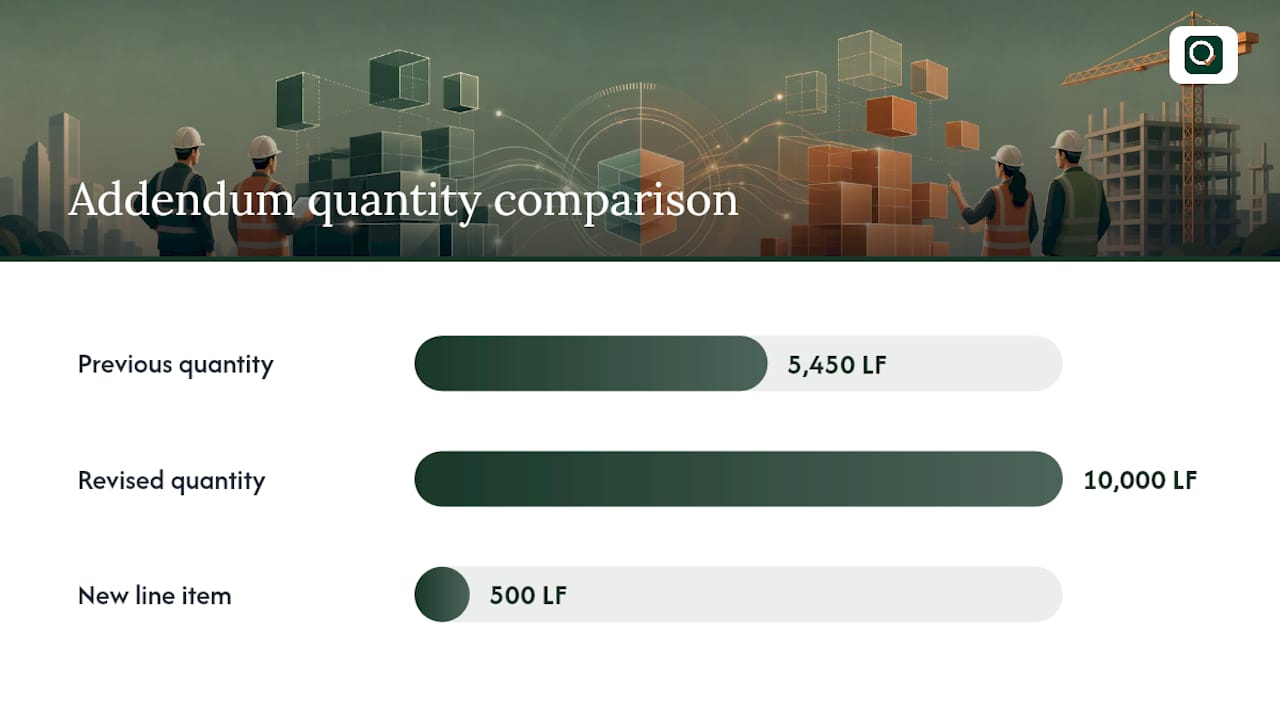
Here's how a real quantity change reads once it reaches your desk, based on the format used in a published addendum changing bid quantities.
Addendum header (what to check first):
| Field | Sample entry | Your action |
|---|---|---|
| Addendum number | Addendum No. 1 | Confirm it's the next number in sequence; a gap means you're missing one |
| Date issued | 14 January 2026 | Log against your master revision log immediately |
| Project ID | Contract ref matching your tender pack | Confirm it matches your bid file, not a similarly named project |
| Issuer | Contracting authority or their agent | Note who to contact for clarification |
| Issued to | All plan holders of record | Confirm you're on the distribution list; if not, query it |
Sample SOI change entry:
| Field | Previous | Revised | Action required |
|---|---|---|---|
| Item description | Pipe supply and install | Pipe supply and install (unchanged) | No description change; quantity only |
| Quantity | 5,450 LF | 10,000 LF | Reprice or apply parametric adjustment |
| New line item | None | Item 22A: Trench support, 500 LF | Price as new item; do not fold into existing rate |
The bidder's job against each row is the same three-part check every time: attach the addendum to the bid form, sign the acknowledgement, and decide whether the change warrants a full reprice or a parametric adjustment given the time left before submission. File the addendum inside your estimate pack next to the relevant trade worksheet, not in a general correspondence folder, and reference its number explicitly in your bid letter so the client's evaluator can see it was incorporated.
Checklist and quick templates for busy bidders
Run this triage sequence the moment an addendum arrives, in order:
- Log it with number, date, and a distribution note to affected estimators
- Distribute internally to every trade the change could plausibly touch
- Mark up drawings and SOI entries with the old and new figures
- Reconcile quantities on the trade worksheet and project summary
- Decide full reprice or parametric adjustment, and record the reasoning
- Acknowledge the addendum on the bid form
- File the addendum and your working papers together for audit purposes
Copy-ready acknowledgement clause for the bid form:
"The undersigned acknowledges receipt of Addendum No. [X], dated [date], and confirms that its provisions have been incorporated into this bid."
Bid-letter boilerplate for a parametric adjustment:
"Pricing for Item [X] reflects a parametric adjustment of [X]% applied under bid-day time constraints, pending confirmation by full measurement."
Keep the addendum, your marked-up drawings, and the reconciliation worksheet together in the estimate pack, and retain them for the same period you retain the rest of the tender file, typically the contract's full limitation period for claims.
How audit-ready workflows cut addendum risk
Most quantity-addendum errors trace back to one failure: a revision that never got fully incorporated because it was tracked in someone's head instead of a system. A structured revision log, one master record plus trade-level worksheets plus a project reconciliation, closes that gap and gives you evidence if a figure is ever questioned post-award.
An eight-step audit-ready take-off workflow typically runs: receive, log, distribute, mark up, reconcile, reprice, review, and file. Each step produces a record, which is the point.
- Structured revision tracking reduces the chance a late change is missed entirely
- Cross-referencing drawing numbers against the SOI catches renumbering errors before they reach the bid form
- Automated take-off tools can flag a changed quantity against the original measurement, though the pricing decision still needs a QS's judgement, not a formula
- Automation earns its keep most clearly when a tender attracts several addenda in a short window and the client expects a fully auditable BoQ
Teams wanting to formalise this can review a full eight-step audit-ready take-off workflow or drawing revision control practices built around the same principle.
What actually matters when quantities change late
Priorities, in order: protect the integrity of your price, meet your obligation to the client to bid on the actual scope, and be transparent with subcontractors about what changed and when. A parametric adjustment is acceptable under time pressure. It is not acceptable to submit a price you know doesn't reflect the revised scope and hope nobody checks.
Ask for a bid extension when a late addendum is structural, not cosmetic. Tell subcontractors and the client the same day you receive it, not the day before submission.
— Michael
Where QuantiFlow fits into this process
Every stage above, logging, cross-referencing, reconciling, is manual work that eats hours during a tender window that's already tight. QuantiFlow automates NRM2-aligned quantity take-offs and Bill of Quantities generation from architectural drawings, using AI to cross-reference revised drawing sheets against existing measurements while leaving the pricing decision, and the professional judgement behind it, with you.

It's most useful precisely when addenda stack up: several quantity changes arriving across a short bidding window, each needing to be traced through drawings, SOI, and bid form without losing the audit trail a client or auditor might ask for after award. The platform logs revisions automatically, so reconciliation doesn't rely on someone's memory of what changed between Addendum 1 and Addendum 3. Pricing details are available on the provider's website. If your tenders regularly attract multiple addenda, take a look at QuantiFlow's take-off platform and see how it handles a revised drawing set on your next live bid.
Sources
- Tender Addendum
- Airport proposal addenda instructions
- 7.1 Addendum Process
- How estimators handle drawing revisions — addenda, RFIs, and scope change management