
How AI supports professional judgement in quantity surveying
AI does not replace professional judgement in quantity surveying. It handles the data-heavy groundwork so surveyors can focus on the decisions that genuinely require experience, ethics, and commercial instinct.
The RICS 2025 survey, which gathered more than 2,000 responses worldwide, found that a majority of QS professionals believe AI will help them deliver greater value, while many feel overwhelmed by the pace of change. Both reactions are reasonable. AI is genuinely useful for a defined set of tasks, and genuinely limited everywhere else.
What AI can do for quantity surveyors:
- Automate NRM2-aligned quantity takeoffs from architectural drawings
- Clean, classify, and find patterns in Bills of Quantities and cost plans
- Flag anomalies in large datasets for human review
- Draft documents and prepare initial project information
- Generate interactive client dashboards and data-driven reports
What professional judgement still owns:
- Procurement strategy, negotiation, and contractor relationship management
- Strategic tender mark-up decisions involving risk appetite, market positioning, and client priorities
- Ethical accountability, conflicts of interest, and duty of care
- Interpreting client intent and translating it into measurable scope
- Final sign-off and legal responsibility for all AI-assisted outputs
The RICS Responsible use of AI professional standard is unambiguous: professional judgement is non-delegable. Using AI does not transfer liability. The surveyor remains accountable.
What AI can and cannot do in your workflow
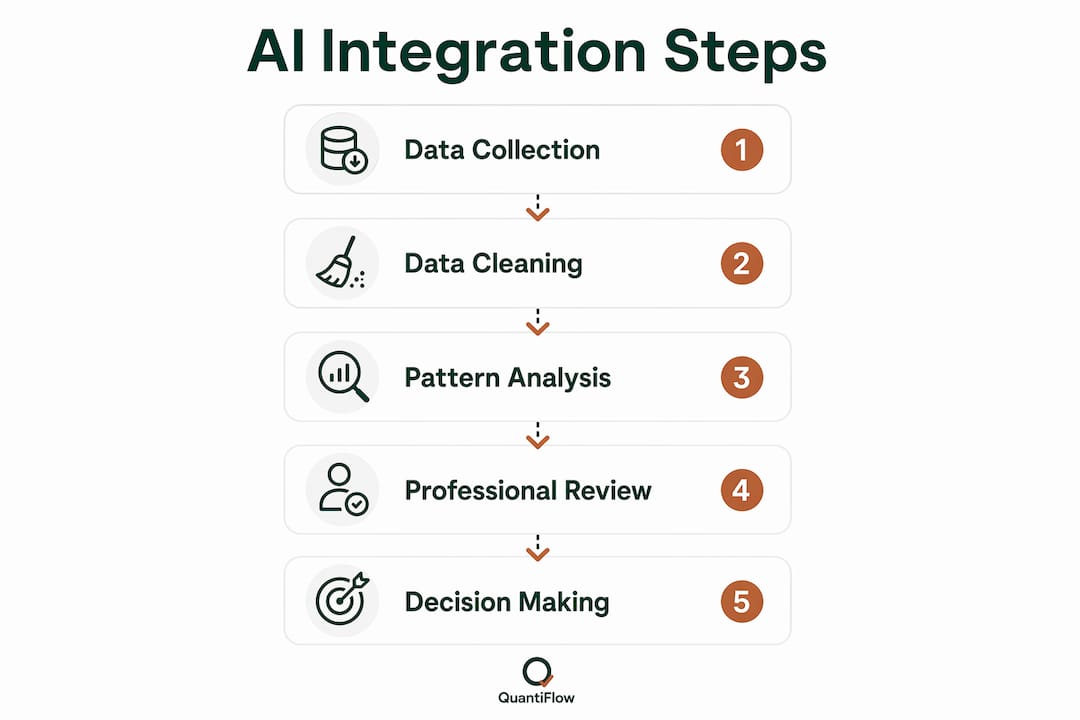
AI's real strength in quantity surveying is handling messy data at scale. It cleans, classifies, and spots patterns in BoQs and cost plans faster than any manual process, which sharpens benchmarking and anomaly detection considerably.

The boundary becomes clear with tender pricing. Research into contractor tendering practice documents two distinct logics at work: first-principles cost estimation and strategic mark-up. AI can support the first. The second, which weighs market positioning, client relationships, and firm-level risk, remains a human exercise. No algorithm decides whether a contractor's pricing strategy is sustainable or likely to cause problems on site.
AI capabilities in practice:
- Pattern recognition across large BoQ datasets
- Automated cross-referencing of drawing sets
- Anomaly flagging in cost plans and procurement schedules
- Document drafting and initial research support
Where human oversight is non-negotiable:
- Verifying and approving all AI-generated outputs before use
- Maintaining auditable logs of AI assessments for professional indemnity compliance
- Disclosing AI involvement to clients where it affects key deliverables
- Protecting client confidentiality by keeping sensitive data out of AI systems
Data hygiene sits at the heart of effective AI use. Poor data quality causes AI tools to propagate errors rather than catch them. Firms that invest in clean, consistently coded datasets get substantially more from AI than those feeding it legacy document formats.
Pro Tip: Build an internal log of every AI assessment, verification step, and approval decision. Leading firms already do this to satisfy professional indemnity requirements under the RICS standard.
AI literacy, including a working understanding of how models handle data and where they fail, is becoming a core competency for QS professionals. Training on agile workflows and data management is now part of staying commercially relevant.
How AI is reshaping decision-making and risk management
AI changes the texture of QS decision-making without changing who is responsible for it. Senior surveyors are shifting from repetitive measurement towards pattern spotting and commercial data strategy, interpreting AI outputs into advice clients can act on.
Interactive dashboards and real-time cost reporting are raising client expectations around transparency. That creates pressure on surveyors to explain their reasoning more clearly, not less. AI generates the data; the surveyor provides the context, the caveats, and the professional opinion. The AI4QS report from Birmingham City University frames this well: AI enhances efficiency and decision-making, but accountability and ethical judgement remain with the professional.
Risk management workflows are changing too. AI can surface cost anomalies and flag programme risks earlier than manual review allows. But assessing whether a risk is acceptable, and advising a client accordingly, still requires the kind of contextual knowledge that comes from years on live projects. For a practical look at how construction workforce strategies are adapting to AI-driven workflows, the picture is consistent: technology handles volume, humans handle judgement.
Where UK quantity surveying is heading with AI
The direction is clear. AI will handle more of the measurement and data processing work, freeing surveyors for higher-value commercial activity. The firms that benefit most will be those that treat data management as a professional discipline, not an administrative task.
The RICS Responsible use of AI standard, published in September 2025, sets mandatory requirements for governance, transparency, and professional oversight. Compliance is not optional. Firms need documented processes for AI use, client disclosure protocols, and clear lines of human accountability. The Nexus Quantity Surveyors AI policy offers a practical model: independent verification of AI outputs, confidentiality protections, and mandatory disclosure to clients where AI influences key deliverables.
Expect AI tools to become more capable at quantity takeoffs and cost benchmarking over the next few years. The surveyors who thrive will be those who use that capability to sharpen their commercial advice, rather than those who treat AI as a replacement for the judgement clients actually pay for.
Quantiflow: AI-powered takeoffs that keep you in control
Quantiflow gives UK quantity surveyors the efficiency of AI without handing over professional control. It automates NRM2-compliant takeoffs directly from architectural drawings, cross-referencing PDF sets to produce structured, priceable BoQ output. The surveyor reviews, adjusts, and signs off. The judgement stays yours.
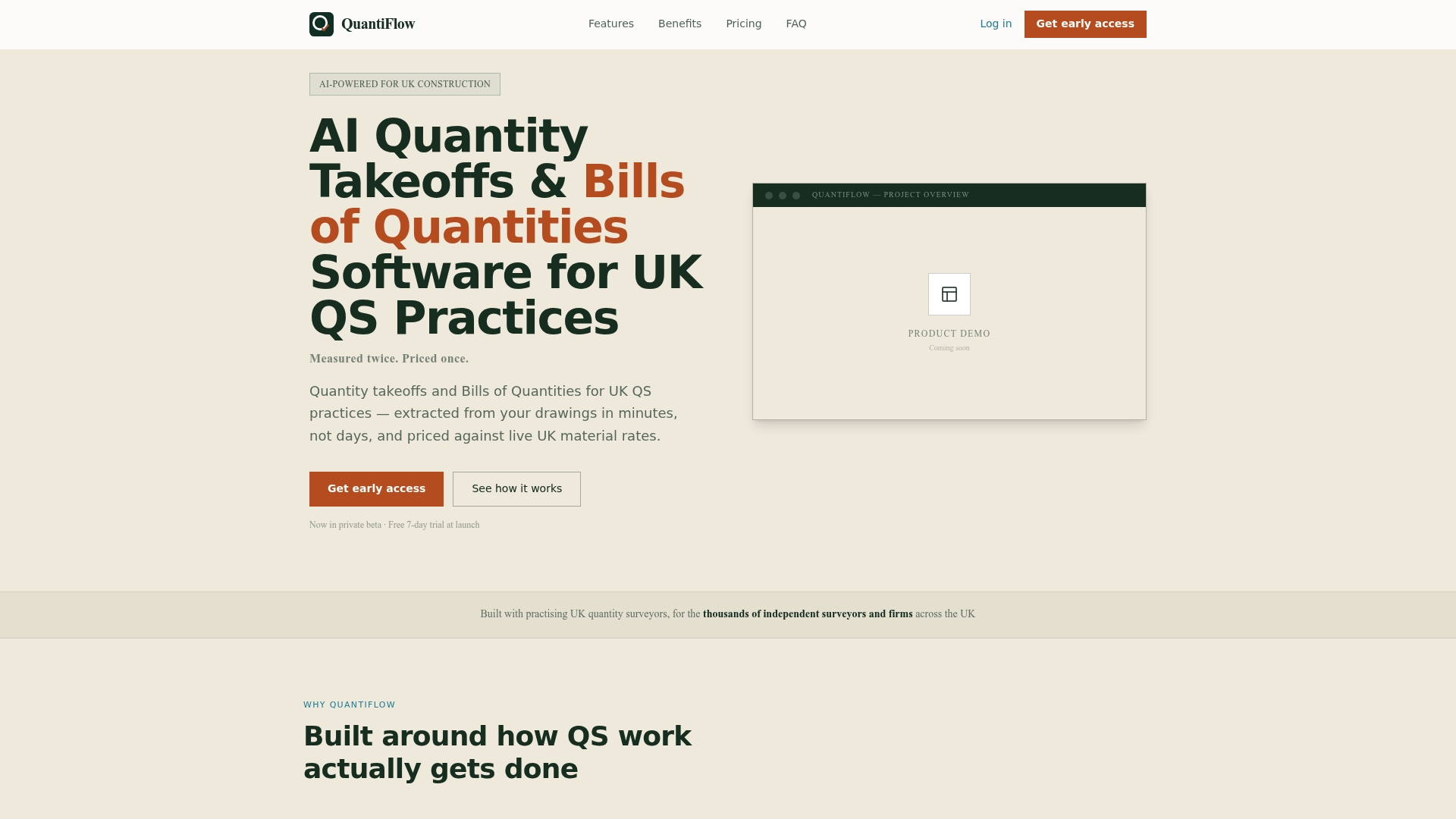
Pricing is straightforward: Solo at £39/month for individual practitioners, Business at £149/month for growing teams, and custom Enterprise for larger firms. Every tier is built around the same principle: accurate, traceable data handling that frees you for the commercial work that matters. Quantiflow's UK-focused guides and resources support surveyors at every stage of AI adoption. Measured twice. Priced once.
Key takeaways
AI augments quantity surveyor professional judgement by automating data-intensive tasks, but legal accountability, ethical decisions, and strategic pricing remain firmly with the surveyor.
| Point | Details |
|---|---|
| AI supports, not replaces | 67% of QS professionals expect AI to add value, but professional judgement stays non-delegable under RICS standards. |
| Data quality determines AI value | Clean, consistently coded datasets are the prerequisite for reliable AI outputs in quantity surveying. |
| Accountability requires audit trails | Firms must log AI assessments and approvals to meet professional indemnity and RICS compliance requirements. |
| Tender pricing stays human | Strategic mark-up decisions involving risk, market position, and client relationships cannot be automated. |
| Quantiflow keeps judgement central | Quantiflow automates NRM2-aligned takeoffs from drawings, freeing surveyors for higher-value commercial decisions. |