
SaaS for quantity surveyors means cloud-hosted software that moves estimating, takeoff, and cost management out of static spreadsheets and into live, browser-accessible environments your whole team can work from simultaneously. The practical payoff is faster BoQ production, fewer transposition errors, and NRM2-aligned outputs that hold up at tender stage. Quantiflow is a concrete UK example: it takes PDF architectural drawings and produces structured, NRM2-classified quantity takeoffs automatically, starting at £39 per month.
Table of Contents
- What SaaS actually means for the QS role
- What types of SaaS tools do quantity surveyors use?
- Why SaaS improves accuracy, speed, and collaboration
- How SaaS differs from on-premises software and spreadsheets
- What features should UK quantity surveyors prioritise?
- How does SaaS pricing work, and what does it cost?
- When should you move from spreadsheets to SaaS?
- Will AI replace quantity surveyors?
- How Quantiflow applies SaaS to quantity surveying
- Key takeaways
- The case for SaaS in UK QS practice is already made
- Quantiflow: NRM2-aligned takeoffs for UK QS firms
- Useful sources
What SaaS actually means for the QS role
SaaS (Software as a Service) replaces locally installed desktop tools and spreadsheet stacks with platforms hosted in the cloud and accessed through a browser. For quantity surveyors, this shift changes the entire data flow of a job.
A typical project moves through four stages in a SaaS environment: drawing import, automated takeoff, NRM2 classification, and BoQ export with live pricing. Each stage feeds the next in real time, so when a drawing revision arrives, the takeoff updates rather than requiring a manual rebuild. RICS commentary highlights that SaaS platforms often act as a common data environment, breaking down silos between office estimators and site teams.
Professional judgement does not disappear in this model. Rate validation, tender strategy, and contract risk assessment remain firmly with the surveyor. What changes is the volume of repetitive measurement work the platform absorbs, freeing you to focus on the interpretive tasks clients actually pay for.
- Drawing import: PDF or BIM file loaded directly into the platform
- Automated takeoff: AI cross-references drawings and extracts quantities
- NRM2 classification: items tagged automatically to the correct work section
- Price library lookup: rates drawn from your firm's historical data or a built-in library
- BoQ export: structured output ready for tender or cost plan
Pro Tip: Keep a version-controlled folder of your original drawing files outside the SaaS platform as well. Cloud platforms handle versioning well, but having a local archive protects you if you ever need to reconstruct a tender audit trail independently.
What types of SaaS tools do quantity surveyors use?
The market has settled into five broad categories, and most platforms combine at least two of them.
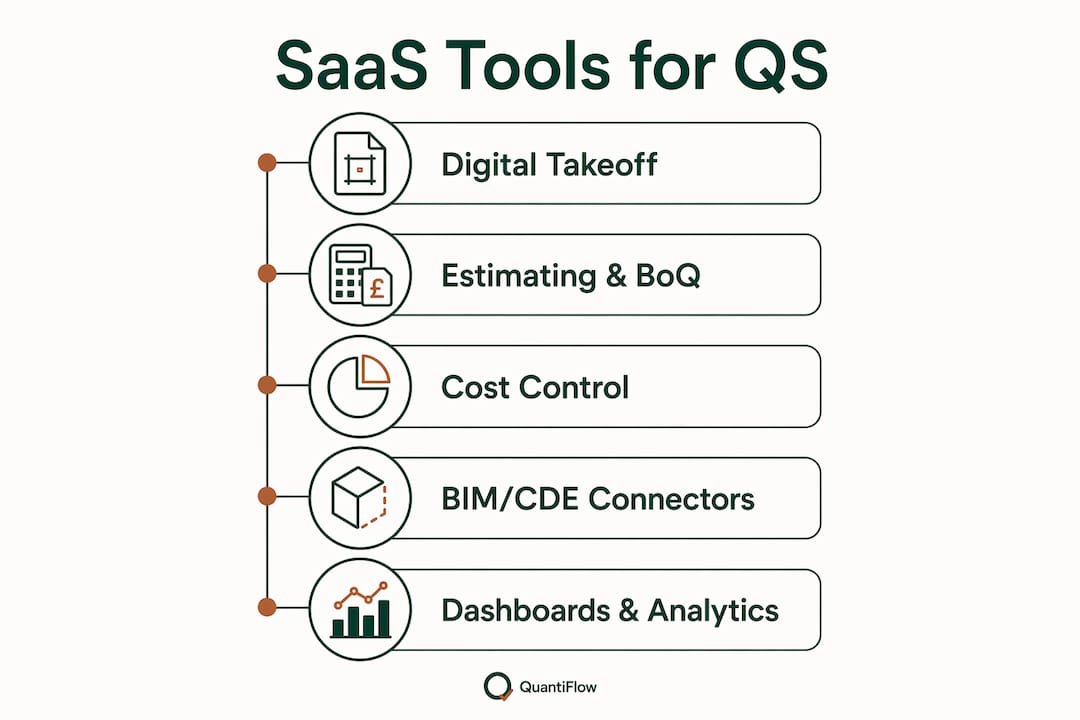
Digital takeoff (2D and 3D) handles measurement directly from plans or model files. On a UK residential scheme, this means uploading floor plans and extracting wall areas, floor finishes, and drainage runs without manual scaling.
Estimating and BoQ generation takes those quantities and produces a priced document. NRM2 alignment is the critical differentiator here: a platform that auto-classifies to the correct work section saves significant rework at tender adjudication.
Cost control and claims management tracks expenditure against budget through the construction phase. Progress claims, variations, and retention calculations sit in one place rather than across multiple spreadsheets.
BIM and CDE connectors pull model-based quantities directly from IFC files or link to platforms such as Autodesk Construction Cloud. This matters increasingly as UK projects move toward ISO 19650 compliance requirements under the Building Safety Act 2022.

Dashboards, analytics, and rate libraries give firms a searchable record of every rate they have ever priced. That compounding knowledge asset is arguably the most underused advantage in the market: pricing from what your firm has actually paid, rather than from a gut feel, changes the quality of every subsequent tender.
Why SaaS improves accuracy, speed, and collaboration
SaaS increases accuracy by centralising data and automating the repetitive measurement tasks most prone to human error. When a single drawing revision previously meant updating five linked spreadsheets, the risk of a missed cell was real. In a SaaS environment, the revision propagates automatically.
The benefits of cloud-based tools for QS professionals include real-time collaboration, automatic updates, and easier integrations with project systems. Concurrent access means a senior QS can review rates while a junior completes the takeoff, without version conflicts.
Only 39% of QS respondents currently use estimating and quantification software together with BIM and a CDE. That gap represents a significant competitive advantage for firms that make the move now.
The business case extends beyond speed. A comprehensive RICS study found strong consensus that data and technology enable QSs to take on more advisory work and improve quantity validation. Firms using software-driven estimating report meaningful accuracy improvements over manual methods, and the audit trail that SaaS platforms generate automatically is increasingly expected by clients and employers.
Key operational benefits:
- Faster takeoff from PDF and BIM sources
- Fewer transposition errors between measurement and pricing
- Concurrent team access without version conflicts
- Automatic update propagation when drawings are revised
- Built-in audit trails for every change
- Integration with BIM and CDE platforms
- Searchable rate libraries that compound in value over time
How SaaS differs from on-premises software and spreadsheets
The fundamental difference is delivery. On-premises software lives on a server your firm manages; SaaS lives on the vendor's infrastructure and is accessed through a browser. That distinction has practical consequences across IT burden, update cadence, and data control.

| Dimension | SaaS | On-premises / spreadsheets |
|---|---|---|
| Updates | Automatic, vendor-managed | Manual installs or manual file maintenance |
| IT overhead | Minimal — no server management | Significant — licences, patches, backups |
| Remote access | Any device, any location | Usually tied to office network or VPN |
| Collaboration | Real-time, concurrent | File-sharing with version risk |
| Data control | Vendor-hosted; check residency | Firm-controlled |
| Upfront cost | Subscription (monthly/annual) | Licence fee plus hardware |
| Offline work | Limited or none | Full offline capability |
Shifting to SaaS removes the in-house update and server maintenance overhead, freeing firms to invest capital in delivery and staff skills rather than infrastructure. The trade-off is that you depend on the vendor's uptime and security posture.
UK governance considerations matter here. Under UK GDPR, you need to confirm where your project data is stored. Reputable UK SaaS vendors store data on UK or EEA servers and provide a Data Processing Agreement. Ask specifically about data residency before signing any contract, and check whether the platform produces an exportable audit trail in a standard format.
What features should UK quantity surveyors prioritise?
NRM2 alignment is non-negotiable. A platform that cannot classify takeoff items to the correct NRM2 work section creates rework at every tender stage and undermines the value of any rate library you build.
Priority features checklist:
- NRM2 classification: automatic tagging to the correct work section
- Takeoff accuracy: AI cross-referencing across multiple drawing sheets
- BIM and IFC import: model-based quantity extraction
- Audit trail: timestamped record of every change, exportable
- Integrations: accounting, ERP, and CDE connectors
- Role-based permissions: control who can edit rates versus view only
- Data residency: UK or EEA storage with a signed DPA
- BoQ export formats: standard formats compatible with your clients' systems
Pro Tip: Watch for these vendor red flags: vague answers about where data is stored, no mention of UK GDPR compliance, and BoQ exports locked to a proprietary format you cannot open elsewhere. A vendor that cannot tell you their data centre location in one sentence is not ready for professional practice.
How does SaaS pricing work, and what does it cost?
Most QS SaaS platforms use one of three models: per-user subscription, per-project seat, or tiered plans that bundle features at increasing price points. Per-user pricing suits growing teams; per-project pricing suits firms with variable workloads.
Quantiflow publishes transparent tiered pricing, which is itself a useful benchmark for what the UK market currently charges for AI-assisted takeoff:
| Plan | Price | Best for |
|---|---|---|
| Solo | £39/month | Individual QSs and sole practitioners |
| Business | £149/month | SME QS firms and small teams |
| Enterprise | Custom | Larger practices with bespoke requirements |
Beyond the headline subscription, budget for:
- Data migration: cleaning and importing legacy rate libraries takes time
- Training: plan for at least one structured session per user group
- Integrations: connecting to your accounting or ERP system may carry a setup fee
- Premium support: some vendors charge extra for priority response times
Annual billing typically reduces the monthly equivalent price, so it is worth asking vendors for an annual quote even if you intend to start monthly.
When should you move from spreadsheets to SaaS?
Pilot SaaS when you have recurring project types, repetitive pricing tasks, and collaboration friction that a subscription cost can clearly justify. A single complex residential scheme with multiple subcontract packages is usually enough to demonstrate ROI within the first month.
Migration checklist:
- Audit your current data — identify which rate libraries, BoQ templates, and drawing archives are worth importing
- Pilot on one live job — choose a small, real project rather than a test scenario
- Build or import your rate library — this is the highest-value asset; protect it
- Train key users — focus on the two or three people who will use the platform daily
- Integrate with existing systems — connect your accounting or project management tools
- Review governance — confirm data residency, permissions, and audit trail settings before going live at scale
The RICS study on data and technology identifies resistance to change and the effort of cleaning legacy data as the two most significant non-technical barriers. Both are real, and both are manageable when the pilot is scoped tightly.
Pro Tip: Before you migrate, export your entire rate library from your current system in a standard format. That library represents years of firm knowledge. Losing it in a migration is the single most avoidable mistake in SaaS adoption.
Will AI replace quantity surveyors?
No. AI will automate routine measurement and data processing tasks, but it will increase demand for the interpretive, advisory skills that define the QS role at its most valuable. Industry analysis consistently concludes that professional judgement in contract strategy, risk assessment, and dispute resolution cannot be replicated by current AI systems.
What AI does change is the task mix. Expect to spend less time on manual measurement and more time on:
- Rate validation and anomaly detection
- Contract risk and procurement strategy
- Client advisory and benchmarking
- Model validation and BIM coordination
Two practical recommendations for QSs preparing for this shift:
- Invest in data hygiene now. A well-structured, NRM2-classified rate library built from your own past tenders becomes more valuable as AI tools improve, because it gives the AI accurate, firm-specific data to work from.
- Upskill for advisory and validation work. The QSs who thrive will be those who can interpret AI-generated outputs critically, not just accept them.
How Quantiflow applies SaaS to quantity surveying
Quantiflow is a UK-built SaaS platform that automates NRM2-aligned quantity takeoffs from architectural drawings, targeting SME QS firms, builders, and architects. Its AI cross-references drawing sheets, extracts quantities, and classifies them to NRM2 automatically, producing a structured BoQ ready for pricing.
Core capabilities include AI-assisted takeoff from PDF drawings, NRM2 classification, a searchable rate library, and BoQ exports in standard formats. Data is stored in the UK, and the platform is built to UK GDPR requirements. For SME QS practices where a single surveyor may be managing multiple live jobs simultaneously, the time saving on measurement alone justifies the subscription.
| Plan | Monthly price | Suited to |
|---|---|---|
| Solo | £39 | Individual practitioners |
| Business | £149 | SME teams |
| Enterprise | Custom | Larger practices |
Quantiflow's positioning is deliberately straightforward: measured twice, priced once. You can request a demo or start a trial directly at quantiflow.co.uk.
Key takeaways
SaaS for quantity surveyors means cloud-hosted platforms that automate measurement, enforce NRM2 classification, and give teams a single, auditable source of project data.
| Point | Details |
|---|---|
| SaaS definition | Cloud-hosted tools that move takeoff, estimating, and cost management into live, collaborative environments. |
| NRM2 alignment | Non-negotiable for UK practice; auto-classification reduces rework at every tender stage. |
| Adoption trigger | Pilot when recurring projects and collaboration pain outweigh the subscription cost — one live job is enough to test. |
| Pricing reality | UK AI-assisted takeoff starts at £39/month (Quantiflow Solo); budget separately for migration, training, and integrations. |
| Quantiflow | UK-built, NRM2-aligned SaaS for SME QS firms, builders, and architects — with transparent tiered pricing and UK data residency. |
The case for SaaS in UK QS practice is already made
The profession's hesitation around SaaS is understandable. QS work is built on precision and professional accountability, and handing measurement to a cloud platform feels like a risk. But the risk calculus has shifted. The real exposure now is in the firms still rebuilding the same spreadsheet templates on every job, losing rate data when a senior surveyor leaves, and spending three days on a takeoff that a well-configured platform could complete in three hours.
SaaS does not replace professional judgement. It removes the low-value work that crowds it out. The RICS data showing only 39% of QSs using estimating software alongside BIM and a CDE is not a sign that the technology is unproven. It is a sign that most firms have not yet captured the advantage.
The change management challenge is real. Resistance to new tools, the effort of cleaning legacy data, and the short-term disruption of a pilot are all genuine costs. But the firms that pilot on a single live job, build their rate library properly, and train two or three key users tend to find that the ROI is visible within the first month. The compounding value of a searchable, NRM2-classified rate library built from your own past tenders is the part most guides understate. That library does not just save time on the next job. It changes the quality of every pricing decision the firm makes from that point forward.
Quantiflow: NRM2-aligned takeoffs for UK QS firms
If you are spending more time measuring than advising, Quantiflow gives you that time back. It turns PDF architectural drawings into structured, NRM2-classified BoQ output automatically, so you can focus on rate validation, procurement strategy, and the advisory work that actually differentiates your practice.
Pricing starts at £39/month for individual practitioners, with the Business plan at £149/month covering SME teams. Data is stored in the UK, the platform is built to UK GDPR requirements, and BoQ exports work with standard formats your clients already use. There is no long-term contract on entry-level plans.
See the full feature set and start a trial at Quantiflow to measure your next job faster.
Useful sources
These are the primary references worth reading alongside this article:
- RICS: Data and technology in quantity surveying and cost management — the most comprehensive profession-wide study on digital adoption, advisory role expansion, and adoption barriers. The 39% BIM/CDE figure cited above comes from this report.
- RICS — the authoritative source for NRM2 guidance and professional standards in UK quantity surveying.
- Building Safety Act 2022 — the legislative context for ISO 19650 and CDE requirements on UK projects.
- Quantiflow blog: quantity surveying software benefits — a practical UK-focused guide to how SaaS platforms improve accuracy and workflow for practising QSs.
- Will AI replace quantity surveyors? — a measured assessment of AI's likely impact on the QS role and the skills that will matter most.