
Project pricing is the process of calculating every cost involved in a build — materials, labour, overheads, and profit — to produce a bid that is both competitive and financially sound. UK builders face 3–5% annual cost increases in construction, which means a rough estimate is no longer good enough. A disciplined approach to cost estimation is the difference between a profitable contract and a loss-making one. This guide covers the core components, the most common mistakes, and how technology is changing the way builders estimate work in 2026.
What are the essential components builders consider to price a project?
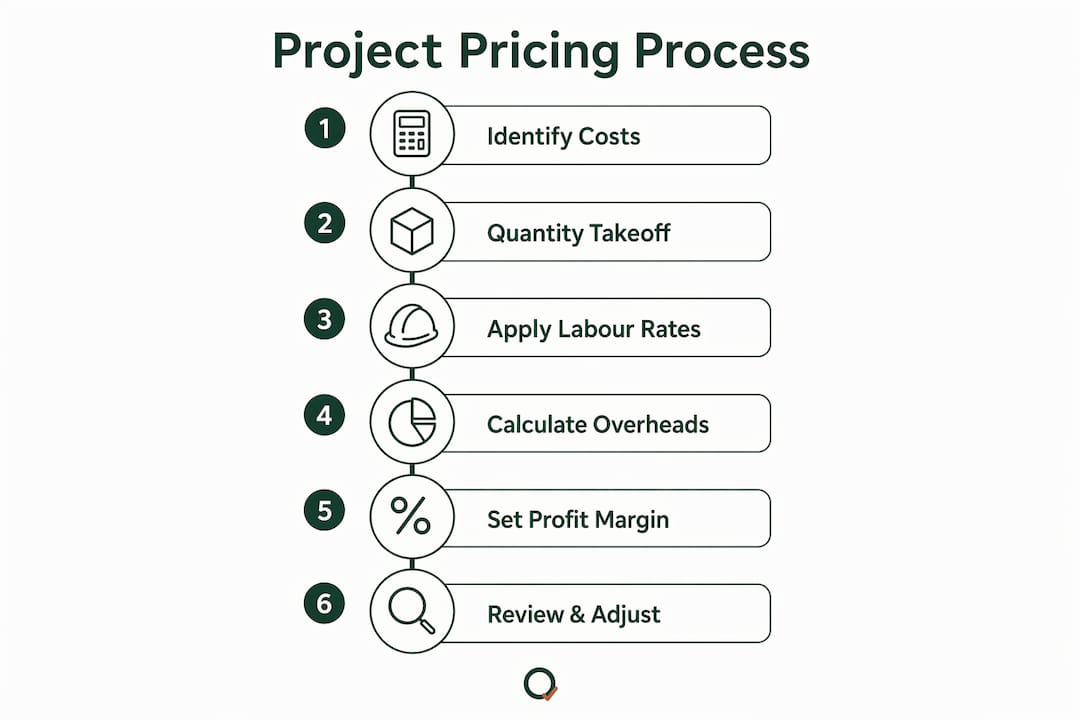
Accurate project pricing starts with understanding every cost category. Miss one, and the margin disappears before the job is finished.
Material costs are the most visible element. Builders source prices directly from suppliers, cross-reference internal databases, and check published benchmarks. Prices must reflect current market rates, not last year's quotes. A £10 per cubic metre underestimate on concrete across 100m³ of pour produces a £1,000 direct loss before a single other error is made.

Labour costs require more than a base hourly rate. The correct figure is the fully burdened rate, which adds 30–45% on top of base wages to cover National Insurance, pension contributions, public liability insurance, and holiday pay. A £35/hour base wage translates to a fully burdened rate of £48–£51 per hour. Using the base rate alone means you are subsidising every hour worked.
Overhead recovery is where many builders go wrong. Fixed monthly costs — office rent, vehicle leases, software subscriptions, accountancy fees — must be distributed across every active project. The method is straightforward: divide total monthly overheads by the number of billable project days, then apply that figure per project. Without this calculation, builders unknowingly subsidise their projects, eroding profitability with every contract they win.
Profit margin is not the same as markup, and confusing the two is one of the most expensive mistakes a builder can make. A 20% markup on costs does not produce a 20% profit margin. The margin and markup distinction matters because margin is calculated as a percentage of the selling price, while markup is calculated as a percentage of cost. Applying the wrong formula consistently underprices every job.
Contingencies and allowances complete the picture. A standard contingency of 5–10% covers unforeseen ground conditions, weather delays, and scope changes. Allowances cover specified but unquantified items, such as provisional sums for client-selected finishes. Both must appear as explicit line items, not mental estimates.
How do builders estimate project costs accurately?
The formal process for translating drawings into priced quantities is called a quantity takeoff. A quantity surveyor or estimator measures every element from architectural drawings — walls, floors, roofing, drainage — and assigns a cost to each measured unit. The output is a Bill of Quantities (BoQ), structured to NRM2 standards in the UK, which gives both the builder and the client a transparent cost breakdown.
Accuracy depends heavily on the quality of the underlying data. Generic unit rates from published price books give a starting point, but internal historical data is far more reliable. Your own records of what a square metre of blockwork actually cost on the last three jobs, including waste, fixing time, and supervision, reflects your true performance. External benchmarks reflect an average that may not match your supply chain, your workforce, or your region.
Sanity checks are a standard part of the estimating process. Comparing the total estimated cost against a cost-per-square-foot figure from similar completed projects quickly reveals scope gaps or quantity errors. A significant deviation from historical norms is a signal to review the takeoff before submission, not after the contract is signed.
Pro Tip: Build a simple cost-per-m² database from every completed project, broken down by build type. After ten projects, you have a sanity-check tool that no published price book can match.
Technology is accelerating this process. AI-powered estimating calibrated to internal historical cost data can cut bid cycles from three weeks to 72 hours and improve estimate accuracy by 15%. That speed allows builders to pursue more bids without increasing headcount. The key word is "calibrated." AI tools that draw only on generic data reproduce the same inaccuracies as a price book. Tools trained on your own job records produce estimates that reflect your actual costs.
| Estimation method | Speed | Accuracy driver | Best suited to |
|---|---|---|---|
| Manual takeoff with price book | Slow | Published benchmarks | One-off or unfamiliar project types |
| Spreadsheet with internal rates | Moderate | Historical job data | Repeat build types |
| AI-assisted takeoff with BoQ output | Fast | Internal data plus AI cross-referencing | High-volume bidding, SME builders |
What common pricing mistakes should builders avoid?
The most damaging pricing errors are not random. They follow a pattern, and recognising them is the first step to avoiding them.
- Underestimating material costs. With UK construction costs rising annually, quotes obtained at tender stage can be out of date by the time work starts. Always build in a material price escalation clause for projects with a start date more than eight weeks away.
- Using base labour rates instead of burdened rates. Every hour priced at £35 instead of £50 is a hidden subsidy to the client. Recalculate your burdened rate at least once a year as employer costs change.
- Omitting overhead recovery. Fixed costs exist whether a project runs or not. Failing to recover them per job means profitable-looking contracts are quietly destroying the business.
- Confusing markup with margin. A 20% markup does not equal a 20% profit margin. Apply the correct formula: margin equals profit divided by selling price, not profit divided by cost.
- Ignoring scope creep. Variations agreed verbally and not priced formally are a primary cause of margin erosion. Every change to scope needs a written variation order with a revised cost.
"Small construction firms often underprice jobs due to rudimentary financial management and lack of accurate cost systems. This causes margin leakage and reactive financial strategies." — Grant Thornton
The typical net profit margin for a general contractor sits at 5–6%, with top performers reaching 10–12%. A 3% estimating miss on a £20 million project produces a £600,000 loss. On smaller projects, the proportional damage is identical. There is no margin of safety in construction pricing that absorbs repeated estimating errors.
How can technology and financial discipline improve pricing strategies?
Treating estimating as a financial management discipline rather than a sales activity is the single biggest shift a builder can make. The most accurate cost systems integrate estimating software with accounting and project management tools, so that actual costs feed back into future estimates automatically.
The practical steps that separate high-margin builders from the rest include:
- Real-time cost tracking. Timesheets, purchase orders, and delivery notes captured during the project create a live picture of cost versus budget. Waiting for the final account to discover a loss is too late.
- Monthly budget reviews. Top contractors review budget versus actual monthly and use the findings to adjust pricing on live bids. This feedback loop is the most reliable way to improve estimate accuracy over time.
- Post-project analysis. Every completed project is a data point. Comparing the priced BoQ against the final cost statement reveals which cost categories were consistently over or under. That analysis directly improves the next bid.
- AI integration. AI estimating paired with historical job data allows firms to increase bid volume without raising headcount. The efficiency gain is real, but only when the AI is trained on internal records rather than generic price data.
Pro Tip: Set a rule that no bid leaves the office without a post-estimate review by someone who was not involved in building it. A fresh pair of eyes catches scope gaps that the estimator has become blind to.
For solo builders managing multiple projects simultaneously, the quantity surveying software benefits extend beyond speed. Structured BoQ output means each project has a consistent cost framework, making it far easier to track performance across a portfolio rather than managing each job in isolation. Architects working alongside builders also play a role: detailed, well-structured drawings reduce ambiguity in the takeoff and directly reduce the risk of pricing errors. Builders who engage early with their design team on cost tools for architects produce more accurate tenders as a result.
Key takeaways
Accurate project pricing requires burdened labour rates, explicit overhead recovery, correct margin calculations, and a feedback loop from completed projects back into future estimates.
| Point | Details |
|---|---|
| Use fully burdened labour rates | Add 30–45% to base wages to cover taxes, insurance, and benefits before pricing any job. |
| Recover overheads explicitly | Apportion fixed monthly costs across every active project or you subsidise each contract. |
| Distinguish margin from markup | A 20% markup does not equal a 20% profit margin; apply the correct formula to every bid. |
| Run post-project cost analysis | Compare final costs against the priced BoQ after every job to improve future estimate accuracy. |
| Use AI calibrated to your own data | Generic AI tools reproduce generic errors; train estimating tools on your internal job records. |
The uncomfortable truth about builder pricing in 2026
Most builders I speak with know their trade inside out. They can read a set of drawings, manage a subcontractor, and solve a site problem before breakfast. Where the business bleeds is in the office, not on the site.
The overhead recovery calculation is the clearest example. Builders who do not explicitly calculate and charge overhead recovery are not breaking even on those costs. They are funding their own business from project revenue without realising it. The fix takes an afternoon: list every fixed monthly cost, divide by billable project days, and apply that figure to every tender. That one change can add several percentage points of margin to every job won.
The markup versus margin confusion is equally damaging and equally fixable. I have seen experienced contractors price a job at a 20% markup, believe they are making a 20% return, and then wonder why the bank account does not reflect it. The maths is not complicated once you understand the distinction. The problem is that nobody taught it, and the industry has not historically demanded it.
Technology adoption is accelerating, and builders who resist it are not protecting their craft. They are protecting a slower, less accurate process. AI-assisted takeoffs, when paired with cost reporting from measured quantities, give builders a financial picture that was previously available only to large contractors with dedicated quantity surveying teams. The playing field is levelling, but only for those who choose to use the tools available.
The builders who will thrive in 2026 are not necessarily the best tradespeople. They are the ones who treat every estimate as a financial document, every completed project as a lesson, and every variation as a billable event.
— Michael
Quantiflow: AI quantity takeoffs built for UK builders
Pricing a project accurately starts with a measured, structured takeoff. Quantiflow automates NRM2-aligned quantity takeoffs and Bills of Quantities directly from architectural drawings, using AI to cross-reference plans and produce traceable, priceable BoQ output.

The platform is built for SME builders, quantity surveyors, and architects who need to price work faster without sacrificing accuracy. Quantiflow preserves professional judgement rather than replacing it, so every figure in the output is reviewable and defensible. Plans start from £39/month for solo builders through to £149/month for business teams. Explore AI quantity takeoffs from Quantiflow and see how faster, more accurate pricing can protect your margins on every project you bid.
FAQ
What does it mean to price a project as a builder?
Pricing a project means calculating the total cost of materials, labour, overheads, and profit to produce a bid that covers all expenses and delivers a return. The process is formally known as cost estimation and typically produces a Bill of Quantities.
Why do builders lose money on projects?
The most common causes are underestimated material costs, base labour rates used instead of fully burdened rates, missing overhead recovery, and confusing markup with profit margin. UK construction costs rising by 3–5% annually compounds every estimating error.
What is the difference between markup and profit margin?
Markup is calculated as a percentage of cost; margin is calculated as a percentage of the selling price. A 20% markup does not equal a 20% profit margin, and applying the wrong formula consistently underprices every job.
How does AI help builders price projects more accurately?
AI-powered estimating calibrated to internal historical data can cut bid cycles to 72 hours and improve estimate accuracy by 15%, allowing builders to bid on more work without increasing staff.
What is a quantity takeoff and why does it matter?
A quantity takeoff is the process of measuring every element of a build from drawings and assigning a unit cost to each item. It produces a Bill of Quantities that gives both builder and client a transparent, auditable cost breakdown before work begins.