
Construction cost transparency is the condition where every stakeholder on a project can see, at any point, the current plan-versus-actual cost position, all committed future expenditure, and the traceable origin of every unit rate. It is not simply reporting totals. As Onetribe Advisory notes, transparency means the ability to see, understand, and explain cost behaviour — a distinction that changes how you build reports and which KPIs you track.
Three data elements make transparency real on a live project:
- Plan vs actual at line-item level — not just overall budget vs spend, but variance traceable to each work section or cost code.
- Committed future costs — subcontract orders placed, materials on order, and anticipated variations not yet instructed.
- Traceable unit rates — every rate linked to its labour, material, and plant source, not a national average with a location factor bolted on.
Achieving this requires alignment with ICMS 2 for life-cycle cost reporting and NRM2 for UK quantity takeoffs, and it is most reliably enforced through open-book or Guaranteed Maximum Price (GMP) procurement models that give owners audit rights over cost data.
Table of Contents
- Why cost transparency matters for QS, builders, and architects
- Which standards and procurement models define transparent cost reporting in the UK
- Where transparency breaks down and the KPIs that reveal it
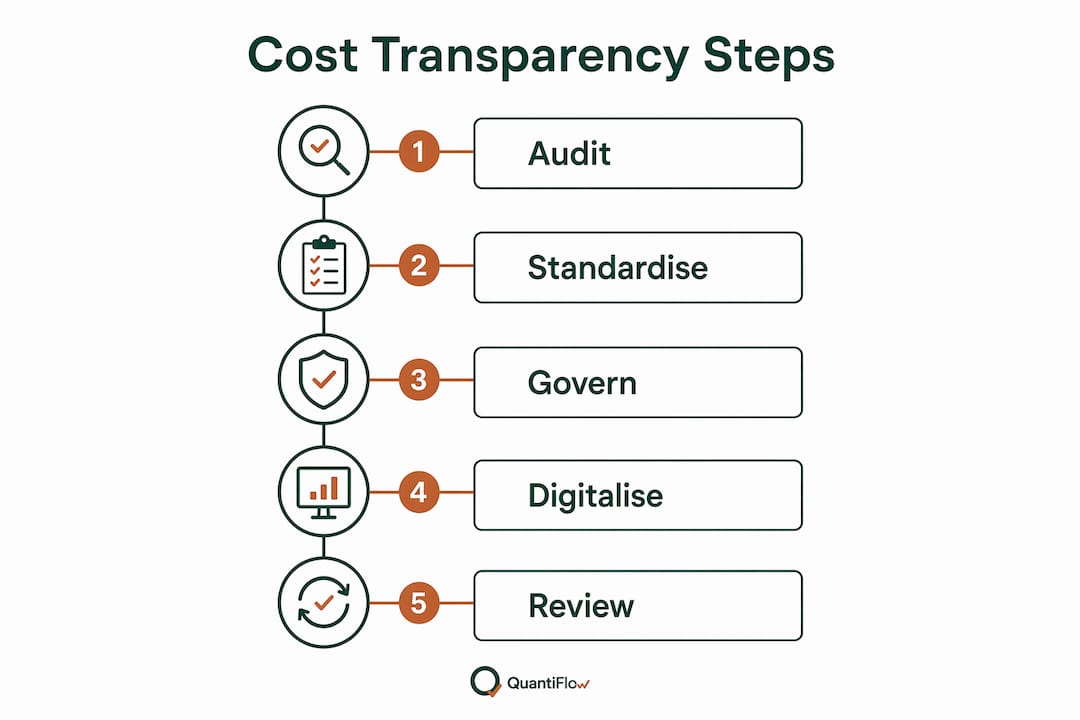
- How to improve cost transparency: audit, standardise, govern, and digitalise
- How digital tools and AI-enabled takeoffs deliver transparency
- Contractual levers and procurement practices that enforce transparency
- Operational red flags that show transparency is weak or being gamed
- How to assess software vendors objectively
- Key takeaways
- Why transparency is the foundation, not the feature
- Quantiflow accelerates your transparency workstream
- Useful sources and further reading
Why cost transparency matters for QS, builders, and architects
The practical benefits split neatly by role, but the underlying driver is the same: earlier, better-quality information reduces the cost of decisions.
- Quantity surveyors gain defensible cost advice. When every rate is traceable, client challenges become conversations about scope, not credibility.
- Builders protect cashflow. Transparent committed-order tracking prevents the late-invoice surprises that compress margins on fixed-price contracts.
- Architects make better design trade-offs. Seeing the cost impact of a specification change in real time, rather than at the next cost report, keeps value engineering productive rather than reactive.
Across all three roles, transparent data shortens change-order cycles, reduces disputes, and makes forensic analysis of overruns straightforward rather than adversarial.
Pro Tip: Start with your top ten cost lines. Mapping plan-versus-actual on those alone, before touching the rest of the BoQ, gives you a quick win that builds organisational buy-in for the wider programme.

Which standards and procurement models define transparent cost reporting in the UK
Three frameworks set the benchmark for what "transparent" actually means in a UK context.
- ICMS 2 standardises construction cost reporting and life-cycle cost recording to enable cross-jurisdictional comparison and better investment analysis. For portfolio owners and public-sector clients, it is the reference point for comparing projects across programmes and geographies.
- NRM2 (RICS New Rules of Measurement, Part 2) structures the BoQ in a way that preserves the calculation hierarchy from takeoff through to final account. A properly structured NRM2 BoQ is itself a transparency instrument: every measured item carries its own rate, quantity, and elemental reference.
- Open-book procurement and GMP require the contractor to give the owner access to cost records sufficient to determine whether the agreed maximum price is fair and reasonable. Under open-book arrangements, direct costs plus markups for indirect costs and profit are disclosed separately, which means the owner can audit fee levels independently of production costs.
Together, these frameworks create the legal and operational conditions under which transparency can be enforced, not just requested.
Where transparency breaks down and the KPIs that reveal it
Most transparency failures trace back to a broken data chain: Excel files, paper site diaries, and accounting systems that never reconcile. The result is multiple versions of the cost position, none of which anyone fully trusts.
| Blind spot | KPI that detects it |
|---|---|
| Spreadsheet-to-finance manual transfer | Reconciliation error rate (£ variance per period) |
| Late change-order detection | Median days from instruction to cost-model update |
| Inconsistent cost codes across packages | % of cost lines with a valid NRM2 reference |
| Committed orders not tracked | Committed-order backlog as % of remaining contract value |
| National average rates masking local risk | % of rates with a traceable local source |
A quick checklist for a running project:
- Can you produce a committed-order backlog report today, without manual assembly?
- Does every variation have a cost-model entry within five working days of instruction?
- Are your cost codes consistent between the BoQ, site diary, and finance system?
- Do your unit rates reference labour, material, and plant separately, or are they composite averages?
If any answer is no, you have a transparency gap. Using construction cost benchmarking methods to audit your current position is the fastest way to quantify how large that gap is.
How to improve cost transparency: audit, standardise, govern, and digitalise
A five-step roadmap works well for mid-market firms, and the first two steps require no new technology at all.
- Rapid audit (Week 1–2): Map every billing source, allocation rule, and report. Identify where the data chain breaks. Set SMART goals for each gap — specific, measurable, achievable, relevant, and time-bound.
- Standardise cost codes (Week 3–4): Align your calculation structure to NRM2. Every cost line needs a consistent reference that travels from takeoff through tender to final account.
- Establish governance (Month 2): Assign data owners for each cost stream. Set a weekly reporting cadence. Define the minimum deliverable: a plan-vs-actual summary, a committed-order log, and a change-order register.
- Incremental technology adoption (Month 2–3): Digitise site diaries and claims first — this is where early value is most visible and buy-in is easiest to secure. Add calculation and tender tools next, then controlling and ERP integration.
- Review and scale (Month 4 onwards): Measure against your SMART goals. Adjust KPI thresholds as the data matures.
For an SME practice, the audit and standardisation steps typically take four to six weeks with existing staff. The governance cadence adds roughly half a day per week per project.
Pro Tip: Sequence your implementation to show early value. Site diary and claims management delivers measurable results within weeks; calculation and controlling tools take longer to embed. Show the wins early and the wider programme funds itself.
How digital tools and AI-enabled takeoffs deliver transparency
Software changes the transparency equation by creating a shared data basis that eliminates manual transfer overhead. Integrated architectures built from four pillars — calculation, tendering, controlling, and contract/claim management — are the practical route to a continuous, unbroken data chain.
AI-enabled quantity takeoffs reduce manual errors and maintain NRM2 structure from the first measurement through to the priced BoQ. Quantiflow automates NRM2-aligned takeoffs directly from PDF drawings, cross-referencing architectural plans to produce structured, priceable BoQ output. The quantity surveyor's judgement stays in the loop; the platform removes the transcription errors and formatting inconsistencies that typically break the data chain between takeoff and tender. For architects, this means quantity calculations are traceable to the drawing revision that generated them.
A short vendor security and compliance checklist:
- Data export: Can you export the full BoQ in a standard format (CSV, GAEB, IFC-compatible) at any time?
- Audit trail: Does the system log every change to a rate or quantity, with a timestamp and user reference?
- Role-based access: Can you restrict rate visibility to authorised users while sharing quantities with subcontractors?
- Data residency: Is project data stored on UK or EEA servers?
Pro Tip: Ask any vendor for a sample audit trail export before you commit. If they cannot produce one in the demo, the feature either does not exist or is not reliable enough to use in a dispute.
Contractual levers and procurement practices that enforce transparency
Transparency written into a contract is enforceable; transparency assumed is not. Open-book and GMP arrangements give owners the right to inspect cost records, but only if the contract specifies what records must be kept and when they must be produced.
Practical clauses and documentation to include:
- Audit schedule: Define the frequency and scope of owner cost audits (monthly is standard on GMP contracts).
- Evidence requirements: Specify that subcontract orders, supplier invoices, and site diary records must be retained and made available within a defined period.
- Schedule of committed orders: Require the contractor to submit an updated committed-order log with each interim application.
- Change-order documentation: Require a cost breakdown for every variation instruction before work proceeds, not retrospectively.
Public-sector clients in the UK are increasingly required to follow Construction Playbook principles, which embed many of these requirements by default. Private clients benefit from the same documentation discipline, particularly on projects where the final account is likely to be contested.
Understanding how BoQs are used in contracts gives you a practical foundation for drafting these clauses accurately.
Operational red flags that show transparency is weak or being gamed
These signals are worth checking on any project where the cost position feels uncertain.
- Unexplained invoice back-dating: Check whether invoice dates cluster just before period-end. A pattern suggests costs are being allocated to close out budget lines rather than reported when incurred.
- Late site diary submissions: If diaries arrive more than 48 hours after the event, the contemporaneous record is compromised. Run a simple log: date of event vs date of submission.
- Frequent small change orders that aggregate: Individual orders below the variation threshold can accumulate to a material sum. Total all variations below £5,000 for the last three months and compare against the contingency draw-down.
- Inability to produce a committed-order backlog: If the project team cannot produce this report within 24 hours, the data chain is broken. Request it immediately and note the response time.
For any of these findings, the immediate remedial step is the same: establish a written record of the gap, set a deadline for correction, and escalate to the contract administrator if it persists beyond one reporting cycle.
How to assess software vendors objectively
Use this checklist before committing to any platform.
- NRM2 and ICMS 2 alignment — does the system structure cost data to match these standards natively, or does it require manual mapping?
- BoQ export formats — CSV, GAEB, and IFC-compatible exports as standard, not add-ons.
- Audit trail — every rate and quantity change logged with user, timestamp, and previous value.
- Integration options — can it connect to your accounting or ERP system without a bespoke build?
- Onboarding time — ask for a realistic estimate for a two-to-five person SME practice; anything over eight weeks for a core implementation is a risk.
- Licensing model — per-user monthly subscription is the most cost-predictable for SMEs; watch for minimum seat commitments that inflate the effective cost.
Scorecard fields to complete for each shortlisted vendor:
- Functional fit (1–5): does it cover calculation, tendering, controlling, and claims?
- Data security (1–5): UK/EEA data residency, role-based access, audit trail.
- Implementability (1–5): onboarding support, training, local market cost data.
- Total cost of ownership: licence fee plus implementation plus annual support.
- Estimated payback period: based on time saved per BoQ and reduction in dispute costs.
Due diligence minimum: request two references from UK practices of similar size, ask for a paid pilot on a live project, and validate local cost data sources against your own market knowledge before going live.
Key takeaways
Construction cost transparency requires a continuous, unbroken data chain from takeoff to final account, governed by NRM2 and ICMS 2 standards and enforced through open-book or GMP contractual arrangements.
| Point | Details |
|---|---|
| Define your baseline | Audit every billing source and cost code before investing in new tools. |
| Fix the data chain | Align cost codes to NRM2 across takeoff, tender, and finance to eliminate reconciliation errors. |
| Set governance early | Assign data owners, set a weekly reporting cadence, and track committed-order backlog as a minimum KPI. |
| Sequence technology adoption | Start with site diaries and claims; add calculation and controlling tools once governance is stable. |
| Quantiflow for NRM2 takeoffs | Quantiflow automates NRM2-aligned BoQ generation from PDF drawings, from £39/month for solo practitioners. |
Why transparency is the foundation, not the feature
Most conversations about cost transparency in construction focus on the tools. The audit trail, the dashboard, the integrated BoQ export. Those things matter, but they are downstream of a more fundamental question: does your organisation actually want to know where the money is going?
The firms that get the most from transparency programmes are not necessarily the ones with the most sophisticated software. They are the ones that have made a deliberate decision to treat cost data as a shared asset rather than a negotiating position. That shift changes how site diaries get written, how change orders get priced, and how subcontract orders get committed. The technology then has something real to work with.
What I find underestimated is the governance step. Practitioners invest in calculation tools and dashboards, then discover that the data feeding those tools is still inconsistent because nobody owns the cost codes. The audit and standardisation work that precedes technology adoption is unglamorous, but it is where transparency is actually built. A well-structured NRM2 BoQ, consistently maintained, does more for cost certainty than any dashboard built on inconsistent source data.
Quantiflow accelerates your transparency workstream
Correcting a broken data chain takes time. Quantiflow compresses the most labour-intensive part of that process: getting from PDF drawings to a structured, NRM2-aligned BoQ without the transcription errors that typically break the cost chain at source.
The platform automates quantity takeoffs, cross-references architectural drawings, and produces priceable BoQ output that preserves the QS's professional judgement at every stage. Pricing starts at £39/month for the Solo plan, £149/month for Business, and custom Enterprise pricing for larger practices. Most SME practices are producing live BoQs within their first week.
If you are starting a transparency audit or preparing for an open-book tender, request a demo at Quantiflow and see how quickly a structured takeoff can replace a spreadsheet-based process.
Useful sources and further reading
- RICS ICMS 2 — the authoritative standard for international construction cost reporting and life-cycle cost comparability. Consult first when setting up cross-project benchmarking or public-sector reporting.
- National Academies — Open-book procurement, Chapter 9 — detailed guidance on GMP fairness tests and owner audit rights. Use when drafting open-book contract clauses.
- National Academies — Open-book pricing practices, Chapter 7 — explains how direct costs and markups are disclosed under open-book arrangements. Useful for understanding fee negotiation mechanics.
- Onetribe Advisory — Cost transparency for mid-market companies — practical five-step roadmap for classification, reporting redesign, and governance. Start here for the audit and standardisation phases.
- GAIM Solutions — Cost transparency in construction projects — covers integrated software architecture (the four pillars) and implementation sequencing for mid-market firms. Use for technology selection and payback logic.
- 4BT — Construction cost transparency is not optional — argues for granular, locally researched cost data over national averages. Relevant when validating vendor cost data sources.