
A subcontractor quotation is a legally binding document that commits a subcontractor to a defined scope of work at a fixed price and within agreed terms. Unlike a proposal, which is a sales-oriented document running to ten or more pages, a quotation is typically 1–5 pages and carries contractual weight the moment a client accepts it. For UK construction professionals, understanding what a subcontractor quotation contains, how it differs from a bid or a price proposal, and how to manage it effectively is not optional. Errors at the quotation stage feed directly into cost overruns, disputed change orders, and delayed programmes.
What is a subcontractor quotation in UK construction?
A subcontractor quotation is the industry's standard term for a formal, priced offer from a subcontractor to carry out a specific package of works. The document specifies scope, rate, programme, and commercial terms. Once accepted, it forms part of the subcontract agreement.

The term is sometimes used interchangeably with "subcontractor bid" or "subcontractor price proposal," but there are meaningful distinctions. A bid is typically submitted in a competitive tender process and may be evaluated alongside several others before acceptance. A price proposal is often exploratory and non-binding. A quotation, by contrast, commits the subcontractor to the stated price for a defined validity period, usually 30–90 days in UK practice.
Quantity surveyors working under RICS guidance treat the quotation as a cost-plan input. Rates submitted by subcontractors are benchmarked against the Building Cost Information Service (BCIS) to identify scope omissions and flag pricing that sits outside expected ranges. A quotation that passes this check gives the QS confidence to include it in a client-facing cost report.
How does the subcontractor quotation process work?
The process begins with a Request for Quotation (RFQ), also called an Invitation to Tender (ITT) or Invitation to Bid (ITB) depending on the procurement route. The RFQ sets out the scope, drawings, specification, programme, and any special conditions the subcontractor must price against.
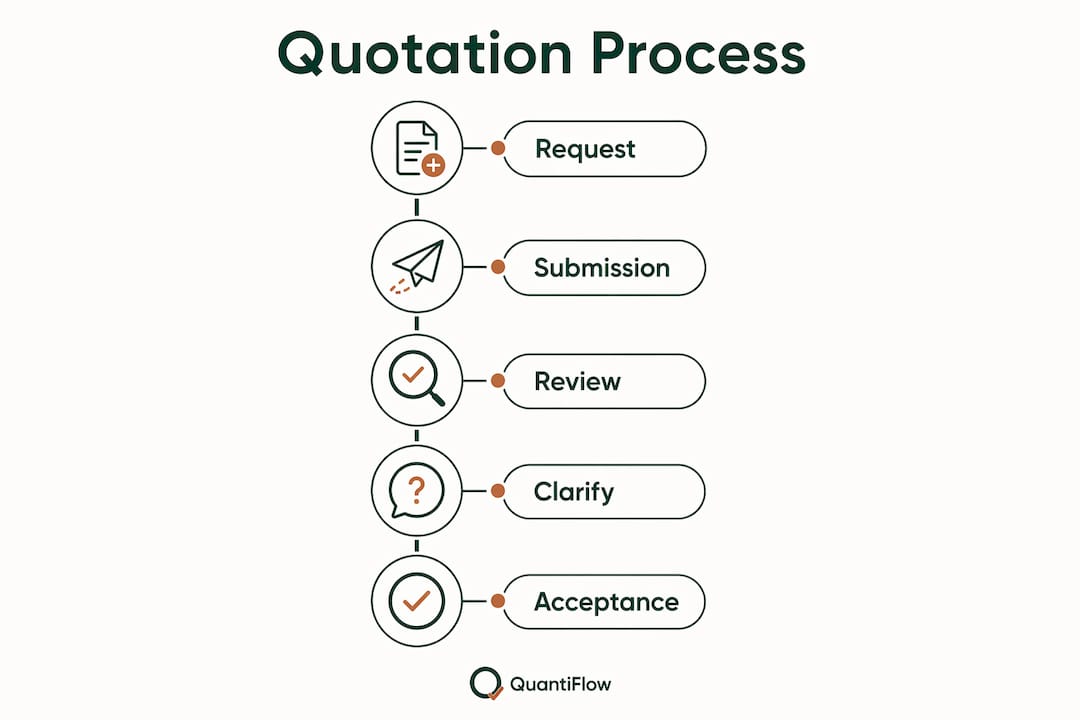
The typical sequence runs as follows:
- Issue the RFQ. The main contractor or QS sends the RFQ package to a shortlist of subcontractors. A professional bid request signals project organisation and attracts timely, higher-quality responses with fewer gaps.
- Manage addenda. If the scope changes during the tender period, addenda are issued. Failing to acknowledge addenda in a submission can legally disqualify a bid regardless of how competitive the pricing is.
- Receive and log submissions. Subcontractors submit their quotations by the stated deadline. The QS logs each submission, checks it for completeness, and confirms the subcontractor has acknowledged all addenda.
- Clarification period. The QS raises queries on ambiguous items. Subcontractors respond in writing, and those responses become part of the quotation record.
- Acceptance or rejection. The client or main contractor accepts one quotation, which then moves into subcontract formation. Unsuccessful subcontractors receive notification within the validity period.
Incomplete or vague RFQs generate clarification questions, delay responses, and produce poor-quality pricing that increases workload for QS teams. The investment in a thorough RFQ package pays back in faster, cleaner submissions.
Pro Tip: Include a subcontractor quotation template with your RFQ. A pre-formatted template reduces formatting inconsistencies and makes bid levelling significantly faster.
How do you evaluate and compare subcontractor quotations?
Evaluating a subcontractor price proposal is not simply a matter of selecting the lowest number. The lowest figure often reflects the most exclusions, and those exclusions become change orders later.
Scope alignment first
Before comparing prices, confirm that every quotation covers the same scope. Check each submission against the RFQ and mark any items that are explicitly excluded, qualified, or assumed. A quotation that excludes preliminaries, waste disposal, or attendance on other trades is not comparable to one that includes them.
Bid levelling worksheets are the standard tool for this. They list every scope item in rows and each subcontractor in columns, allowing the QS to normalise the figures before ranking them. This process turns an apples-and-oranges comparison into a like-for-like assessment.
Key evaluation criteria
- Labour and plant rates. Check whether rates are all-in or exclude NI contributions and holiday pay.
- Materials specification. Confirm the subcontractor has priced the specified product, not a cheaper equivalent.
- Preliminaries and attendance. Clarify what site facilities the subcontractor expects the main contractor to provide.
- Insurance and bonding. Verify public liability cover meets the contract minimum, typically £5m or £10m on UK commercial projects.
- Programme. Confirm the subcontractor's stated start date and duration align with the master programme.
- Validity period. Check the quotation remains valid long enough to reach contract award.
Benchmarking against BCIS
Quantity surveyors validate submitted rates by benchmarking them against BCIS data. A rate that sits more than 15% below the BCIS median warrants a clarification call. It may reflect a genuine efficiency, a scope omission, or a pricing error that will surface as a claim later.
Pro Tip: Flag outliers before you shortlist, not after. A subcontractor who prices 30% below the field on groundworks but 20% above on drainage may have misread the drawings. Resolve it at tender stage.
How do quantity surveyors manage subcontractor quotation data?
Managing subcontractor quotation data effectively is one of the less glamorous but most commercially significant tasks a QS team performs. Poor data management leads to missed deadlines, lost submissions, and pricing decisions made on incomplete information.
Traditional methods rely on email inboxes and spreadsheets. The problems are well documented. Fragmented systems increase the risk of delays and errors in the pre-contract stage, particularly when multiple packages are tendered simultaneously and submissions arrive from dozens of subcontractors across different formats.
Centralised quotation management addresses this directly. The key features of an effective system include:
- A single repository for all received quotations, linked to the relevant package and project.
- Automated logging of submission dates and validity expiry dates.
- A pre-qualification register that records financial standing, insurance status, and past performance for each subcontractor.
- Pricing trend tracking across projects, so the QS can spot when a subcontractor's rates have shifted materially since their last submission.
- Audit trails for all clarifications and addendum acknowledgements.
Maintaining a pre-qualified subcontractor database with audited financial and performance history leads to higher-quality bid submissions. Subcontractors on a pre-approved list understand the client's standards and submit more complete quotations from the outset.
The role of the QS in SME practices often extends to building and maintaining this database personally, which makes the choice of tools particularly consequential. A well-maintained database is a commercial asset that reduces tendering time on every subsequent project.
What are the practical implications for project management?
Subcontractor quotations feed directly into cost plans, client proposals, and contract budgets. A quotation that is accepted on the basis of an incomplete scope assessment creates a budget that will not hold.
The most common practical risk is scope gaps. These occur when the RFQ is ambiguous, the subcontractor makes assumptions, and neither party notices the discrepancy until work is underway. At that point, the subcontractor raises a variation, the QS must assess it, and the client faces an unexpected cost. Scope omissions identified early through rigorous quotation review prevent the majority of these claims.
Quotations also underpin the payment process. Under the Housing Grants, Construction and Regeneration Act 1996, subcontractors have statutory rights to interim payments and adjudication. A well-documented quotation, with clear rates and a defined scope, makes it far easier to assess interim applications and resist inflated claims.
From a programme perspective, the quotation validity period creates a procurement deadline. If contract award slips beyond the validity date, the subcontractor is entitled to reprice. On projects where design development is slow, this can trigger a second round of tendering and further delay. Project managers who track validity dates as part of their procurement schedule avoid this problem.
Accurate cost reporting from measured quantities, combined with well-managed subcontractor quotations, gives the QS the data needed to produce reliable cost reports at every stage of the project.
Key takeaways
A subcontractor quotation is a binding, scope-specific document that shapes every downstream cost, payment, and programme decision on a UK construction project.
| Point | Details |
|---|---|
| Quotations are legally binding | Once accepted, a quotation forms part of the subcontract and fixes the price for the defined scope. |
| Addenda acknowledgement is critical | Failing to acknowledge all issued addenda can disqualify a submission regardless of price competitiveness. |
| Bid levelling is non-negotiable | Normalise all quotations against a common scope before comparing prices to avoid hidden exclusions. |
| Centralised data management reduces risk | Fragmented email and spreadsheet systems increase errors; a single repository improves accuracy and speed. |
| BCIS benchmarking validates rates | Comparing submitted rates against BCIS data identifies scope omissions and pricing outliers before contract award. |
The uncomfortable truth about subcontractor quotations
I have reviewed hundreds of subcontractor quotations across residential, commercial, and infrastructure projects. The single most consistent finding is this: the problems that cause the most commercial damage are not in the numbers. They are in the words.
A subcontractor who prices £180,000 for a groundworks package but excludes "dewatering, contaminated material disposal, and attendance on the piling contractor" has not priced the job. They have priced a version of the job that does not exist on that site. The QS who accepts that quotation without reading the exclusions clause has handed the subcontractor a blank cheque for variations.
The fix is not complicated. Read every exclusion. Map every assumption back to the RFQ. If the subcontractor has assumed something that the RFQ does not support, raise a clarification before you shortlist. Do not wait until post-award.
Technology helps, but it does not replace this discipline. A centralised platform that logs submissions and tracks validity dates is genuinely useful. It does not, however, read the small print for you. The QS's professional judgement remains the last line of defence against a poorly scoped quotation becoming a poorly controlled contract.
The practices that separate good QS teams from average ones are not exotic. They issue thorough RFQs, they level bids properly, they benchmark against BCIS, and they maintain a pre-qualified subcontractor list. None of this is new. The teams that do it consistently are the ones whose cost plans hold.
— Michael
Quantiflow and subcontractor quotation management
Quantiflow is built for UK quantity surveyors and construction professionals who need accurate, traceable cost data from the earliest stages of a project.
When your BoQ is produced from NRM2-aligned, AI-assisted takeoffs, the scope you send to subcontractors is measurably clearer. Clearer scope means fewer clarification questions, fewer exclusions, and quotations that are genuinely comparable. Quantiflow's AI quantity takeoff platform turns PDF drawings into structured, priceable BoQ output, giving your subcontractor packages a measured foundation before a single quotation lands in your inbox. Plans start from £39/month for Solo users. If you want quotation data built on solid measured quantities, Quantiflow is where that process starts.
FAQ
What is the difference between a quotation and a bid?
A quotation is a binding offer at a fixed price for a defined scope, typically valid for 30–90 days. A bid is submitted in a competitive tender process and may be evaluated before any binding commitment is made.
What should a subcontractor quotation include?
A subcontractor quotation should include the scope of works, unit rates or lump sum price, programme, inclusions, exclusions, assumptions, insurance details, and a validity period. Missing any of these creates ambiguity that leads to variations.
How do quantity surveyors check subcontractor quotations?
Quantity surveyors benchmark submitted rates against BCIS data and use bid levelling worksheets to normalise quotations before comparing them. This process identifies scope gaps and pricing outliers before contract award.
Why does addendum acknowledgement matter in a quotation?
Failing to acknowledge addenda can legally disqualify a subcontractor's submission, even if the pricing is the most competitive. Every addendum issued during the tender period must be confirmed in the submission.
How long is a subcontractor quotation valid for?
Validity periods vary by project and subcontractor, but 30–90 days is standard in UK construction practice. If contract award slips beyond the validity date, the subcontractor is entitled to reprice, which can trigger a second tender round.