
Measured work in UK construction is defined as the systematic quantification and description of construction tasks, governed by the RICS New Rules of Measurement (NRM2), to produce Bills of Quantities for tender pricing and cost management. The industry term is "measured work," and it sits at the heart of every well-run UK construction project. Understanding what is measured work in UK construction matters because it determines how contractors price jobs, how clients control budgets, and how disputes get resolved. NRM2 remains the primary standard as of june 2026 for producing auditable, comparable measurement data across the industry.
What standards and rules govern measured work in UK construction?
NRM2 sets the rules for measured work in UK construction by defining how quantities are described, grouped, and presented in a Bill of Quantities (BoQ). The RICS publishes NRM2 as part of a three-part suite, each covering a different stage of a project's life.
The three standards divide responsibility clearly:
- NRM1 covers elemental cost planning at early design stages, giving clients an order-of-cost estimate before detailed drawings exist.
- NRM2 governs detailed measurement and BoQ production for building works, the stage most quantity surveyors associate with measured work.
- NRM3 addresses maintenance and lifecycle costing, applying after a building is in use.
Beyond the NRM suite, the RICS Code of Measuring Practice governs building area measurement. Standards such as Gross Internal Area (GIA), Net Internal Area (NIA), and the International Property Measurement Standards (IPMS) apply when measuring floor areas for valuation or agency purposes. These area measurement standards are distinct from NRM2 and serve a different purpose entirely.
NRM2 sets expectations on units, inclusions, and exclusions to produce repeatable measurements that different contractors can price on equal terms. Comparability, auditability, and repeatability are the three qualities that make a BoQ legally and commercially useful. Without them, tender returns become impossible to compare fairly.

Pro Tip: NRM2 is not mandatory on every project. The employer's requirements determine whether a full BoQ is produced. Always confirm the measurement standard required before starting a takeoff.
How does measured work differ from building measurement and cost planning?
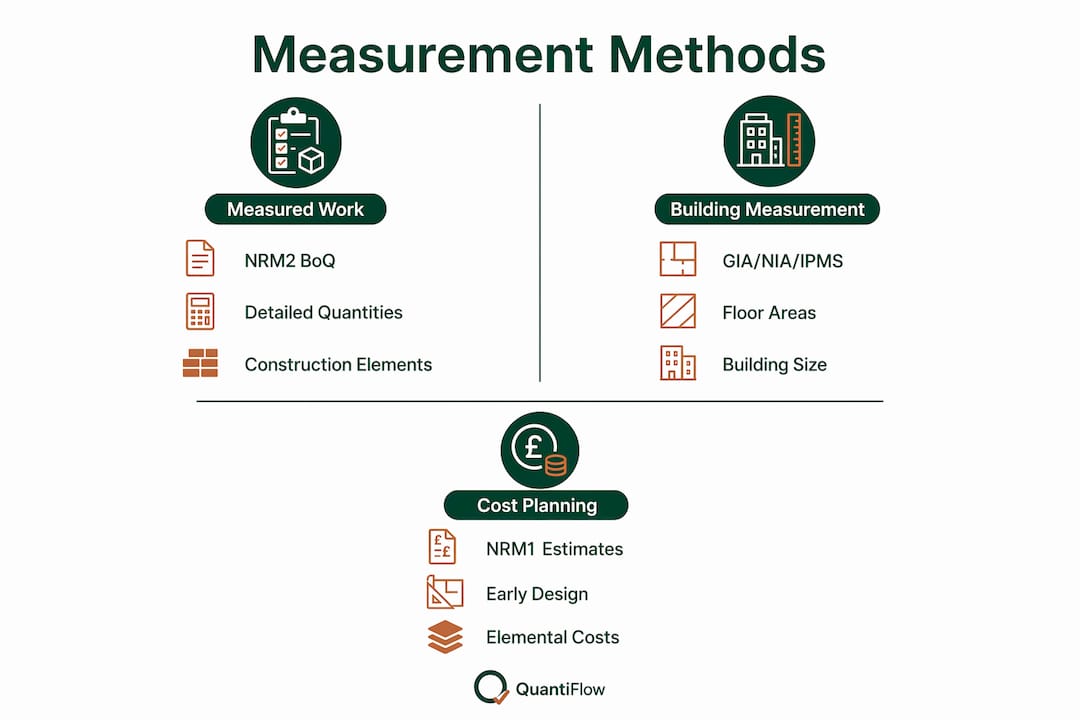
Measured work, building area measurement, and cost planning are three distinct processes. Confusing them creates scope gaps and pricing errors.
Measured work under NRM2 quantifies specific construction elements: cubic metres of concrete, square metres of blockwork, linear metres of skirting. Each item carries a description that tells a contractor exactly what is included and what is not. The detail in a BoQ is what separates measured work from every other cost document.
The table below shows how the three processes compare across key criteria.
| Criterion | Measured work (NRM2 BoQ) | Building area measurement (GIA/NIA/IPMS) | Cost planning (NRM1) |
|---|---|---|---|
| Primary purpose | Tender pricing and valuation | Valuation, agency, and lettings | Early budget setting |
| Unit of measure | Trade-specific (m², m³, linear m, nr) | Floor area in m² | Elemental cost per m² |
| Stage of project | Detailed design and tender | Any stage | RIBA Stages 1–3 |
| Output document | Bill of Quantities | Measurement certificate | Elemental cost plan |
| Governing standard | NRM2 | RICS Code / IPMS | NRM1 |
NRM2's detailed measurement is not mandatory for all projects. Smaller schemes often use schedules of work or specification-only documents. However, where a BoQ is produced, NRM2 compliance gives every party a shared language for pricing, valuation, and change management.
Cost planning under NRM1 uses elemental rates to estimate total project cost at early design stages. That figure then drives the decision to proceed to detailed design. Once detailed drawings exist, the quantity surveyor moves from NRM1 cost planning to NRM2 measured work, translating design intent into priceable quantities.
What are Measured Term Contracts and their relation to measured work?
Measured Term Contracts (MTCs) are legal frameworks where contractors are paid for actual measured work performed over a set period at pre-agreed rates. They are common in UK public sector maintenance, facilities management, and infrastructure programmes where the volume of work is unpredictable but the type of work is repetitive.
MTCs have several defining features:
- Pre-agreed schedule of rates. The contract sets a rate for each type of work item before any work begins. Payment is calculated by multiplying the measured quantity by the agreed rate.
- Periodic measurement and valuation. Work is measured at regular intervals, typically monthly, and payment certificates are issued based on confirmed quantities.
- Term duration. Contracts run for a fixed period, often one to five years, with options to extend based on performance.
- Variable volume. Unlike a lump-sum contract, the total value is not fixed. It rises or falls depending on how much work the client instructs.
- Instruction-based workflow. Each task begins with a formal instruction from the client or contract administrator, which is then measured on completion.
The key distinction between an MTC and a fixed-price contract is risk allocation. Under a fixed-price contract, the contractor carries the risk of underestimating quantities. Under an MTC, the client pays for what is actually done, measured and verified against the schedule of rates. This makes MTCs well suited to maintenance programmes where scope cannot be defined in advance.
MTCs depend entirely on the quality of measurement. If site measurement is inaccurate or poorly documented, payment disputes follow. Clear measurement records, agreed at the time of work, are the primary protection for both parties.
How is the quantity of work performed tracked and validated on site?
Tracking actual quantities on site is the practical application of construction measurement methods in the UK. The gap between estimated and actual quantities drives cost overruns, delayed payments, and contractual disputes.
The standard process for validating quantities follows these steps:
- Establish the measurement basis. Agree with the contractor which measurement rules apply, typically NRM2 or the MTC schedule of rates, before work starts.
- Take site measurements. Record dimensions on site using tapes, total stations, or laser distance meters. Measurements must be taken at the correct stage: concrete before it is poured over, excavation before backfill.
- Cross-reference with drawings. Compare site dimensions against architectural and structural drawings to identify discrepancies. Tools that cross-reference drawings automatically reduce the risk of human error at this stage.
- Apply BIM or drone survey data. For large or complex sites, Building Information Modelling (BIM) and drone surveys provide verifiable quantity data that supplements traditional field measurement.
- Produce a measurement record. Document agreed quantities in a format that supports payment certification and audit. This record becomes the evidence base if a dispute arises.
Tracking actual quantities is fundamental to staying on budget and schedule. Modern tools create verifiable audit trails that traditional measurement alone cannot match.
Pro Tip: Always agree measured quantities with the contractor's representative on site before work is covered up. A signed measurement sheet at the time of measurement is worth more than any retrospective calculation.
Drone surveys and BIM-integrated software are increasingly used on UK infrastructure and commercial projects. They complement traditional measurement rather than replace it. The quantity surveyor's judgement remains central to interpreting what the data means in contractual terms.
What are the common challenges in applying measured work standards?
Applying UK construction measurement practices consistently is harder in practice than the standards suggest. Several recurring issues affect even experienced quantity surveyors.
Ambiguities at work interfaces cause the most disputes. Where new structure meets existing fabric, or where one trade's work ends and another's begins, the BoQ description often fails to capture the full complexity. Temporary works, access constraints, and phasing rarely appear in standard measurement items but can dominate actual site costs.
Practitioners recommend the following to manage these risks:
- Write project-specific preambles. Standard NRM2 descriptions cover most situations, but site-specific notes clarify what is included in each item for this project.
- Measure complexity, not just quantity. A cubic metre of concrete in a confined basement costs more to place than the same volume in an open ground-floor slab. The measurement must reflect that difference through separate items or pricing notes.
- Integrate cost planning with measured work. The NRM1 cost plan sets the budget framework. The NRM2 BoQ must align with it. Gaps between the two create scope confusion at tender stage.
- Describe scope clearly in every BoQ item. Vague descriptions invite conflicting assumptions from different tenderers, making price comparison unreliable.
Focusing solely on material quantities without accounting for complexity factors such as site access, phasing, and waste management is one of the most common and costly mistakes in construction measurement. Supplementing standard measurements with contextual notes is not optional on complex projects. It is the difference between a BoQ that controls costs and one that generates claims.
Understanding the employer's requirements before selecting a measurement approach is the foundation of good practice. A well-measured BoQ prevents scope misinterpretation at every stage from tender to final account.
Key takeaways
Measured work in UK construction is the NRM2-governed process of quantifying and describing construction elements to enable accurate pricing, fair tendering, and defensible cost control throughout a project's life.
| Point | Details |
|---|---|
| NRM2 is the governing standard | NRM2 defines how quantities are described and presented in a Bill of Quantities for UK building works. |
| Measured work differs from area measurement | GIA, NIA, and IPMS apply to floor area valuation; NRM2 applies to construction element quantities. |
| Measured Term Contracts rely on site measurement | MTCs pay contractors at pre-agreed rates for actual quantities measured and verified on site. |
| Site validation prevents disputes | Agreeing measured quantities with contractors before work is covered protects both parties at final account. |
| Complexity factors must be captured | Standard measurement items alone do not reflect site access, phasing, or temporary works costs. |
Why measured work still separates good projects from troubled ones
After years working across UK construction projects of varying scale, I have come to one firm conclusion: the quality of measured work at tender stage determines the quality of the project outcome more than almost any other single factor.
NRM2 is a genuinely effective standard. When it is applied with care, it reduces disputes, clarifies scope, and gives every party a shared reference point from tender to final account. The problem is not the standard. The problem is the shortcuts taken in applying it. Preambles get copied from previous projects without revision. Complexity items get omitted because they are hard to measure. Interfaces between trades get left to the contractor to sort out on site.
The arrival of AI-assisted measurement tools changes this dynamic. Platforms that automate NRM2-aligned takeoffs from PDF drawings reduce the time spent on routine measurement, which means quantity surveyors can spend more time on the judgement calls that actually matter: how to describe a complex interface, whether a provisional sum is appropriate, how to structure a BoQ to reflect phasing. Technology does not replace that judgement. It creates the space to exercise it properly.
BIM integration and drone surveys are moving from specialist tools to standard practice on larger UK projects. For SME quantity surveyors and project managers working on smaller schemes, the equivalent shift is AI-assisted takeoff software that brings the same auditability and traceability to PDF-based workflows. The role of the quantity surveyor is not diminishing. It is becoming more technical, more defensible, and more valuable when supported by the right tools.
— Michael
How Quantiflow supports measured work in UK construction
Quantiflow is built specifically for UK quantity surveyors, builders, and architects who need NRM2-aligned quantity takeoffs produced from architectural drawings without the manual overhead.

The platform uses AI to cross-reference PDF drawings and produce structured BoQ output, preserving the quantity surveyor's professional judgement at every stage. Quantiflow's AI quantity takeoff tool turns dense drawing sets into measured, priceable Bills of Quantities. Plans start from £39 per month for solo practitioners, rising to £149 per month for business teams, with custom Enterprise pricing available. If you manage measured work, cost reporting, or tender preparation for UK construction projects, Quantiflow is worth a close look.
FAQ
What is measured work in UK construction?
Measured work is the systematic quantification and description of construction tasks, governed by RICS NRM2, to produce Bills of Quantities for tender pricing and cost management. It forms the basis for contractor payment, scope definition, and change valuation on UK building projects.
What is the difference between NRM1, NRM2, and NRM3?
NRM1 covers elemental cost planning at early design stages, NRM2 governs detailed measurement and BoQ production for building works, and NRM3 addresses maintenance and lifecycle costing. All three form part of the RICS New Rules of Measurement suite used across a project's full life.
What is a Measured Term Contract in UK construction?
A Measured Term Contract is a legal framework where a contractor is paid for actual work performed over a set period at pre-agreed rates. MTCs are common in public sector maintenance and infrastructure programmes where work volume is variable but work type is repetitive.
How are actual quantities validated on a construction site?
Quantities are validated by taking site measurements at the correct stage, cross-referencing against drawings, and producing agreed measurement records signed by both parties. BIM software and drone surveys increasingly supplement traditional field measurement on larger UK projects.
Is NRM2 mandatory on all UK construction projects?
NRM2 is not mandatory on every project. Its use depends on the employer's requirements and the procurement route chosen. Where a full Bill of Quantities is required, NRM2 compliance provides the consistency and auditability needed for fair tender comparison and robust cost control.