
An MEP quantity takeoff, as covered here, is an NRM2‑aligned measurement exercise that turns architectural and construction drawings into a draft Bill of Quantities, ready for a quantity surveyor to check and sign off. The deliverable is a set of measured works arranged in NRM2 order, alongside preliminaries and a summary page, with every line traceable back to a drawing reference or specification clause. Get that traceability right and the rest, the workflow, the QA, the digital shortcuts, follows a predictable pattern.
TL;DR:
- Finalized, tender-ready Bill of Quantities should be prepared at RIBA Stage 4 when technical design is largely fixed, avoiding early-stage assumptions.
- Always confirm the current revision of drawings and specifications before measuring, and record trace references for every measurement to ensure full traceability.
- Use a structured eight-step process and check for common errors like omissions, double counts, and vague provisional sums to ensure the BoQ's defensibility.
- Digital tools like Vector PDFs and BIM models can aid measurement accuracy but require manual review and mapping into NRM2 standards to remain audit-ready.
- Treat software-generated draft BoQs as working documents for review, and always have a quantity surveyor verify quantities before final sign-off.
Table of Contents
- Why NRM2 matters and what you must collect before you start
- When to prepare the takeoff and how it fits the RIBA stages
- Eight steps to a defensible NRM2 takeoff
- Quality assurance: common errors and fast checks to defend a tender
- Digital workflows and tools that keep your takeoff audit-ready
- One-page checklist and NRM2 templates to download
- Where Quantiflow fits into your takeoff workflow
- Sources
- FAQ
Why NRM2 matters and what you must collect before you start
RICS NRM2 sets the detailed rules for measuring and describing building works, and it is the framework that makes a Bill of Quantities defensible under scrutiny, whether from a contractor's estimator or an adjudicator months later. The RICS NRM: New rules of measurement standard also ships with downloadable templates that save you building a BoQ shell from scratch every time. NRM2 sits alongside the RIBA Plan of Work, feeding cost certainty as a project moves from concept through to technical design, rather than appearing only once at tender stage.
Before you pick up a scale rule or open a PDF, you need a defined document set. Missing even one of these routinely produces a BoQ riddled with provisional sums that should have been firm quantities.
- General arrangement (GA) drawings for overall layout and gridlines
- Section and elevation drawings for heights, levels and vertical build‑up
- Component and detail drawings for junctions, fixings and finishes
- Door, window and finishes schedules
- The specification, including performance clauses and material standards
- Room data sheets and the employer's requirements document
Set up a drawing and specification register on day one. Record revision letters, issue dates and the scale of every sheet you use, because NRM2 sets out exactly what drawn information a BoQ should be built from, and an out-of-date revision is the single most common cause of a dispute at valuation.
When to prepare the takeoff and how it fits the RIBA stages
A final, tender‑ready BoQ belongs at RIBA Stage 4, once technical design is largely fixed. Earlier stages support cost planning, not full measurement. A takeoff attempted at Stage 2 or 3 will always carry more assumptions than one done at Stage 4.
- Traditional procurement: the QS or an external cost consultant prepares the BoQ before tender, giving contractors a firm basis for pricing.
- Design and build: the contractor's own QS usually measures from the employer's requirements, which shifts risk and detail earlier in the process.
- Provisional sums: use a defined provisional sum when the scope is known but design detail is not, and an undefined provisional sum when even the nature of the work is uncertain. Mislabelling one as the other invites disputes over whether the contractor should have allowed for preliminaries.
For SME QS practices, this timing question decides workload as much as method. A firm brought in late at Stage 4 has less room to query gaps, which is exactly why the document register from the previous section matters so much.
Eight steps to a defensible NRM2 takeoff
Working through a takeoff in a fixed order keeps every line traceable and stops gaps appearing at the worst possible moment, during tender return.
- Gather and index every drawing and specification clause. Open your drawing register and confirm you hold the current revision of each sheet before measuring a single item.
- Build the BoQ shell in NRM2 work section order. Set up preliminaries headings first, since contractors price these against the whole scope, not individual elements.
- Measure systematically, either room by room or element by element, and stay consistent across the whole project rather than switching method halfway through.
- Record a trace reference for every line, linking each quantity to a specific drawing number and, where relevant, a grid location or room name.
- Where an item cannot yet be measured, raise a provisional sum and log the assumption behind it in a separate assumptions register, not buried in a footnote.
- Reconcile the takeoff against the cost plan and flag any variance for the client to see before the BoQ goes to tender, not after.
- Assemble the finished BoQ, including the pricing schedule and contractor preliminaries headings, following the structure NRM2 sets out for measured works and the main summary.
- Run an internal QA pass and formal sign‑off before the document leaves your desk. This is a separate, deliberate step, not something that happens as you go.
Pro Tip: Practitioner training generally recommends learning the ten most common NRM2 work sections first and practising sample takeoffs on those, rather than attempting to absorb the whole standard before starting real work, according to learndirect's measurement guidance.
Step 4 deserves particular attention, as demonstrated in the CHC Concrete Case Study which shows how structured data and templates improve takeoff accuracy. A takeoff line with no trace reference is effectively unverifiable, and practitioner guidance is consistent on this point: a drawing and specification register, paired with an assumptions log, is what actually defends a tender figure when a contractor queries it six weeks later. The abstract sheet you build in step 4 becomes the audit trail in step 7, so treat the two as one continuous record rather than separate tasks.
Anyone measuring structural steel as part of a wider takeoff will find the sequence above maps closely onto a structural steel takeoff walkthrough, where the same drawing‑to‑line traceability applies to connections and member schedules.
Quality assurance: common errors and fast checks to defend a tender
The same handful of mistakes account for most tender queries, and most of them are avoidable with a five‑minute check before the BoQ goes out.
- Omissions, usually where a schedule item never made it from the drawing register into the measured works.
- Double counts, common where two trades' drawings overlap on the same element.
- Incorrect unit application, particularly mixing linear and superficial measurement on the same work section.
- Vague provisional sum descriptions, which give a contractor grounds to price defensively or query scope later.
Run these checks before sign‑off: reconcile your BoQ totals back against the drawings, sample‑check a handful of measurements against the source sheet, apply a sanity check to unusual units (does that quantity look plausible for the building's size?), and confirm every line sits under the correct NRM2 work section rather than a convenient nearby one.
Pro Tip: When a drawing is ambiguous, raise a formal written query to the design team and log both the question and the answer against the relevant BoQ line. A verbal clarification that never makes it into the assumptions register is worth nothing at valuation stage.
Firms that want a structured routine for this stage can adapt the QA process described in construction measurement quality control guidance for smaller practices, or the shorter electrical takeoff QA routine, which applies the same principle to a single work section in five to fifteen minutes.
Digital workflows and tools that keep your takeoff audit-ready
Vector PDF drawings give the cleanest geometry to work from, since lines and text remain selectable rather than flattened into a scanned image. CAD and BIM exports go further, carrying dimensional data directly, but their reliability depends on model maturity. Guidance on BIM‑based measurement notes that models are generally dependable for measurement once they reach a higher level of development, roughly LOD 350 and above; below that, treat extracted quantities as indicative rather than final.
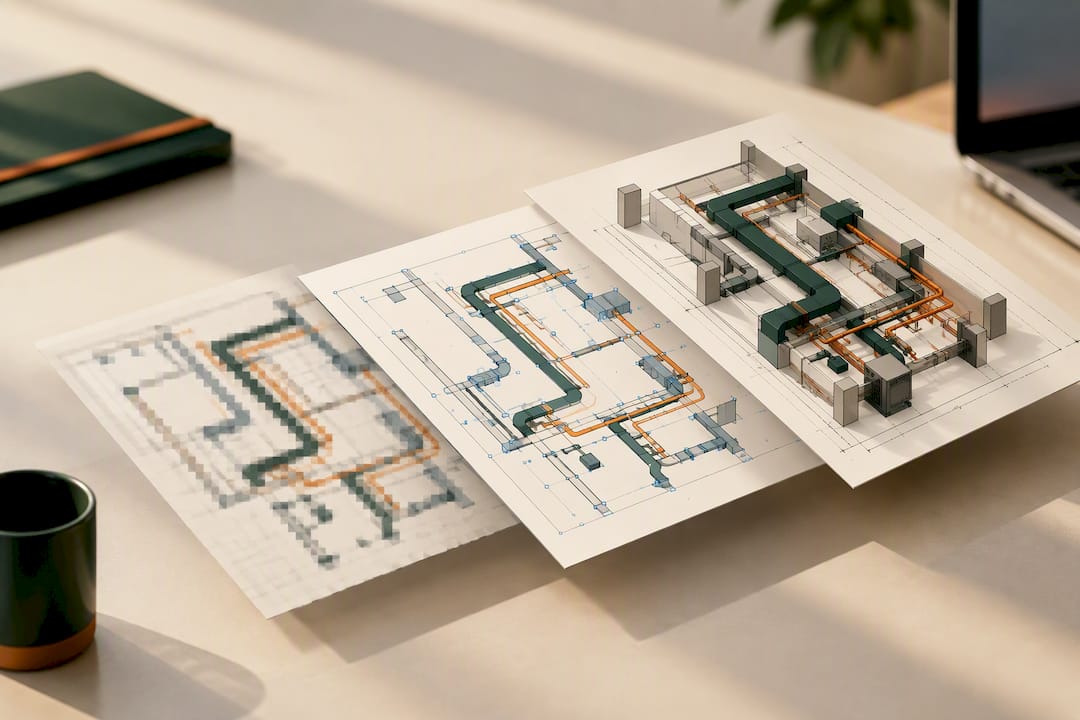
Whatever the input, extracted or measured quantities still need mapping into NRM2 section order by a human, since no drawing format encodes NRM2's rules of measurement automatically. That mapping step, and the judgement it involves around provisional sums and ambiguous scope, is where manual review stays mandatory regardless of the tool used.
Keeping software output audit‑ready comes down to a few practical controls:
- Annotate measured items directly on the drawing so a reviewer can see what was measured and where.
- Keep revision history visible, so nobody prices against a superseded sheet.
- Export abstract sheets or line‑by‑line reports rather than relying on a summary total alone.
QuantiFlow, a UK B2B SaaS platform still in development, reads construction drawings and produces a draft Bill of Quantities for a quantity surveyor to review and sign off, functioning as one option in this category of drawing‑to‑BoQ tools. Firms comparing tools for this stage may also find background in best builder estimating software for UK SMEs useful.
One-page checklist and NRM2 templates to download
Print or save this before your next takeoff:
- All drawings and specification clauses logged in the register, with revision dates checked
- Every measured line mapped to its correct NRM2 work section
- Provisional sums labelled defined or undefined, with assumptions logged separately
- Trace references linking each BoQ line back to a drawing number
- Internal QA sign‑off recorded before issue
RICS publishes downloadable NRM2 templates, including appendices B to F, which cover preliminaries and pricing summary formats and save you rebuilding these from scratch. Store your completed audit trail, drawing register, assumptions log and abstract sheets together, since you will need the same evidence again at post‑contract valuation.
Where Quantiflow fits into your takeoff workflow
If the eight‑step workflow above sounds right in principle but heavy in practice, Quantiflow is built for exactly that gap. It reads architectural drawings and produces a draft Bill of Quantities, structured for a quantity surveyor to review, adjust and sign off, rather than a finished document you're expected to accept as is.
It suits quantity surveying practices, builders and architectural practices who prepare their own measured quantities for tender and want a structured starting point rather than a blank BoQ template. The platform aims to keep quantities traceable to the drawing they came from, supporting an audit‑trail discipline, and includes UK rate data alongside export options to PDF and Excel. Plans run from Solo at £69 per month to Business at £299 per month, with Enterprise pricing available on request, all detailed on the Quantiflow website. If your next takeoff is sitting in a stack of PDF drawings, that's the natural place to start.
Sources
Keep the RICS NRM2 PDF and its templates open alongside the Designing Buildings NRM2 summary while measuring. For BoQ format decisions, see which bill of quantities format should you use.
- RICS NRM: New rules of measurement
- NRM2 explained: A Quantity Surveyor's Guide | Rate QS Insights
- NRM2 measurement guide for QSs | learndirect
FAQ
What Does MEP Quantity Takeoff Mean in This Guide?
Here, MEP quantity takeoff refers to an NRM2‑aligned measurement process that produces a draft Bill of Quantities traceable to drawings and specifications, for a quantity surveyor to check and sign off. It covers the full measured‑works workflow rather than a single trade's material list.
Which RIBA Stage Should the BoQ Be Ready By?
A tender‑ready BoQ is generally prepared at RIBA Stage 4, once technical design is largely fixed. Measurement carried out earlier supports cost planning but usually carries more assumptions and provisional sums.
What Is the Difference Between a Defined and Undefined Provisional Sum?
A defined provisional sum applies when the scope of work is known but the design detail is not yet finalised. An undefined provisional sum applies when even the nature of the work itself remains uncertain, and NRM2 treats the two differently for preliminaries pricing.
Can Software Produce a Finished BoQ Without a QS?
No software output should be treated as final without a quantity surveyor's review, since mapping extracted quantities into NRM2 order involves professional judgement that no tool automates. QuantiFlow, for example, produces a draft BoQ from drawings specifically for a QS to review and sign off, not a finished document.
Where Can I Download the Official NRM2 Templates?
The RICS NRM2 standards page hosts the official downloadable templates, including preliminaries and pricing summary appendices B to F. These give you a ready‑made BoQ shell rather than building one from scratch each time.
Recommended
- Audit Ready NRM2 Tiling Takeoff in 5 Steps for UK Quantity Surveyors
- Audit Ready Electrical Takeoff for QSs: 5–15 Minute NRM2 QA
- Six Steps to an Audit Ready Cut and Fill Takeoff for UK QSs
- Construction measurement quality control: the UK SME guide
This article is for general information only and is not professional, legal or commercial advice. Quantity surveying decisions should be taken by a qualified professional with reference to the specific project, drawings and contract in question. Content is produced with AI assistance and reviewed before publication. QuantiFlow Ltd accepts no liability for reliance on it.