
Cost tools are the financial backbone of any small architectural practice that wants to deliver projects on budget and protect its profit margins. Without them, firms rely on spreadsheets, memory, and guesswork to manage money that belongs to clients and to the business itself. The Association of Consulting Architects (ACA) now emphasises data-driven fee proposals over generic percentage estimates, and 77% of architecture and engineering firms miss project deadlines because of fragmented financial data. That figure is not a coincidence. It is the direct result of small practices running complex, multi-phase projects without the financial visibility that cost tools provide. Understanding why small architects need cost tools starts with understanding exactly what breaks down when those tools are absent.
What financial challenges do small architectural firms face without cost tools?
Fragmented data is the root cause of most financial problems in small practices. When time records, invoices, and project budgets live in separate spreadsheets or disconnected apps, no one has a clear picture of where money is going until it has already gone. The result is budget blindness: a firm believes a project is profitable until reconciliation reveals otherwise.
The numbers behind this problem are specific and significant. Firms typically lose 3–8% of billable revenue to unrecorded reimbursable expenses. On a £500,000 project, that translates to £15,000–£40,000 in permanent financial leakage. Those are receipts that were never coded to a project, site visits that were never logged, and consultant calls that were never billed.
Manual billing compounds the problem. Late invoice processing delays cash flow, and without automated phase tracking, firms often invoice at the wrong stage or miss milestone triggers entirely. Each delay erodes client confidence and creates administrative friction that consumes hours better spent on design.
The least visible cost is what practitioners call the coordination tax. Client meetings, internal reviews, and consultant management consume 10–15% of project hours but are routinely omitted from project budgets. A project that looks profitable on paper quietly loses money because those coordination hours were never costed in. Small firms feel this most acutely because every principal hour carries a high opportunity cost.
The combined effect of these gaps is predictable:
- Budget overruns that only surface at project completion
- Scope creep that goes undetected until the fee is exhausted
- Unbilled expenses that reduce net margin on every project
- Late invoicing that strains cash flow and client relationships
- Inaccurate fee proposals that undervalue the firm's actual workload
Each of these problems has a direct solution in purpose-built cost management tools. The challenge is that many small firms do not adopt them until the financial damage is already done.
How do cost tools improve budgeting accuracy and fee forecasting?
Bottom-up budgeting is the most reliable method for small architectural practices to build accurate project fees. Rather than applying a percentage of construction cost, bottom-up budgeting builds the fee from detailed tasks, hours per phase, and staff rates. The result is a fee proposal grounded in the firm's actual workload, not an industry average.
The ACA's Time/Cost Calculator Guide, updated in february 2026 with 47 specific revisions, gives UK practices a structured framework for this approach. Those updates reflect real changes in how firms operate, including remote working patterns, consultant coordination demands, and inflation in staff costs. Applying them produces fee proposals that hold up under scrutiny.
The Direct Labor Multiplier (DLM) sits at the centre of sustainable fee calculation. The DLM, typically between 2.80 and 3.54, multiplies the direct labour cost of a project to recover overheads and generate profit. A firm that does not know its DLM is almost certainly undercharging. Cost tools calculate and apply the DLM automatically, removing the risk of human error in fee proposals.
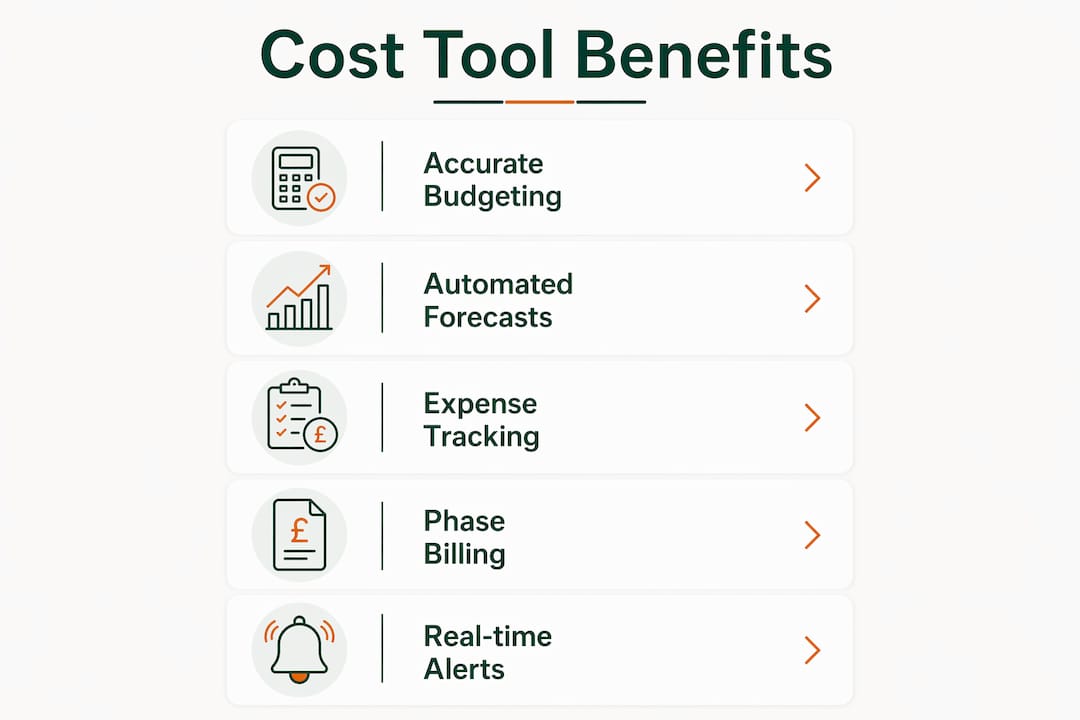
Automated forecasting is where cost tools deliver their clearest advantage. Specialised tools update forecasts directly from timesheets and invoices, creating a living budget that reflects actual project status rather than a static snapshot taken at the start. This removes the manual reconciliation burden that consumes hours in firms running three or more active projects simultaneously.
| Feature | Benefit for small practices |
|---|---|
| Bottom-up phase budgeting | Fees reflect actual workload, not guesswork |
| DLM calculation | Overheads and profit are recovered reliably |
| Automated forecast updates | Budget stays current without manual input |
| ACA-aligned fee templates | Proposals meet professional standards |
| Phase milestone invoicing | Cash flow matches project delivery stages |
Pro Tip: Set your DLM at the start of each financial year using your actual overhead costs and target profit margin. Review it quarterly. A DLM that drifts below 2.80 is a signal that overheads have risen faster than fees.
What practical benefits do cost tools deliver during design and execution?
Real-time cost feedback during design development is the benefit that most small architects underestimate. When a cost tool connects design decisions to live budget data, the architect knows immediately whether a specification change pushes the project over budget. That knowledge prevents the late-stage value engineering that forces painful design compromises and damages client relationships.

Collaborative estimating changes the dynamic between architect, client, and builder. When all three parties work from the same cost model, there are no surprises at tender. Clients understand the financial implications of design choices before those choices are locked in. Builders can flag constructability issues early. The cost tool becomes the shared language of the project rather than an internal document the client never sees.
Automated expense tracking addresses the £15,000–£40,000 leakage problem directly. When expenses are coded to projects at the point of submission, nothing falls through the cracks. A site visit logged on a mobile app is immediately attached to the correct project and phase. The firm bills it, recovers it, and moves on. Without that automation, the expense relies on someone remembering to record it later, and that rarely happens consistently.
Pro Tip: Run a 10–15 minute weekly budget check-in comparing hours burned against percent complete for every active project. This single habit, supported by cost tool dashboards, is the most reliable way to catch overruns before they become unrecoverable.
Automated burn rate alerts give small practices the early warning system that manual tracking cannot provide. When a project reaches 70% of its fee budget at 50% completion, the tool flags it. The firm can then have a scope conversation with the client, issue a variation, or adjust resource allocation. Without the alert, the same firm discovers the problem at 100% fee burn and 75% completion, with no good options left.
Cost tools act as creative enablers rather than constraints. Architects who know their budget position in real time design with confidence. They can push a specification knowing the budget allows it, or pull back knowing it does not. That clarity protects design integrity far more effectively than optimism and retrospective reconciliation.
Which features should small UK architects prioritise when choosing cost tools?
The right feature set depends on the firm's specific pain points, but several capabilities deliver consistent value across small practices. Integrated time tracking that connects directly to project budgets and invoices is non-negotiable. Without it, the coordination tax remains invisible and unbillable.
Phase-based billing and milestone invoicing matter because architectural fees are earned in stages. A tool that triggers invoices automatically when a phase is complete removes the administrative lag that delays cash flow. Expense coding at submission, rather than retrospective allocation, closes the reimbursable leakage gap. Automated alerts for budget thresholds give principals the early warning they need to manage scope proactively.
The choice between an all-in-one platform and a best-of-breed approach depends on firm size and complexity. A sole practitioner with five active projects needs different functionality from a ten-person practice managing thirty concurrent commissions. All-in-one platforms reduce integration friction and training time. Best-of-breed combinations offer deeper functionality in specific areas but require more setup and ongoing maintenance.
Annual software costs for small firms typically run from £1,500 to £4,000 per user. That figure sounds significant until you calculate the return. A ten-person firm billing at £150 per hour that recovers just two previously unlogged hours per week generates approximately £156,000 in additional revenue annually. The software pays for itself many times over.
Disciplined budgeting and regular monitoring are the practices that separate consistently profitable firms from those that finish projects hoping the numbers work out. The tool is the mechanism. The discipline is the habit. Both are required.
Key takeaways
Small architectural practices that adopt purpose-built cost tools recover lost revenue, produce accurate fee proposals, and deliver projects within budget far more consistently than those relying on generic tools or manual tracking.
| Point | Details |
|---|---|
| Fragmented data costs money | Firms lose 3–8% of billable revenue to unrecorded expenses without integrated tracking. |
| The coordination tax is real | Client meetings and reviews consume 10–15% of project hours and must be budgeted explicitly. |
| DLM drives sustainable fees | The Direct Labor Multiplier, between 2.80 and 3.54, is the key metric for recovering overheads and profit. |
| Weekly check-ins prevent overruns | A 10–15 minute budget review comparing hours burned to percent complete catches problems early. |
| Software ROI is rapid | Recovering two unlogged hours per week per person at £150/hour generates £156,000 annually for a ten-person firm. |
Why I think most small practices are solving the wrong problem
Michael's perspective here is blunt: the firms I see struggling with profitability are not struggling because they lack design talent or client work. They are struggling because they treat financial management as an administrative afterthought rather than a core professional skill.
The resistance to cost tools is almost always framed as complexity. Principals say the software is too complicated, too expensive, or too disruptive to implement mid-project. What they rarely say, but what I observe consistently, is that generic tools quietly generate friction that causes financial damage long before anyone notices. A spreadsheet feels familiar. It does not feel like a risk. But it is.
My recommendation to small practices is not to overhaul everything at once. Pick the single most painful financial problem, whether that is untracked expenses, late invoicing, or inaccurate fee proposals, and find a tool that solves it specifically. Get comfortable with that one capability before adding more. The firms that build financial discipline incrementally are the ones that sustain it.
Cost tools do not constrain creative practice. They protect it. When you know your budget position in real time, you design with authority rather than anxiety. That confidence shows up in client relationships, in the quality of your proposals, and in the consistency of your delivery.
— Michael
How Quantiflow supports cost accuracy for UK architectural practices
Small architectural practices that want to close the gap between drawing and cost need tools built for the UK construction context.
Quantiflow is a UK platform that automates NRM2-aligned quantity takeoffs and Bills of Quantities directly from architectural drawings. Its AI cross-references drawings to produce structured, priceable BoQ output, giving architects and quantity surveyors a traceable cost foundation from the earliest design stages. That means less time on manual measurement and more time on the decisions that protect project budgets. Practices can access Quantiflow from £39 per month on the Solo plan, with Business plans at £149 per month for larger teams. Explore Quantiflow's AI takeoff tools to see how automated measurement supports better cost control from design through to tender.
FAQ
Why do small architectural firms lose money on reimbursable expenses?
Firms lose 3–8% of project revenue because expenses are not coded to projects at the point of submission. Integrated cost tools automate this coding, recovering £15,000–£40,000 on a typical £500,000 project.
What is the Direct Labor Multiplier and why does it matter?
The Direct Labor Multiplier (DLM) is a fee calculation metric, typically between 2.80 and 3.54, that multiplies direct labour costs to cover overheads and profit. Small firms that do not apply it consistently undercharge for their services.
How often should small practices review project budgets?
Weekly budget check-ins of 10–15 minutes, comparing hours burned against percent complete, are the most effective way to catch overruns early. Cost tools with dashboard reporting make this review fast and consistent.
What does cost management software typically cost for a small firm?
Annual software costs for small architectural practices run from £1,500 to £4,000 per user. The investment is typically recovered through captured billable time and reduced scope creep within the first year.
How do cost tools support better fee proposals?
Cost tools apply bottom-up budgeting methods and frameworks such as the ACA Time/Cost Calculator Guide to build fees from actual task hours and staff rates. This produces proposals grounded in firm-specific data rather than industry percentage estimates.