
A quantity surveyor in an SME is defined as the professional responsible for managing all financial and contractual aspects of a construction project, from initial cost estimates through to final account agreement. In UK SME construction, the role of quantity surveyor in SME firms extends well beyond measuring and pricing. It covers contract administration under JCT and NEC forms, budget monitoring, variation management, and strategic financial reporting that directly affects business profitability. The RICS sets the professional standards that govern this work, and those standards apply equally to a two-person commercial team as to a large contractor.
What are the primary responsibilities of a quantity surveyor in SME construction projects?
The QS responsibilities span the entire project lifecycle, from feasibility through to post-completion financial closeout. That breadth is what makes the role so commercially significant in an SME, where one person often carries the full weight of cost and contract management across multiple live projects.
The core duties break down as follows:
- Estimating and budgeting. The QS produces cost plans at feasibility and design stages, giving the business a realistic picture of project viability before committing resources.
- Tender preparation and Bills of Quantities. Preparing NRM2-compliant BoQ documents gives subcontractors and suppliers a consistent basis for pricing, reducing ambiguity and post-award disputes.
- Budget monitoring and valuations. During construction, the QS tracks expenditure against the contract sum, prepares interim valuations, and flags cost movements before they become overruns.
- Contract variation management. Every instructed change carries a cost and a contractual obligation. The QS prices, submits, and agrees variations under the applicable JCT or NEC contract, protecting the firm's entitlement.
- Final account agreement. At project completion, the QS reconciles all costs, claims, and adjustments to reach an agreed final sum with the client or main contractor.
- Cost Value Reconciliation (CVR) reporting. The CVR report links project-level cost detail to business-level profitability, giving directors the financial visibility they need to make decisions.
Pro Tip: Set up your CVR template before a project starts, not halfway through. Retrospective reconciliation wastes time and increases the risk of missing committed costs.
How does the role of a quantity surveyor in SMEs differ from larger firms?

In larger contractors, the QS and Commercial Manager are distinct roles with separate reporting lines. In SMEs, that boundary dissolves. Firms under £20m turnover typically have QSs performing both functions, combining detailed project cost management with strategic oversight of business profitability.
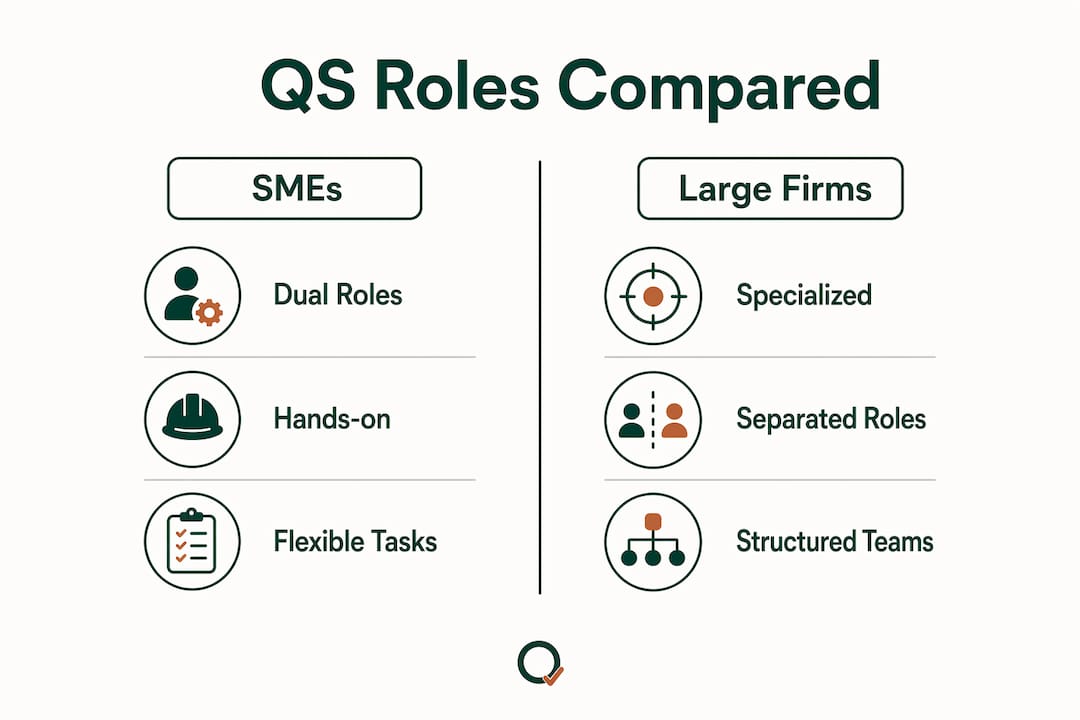
This dual responsibility creates a different kind of pressure. The SME QS must hold two lenses simultaneously: the granular detail of a single project's cost plan, and the broader picture of how that project contributes to the firm's margin for the quarter.
The table below shows where the roles converge and diverge depending on firm size:
| Responsibility | SME QS (under £20m) | Larger firm QS |
|---|---|---|
| Project cost management | Yes | Yes |
| Contract administration | Yes | Yes |
| CVR and business reporting | Yes, combined | Separate Commercial Manager |
| Bid strategy and pricing | Yes, often sole lead | Shared with estimating team |
| Subcontract procurement | Yes | Dedicated procurement team |
The role divergence typically occurs once an SME grows beyond three concurrent projects. At that point, the volume of work makes it impractical for one person to maintain both project detail and strategic oversight without support. Until that threshold, the blended role is not a compromise. It is the most efficient commercial structure available to a smaller firm.
- Recognise the dual mandate. The SME QS is simultaneously a project accountant and a business commercial manager. Both functions require equal attention.
- Build reporting rhythms. Weekly project cost reviews and monthly CVR presentations keep both lenses in focus without one crowding out the other.
- Document role boundaries clearly. Even in a small team, defining who owns contract administration versus business reporting prevents gaps and duplication.
- Plan for growth. Identify the project volume at which the blended role becomes unworkable and plan the hire of a dedicated commercial manager accordingly.
What technological trends are shaping the modern QS role in SMEs?
The QS role is shifting from bill production to cost custodianship. Automation now handles routine quantity takeoffs, freeing QSs to focus on value engineering, risk modelling, and commercial strategy. That shift is not theoretical. It is already visible in how SME QSs spend their working week in 2026.
The key trends reshaping daily practice are:
- Automated quantity takeoffs. AI tools read PDF drawings and produce structured BoQ output, cutting the time spent on manual measurement. The QS validates the output rather than generating it from scratch.
- Human-in-the-loop validation. RICS mandates that QS professionals apply professional scepticism to all automated outputs. Site-specific conditions, contract terms, and specification nuances still require human judgement. Automation accelerates the process; it does not replace the professional.
- Data analytics for cost forecasting. QSs who can interrogate cost data and model scenarios add more value than those who only report historical spend. Predictive cost control is becoming a standard expectation.
- BIM integration. Building Information Modelling links design data to cost data, allowing QSs to update cost plans as designs evolve rather than re-measuring from scratch.
Pro Tip: When reviewing AI-generated takeoffs, always cross-reference against the specification and any site visit notes. Drawings do not capture everything, and the contract will not forgive a missed item.
The human-in-the-loop model is the defining framework for modern QS practice. Technology augments professional judgement. It does not substitute for it.
Why is the quantity surveyor role critical for SME project success?
The QS is the primary line of defence against margin erosion in an SME construction project. Contractual risk protection through timely variation claims and rigorous contract administration is often the difference between a profitable job and a loss-making one.
The value of early QS involvement is frequently underestimated. SME leaders who treat QSs as administrative rather than strategic contributors tend to engage them after design is fixed and budget pressure is already building. The firms that consistently deliver projects within margin bring the QS in at feasibility, using design-to-cost principles to shape the scheme before it becomes expensive to change.
The table below contrasts the outcomes of early versus late QS engagement:
| Engagement point | Typical outcome |
|---|---|
| Feasibility and design stage | Budget set realistically; design shaped to cost; fewer post-award surprises |
| Tender stage only | Pricing accurate but design changes costly; limited scope to influence value |
| Post-award | Reactive cost management; higher risk of overruns and unrecovered variations |
CVR reports prepared by the QS give SME directors a live view of project financial health, showing actual spend, committed costs, risks, and forecast profit. Without that visibility, directors are making business decisions on incomplete information. That is a risk no SME can afford to carry across multiple projects simultaneously.
How should SMEs integrate quantity surveyors into their projects effectively?
Effective integration starts before the project starts. QS involvement during bid preparation produces bids that are commercially sound and realistically priced, reducing the risk of post-award cost surprises that erode margin from day one.
The following practices define high-performing SME commercial teams:
- Engage the QS at feasibility. Cost planning at the earliest stage shapes design decisions and prevents expensive late changes. A QS who joins at tender stage can price the scheme; a QS who joins at feasibility can influence it.
- Align QS outputs with business reporting. CVR formats should match the information directors need to manage the business, not just the project. Build the reporting template together before work starts.
- Maintain a variation register from day one. Every potential change should be logged, priced, and submitted promptly. Delayed variation claims are harder to agree and easier for clients to dispute.
- Use QS insights for risk management. The QS's view of contract exposure, subcontractor performance, and cost trends is a business intelligence asset. Share it with the wider leadership team, not just the project team.
- Review the QS workload regularly. An overloaded QS cuts corners on contract administration. That is where margin leaks. Capacity planning is a commercial decision, not just an HR one.
The most effective SMEs treat the QS as a commercial partner, not a back-office function. That shift in perception is what separates firms that consistently hit their margin targets from those that are perpetually surprised by project outcomes.
Key takeaways
The quantity surveyor in an SME is the single most important commercial role for protecting project margin and ensuring financial control across the business.
| Point | Details |
|---|---|
| QS responsibilities span the full lifecycle | From feasibility cost plans to final account agreement, the QS manages every financial stage. |
| SME QSs combine two roles | Under £20m turnover, QSs typically perform both project cost management and commercial oversight. |
| Early engagement protects margin | Involving the QS at feasibility prevents costly design changes and post-award budget surprises. |
| Automation requires human validation | AI takeoff tools accelerate measurement, but RICS standards require QS professional judgement on all outputs. |
| CVR reports are a business tool | Cost Value Reconciliation gives SME directors live visibility of project profit and risk exposure. |
The QS role in SMEs is bigger than most firms realise
I have spent years watching SMEs undervalue their QS function, and the pattern is consistent. The firms that struggle commercially are almost always the ones that bring the QS in late, treat the role as administrative, and then wonder why their project margins do not match their tender margins. The firms that perform well do the opposite. They put the QS in the room at feasibility, give them authority over contract administration, and treat CVR reporting as a board-level conversation.
The blended QS and Commercial Manager role in smaller firms is not a compromise forced by budget constraints. It is actually a commercial advantage when managed well. One person holding both the project detail and the business picture can make faster, better-informed decisions than two people who have to align before acting. The risk is burnout and overload, which is why capacity planning matters as much as technical competence.
The technology shift is real and accelerating. Automated takeoffs are already saving hours per project in firms that have adopted them. But the QSs I have seen get the most from these tools are the ones who treat them as a starting point, not a finished product. They validate, they question, and they apply the site-specific knowledge that no algorithm has yet. That is the human-in-the-loop principle in practice, and it is what RICS expects.
The future for QSs in SMEs is genuinely exciting. As data literacy becomes a standard expectation, the QS who can model cost scenarios, interpret trends, and advise on commercial strategy will be indispensable. That is a long way from measuring brickwork. It is exactly where the profession should be heading.
— Michael
How Quantiflow supports SME quantity surveyors
SME quantity surveyors carry a significant workload. Automating the measurement stage frees up time for the higher-value work that actually protects project margin.

Quantiflow is built specifically for UK SME QSs, builders, and architects. It reads PDF drawings, cross-references them with AI, and produces NRM2-aligned BoQ output that is structured, traceable, and ready to price. The QS retains full professional control over the output. Quantiflow handles the measurement; you handle the judgement. Plans start from £39 per month for the Solo tier, with Business at £149 per month and custom Enterprise pricing available. Measured twice. Priced once.
FAQ
What does a quantity surveyor do in an SME?
A quantity surveyor in an SME manages all financial and contractual aspects of construction projects, including cost estimating, BoQ preparation, budget monitoring, variation management, and final account agreement. In smaller firms, the QS typically also handles strategic commercial reporting that would fall to a separate Commercial Manager in a larger business.
What is the difference between a QS and a Commercial Manager in an SME?
In SMEs with turnover under £20m, the roles are usually performed by the same person. The QS handles project-level cost management while the Commercial Manager function covers business profitability reporting. The roles typically separate once a firm grows beyond three concurrent projects.
Why is early QS involvement important for SME projects?
Engaging the QS at feasibility allows cost plans to shape design decisions before changes become expensive. Firms that involve the QS only at tender stage lose the opportunity to influence the scheme's commercial viability, increasing the risk of post-award overruns.
How does automation affect the QS role in SMEs?
Automation handles routine quantity takeoffs, reducing the time QSs spend on manual measurement. RICS standards require QS professionals to validate all automated outputs using professional judgement, particularly for site-specific conditions and contract terms.
What is a CVR report and why does it matter for SMEs?
A Cost Value Reconciliation report is a financial document prepared by the QS that shows actual spend, committed costs, risks, and forecast project profit. It gives SME directors the financial visibility they need to manage both individual projects and overall business performance.