
Cost engineering in construction is defined as the application of scientific and engineering principles to estimate, control, forecast, and manage project costs across the full project lifecycle. Recognised formally by AACE International, the discipline operates across more than 100 countries and sectors including construction, defence, and energy. Its core goal is to balance cost, quality, and time. For construction professionals and architects, understanding what cost engineering in construction involves is the difference between a project that finishes on budget and one that haemorrhages money in the final quarter.
What is cost engineering in construction, and how does it differ from estimating?
Cost engineering is not the same as cost estimating. Estimating is one component of a much broader discipline. Cost engineering encompasses the full lifecycle of financial management, from initial feasibility through to project closure.

Cost estimating produces a number. Cost engineering asks whether that number is correct, what it should be given the design and materials, and how it will change as the project evolves. DFMA Resources defines the discipline as covering three operational phases: measurement, control, and improvement. That framework applies from the first sketch on a drawing board to the final account.
The US Army Corps of Engineers applies cost engineering across civil works and military construction to achieve fair pricing and future cost alignment. Their practice illustrates how the discipline goes well beyond counting quantities.
"Cost engineering is broader than estimating. It includes value engineering, should-cost analysis, and supplier negotiation support, requiring deep technical understanding of design, materials, and manufacturing or construction processes." — Boothroyd Dewhurst
The distinction matters for architects and quantity surveyors. A cost estimate tells you what something will cost. A cost engineering programme tells you what it should cost, why it costs that, and how to control it going forward. Should-cost analysis, in particular, forces a technical interrogation of every line item rather than accepting market rates at face value.
Key activities that sit within cost engineering but outside basic estimating include:
- Value engineering: systematic review of design alternatives to achieve required function at lower cost
- Risk and investment appraisal: quantifying financial exposure before commitments are made
- Technical cost analysis: examining material choices, construction methods, and labour productivity
- Supplier negotiation support: providing cost intelligence to procurement teams
What are the core methods used in construction cost engineering?
Cost engineering draws on a structured set of techniques applied at different project stages. The most widely used framework is the Total Cost Management (TCM) framework, published by AACE International. TCM treats cost management as a continuous process rather than a series of one-off estimates.
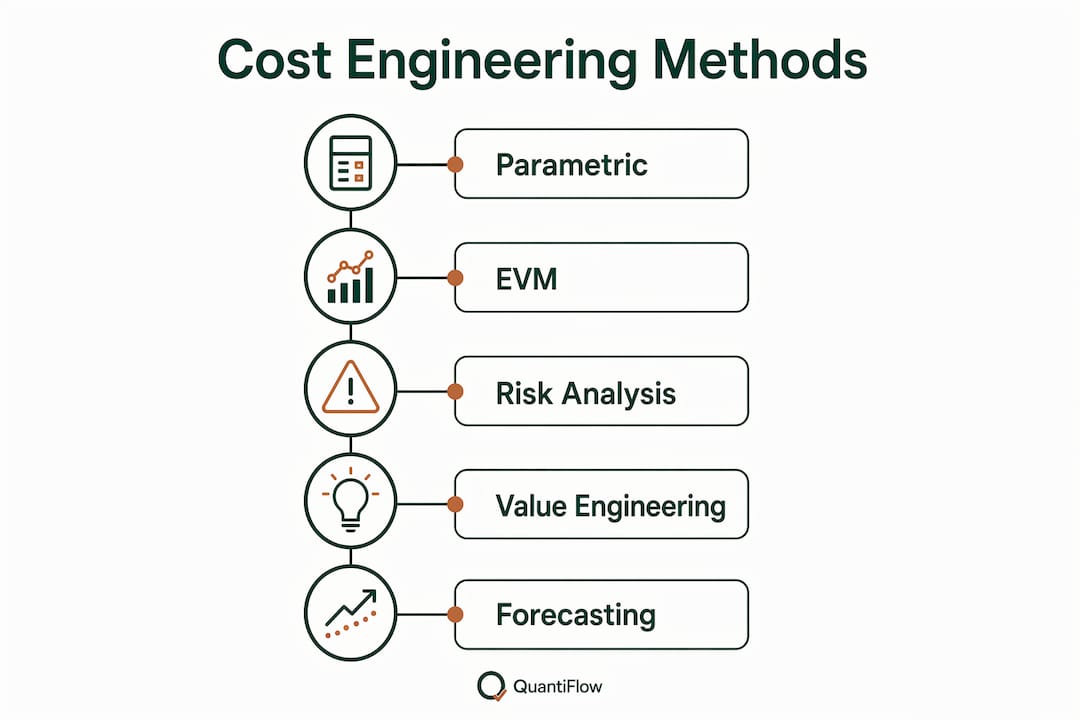
The core methods fall into three categories:
- Parametric estimating: uses historical cost data and statistical relationships to produce early-stage estimates before detailed design is complete. A cost per square metre for a hospital ward, adjusted for location and specification, is a parametric estimate.
- Detailed bottom-up estimating: builds cost from measured quantities, labour rates, plant, and materials. This is where quantity takeoffs feed directly into cost engineering.
- Earned Value Management (EVM): integrates cost and schedule data to measure actual project performance against the plan.
EVM produces two critical metrics. The Cost Performance Index (CPI) measures cost efficiency: a CPI below 1.0 means the project is spending more than planned for the work completed. The Schedule Performance Index (SPI) measures time efficiency in the same way. Both indices allow cost engineers to forecast final costs with far greater accuracy than traditional progress reporting.
| Method | Stage applied | Primary output |
|---|---|---|
| Parametric estimating | Feasibility and concept | Order of magnitude cost |
| Bottom-up estimating | Detailed design | Priced Bill of Quantities |
| Earned Value Management | Construction phase | CPI, SPI, forecast final cost |
| Should-cost analysis | Design and procurement | Target cost benchmark |
| Risk and investment appraisal | Pre-contract | Contingency and risk register |
Pro Tip: Apply EVM from the first month on site, not after problems emerge. A CPI of 0.9 in month two is a warning. The same figure in month eight is a crisis.
Cost engineering also requires cost reporting from measured quantities to be traceable and auditable. Every cost position should link back to a measured quantity and a rate, so that changes in scope translate automatically into revised cost forecasts.
Why is cost engineering vital for managing large construction projects?
Construction projects fail financially for predictable reasons. Scope creep, inaccurate early estimates, and reactive rather than proactive cost management are the three most common causes of budget overrun. Cost engineering addresses all three directly.
Early integration of cost engineering in the design phase enhances financial predictability and mitigates risk significantly. The earlier a cost engineer is involved, the more influence they have over the outcome. Decisions made at concept stage lock in the majority of a project's cost. Waiting until tender to apply cost discipline is too late.
The practical benefits for construction professionals include:
- Prevention of cash-flow crises: predictive analytics applied early identify resource-intensive phases before they arrive, allowing procurement and financing to be planned accordingly
- Scope control: a live cost plan linked to the design model flags the cost impact of every design change before it is approved
- Resource optimisation: cost engineers analyse labour, plant, and material deployment to identify inefficiencies before they compound on site
- Audit trail: structured cost engineering produces documentation that supports contract administration, dispute resolution, and final account settlement
- Informed decision-making: investment appraisal techniques give clients and project managers the data to make go or no-go decisions at each project gateway
The US Army Corps of Engineers demonstrates this in practice. Their cost engineers do not simply price work. They analyse, adapt, and forecast, maintaining a continuous lifecycle commitment to cost and schedule data rather than relying on reactive accounting methods. That proactive posture is what separates cost engineering from conventional cost control.
For architects, the role of cost engineering is particularly relevant at RIBA Stages 2 and 3, where design decisions have the greatest cost leverage. A cost engineer embedded at those stages can test design options against budget constraints before the project reaches detailed design, avoiding expensive redesign later.
How do digital tools improve construction cost engineering?
Digital tools have changed the speed and accuracy of cost engineering without changing its underlying principles. The most significant shift is in quantity takeoff, which historically consumed a large proportion of a cost engineer's time.
AI-driven quantity takeoffs improve accuracy and efficiency in cost estimation and forecasting, giving project managers real-time data rather than periodic snapshots. That shift from periodic to continuous cost data is what makes modern cost engineering genuinely proactive rather than retrospectively reactive.
The benefits of digital integration for cost engineering professionals include:
- Faster takeoff cycles: automated measurement from PDF drawings reduces the time from drawing issue to priced BoQ from days to hours
- Reduced transcription errors: AI cross-referencing of drawing sets catches discrepancies that manual takeoff misses
- Live cost forecasting: integration between measured quantities and cost databases produces updated forecasts as drawings change
- Audit-ready outputs: structured digital takeoffs create a traceable link between the drawing, the quantity, and the cost
Pro Tip: When evaluating quantity takeoff software, check whether it preserves your professional judgement or attempts to replace it. The best tools produce structured output that you review and approve, not a black-box number.
Quantiflow is built specifically for UK quantity surveyors and architects working to NRM2 standards. It uses AI to cross-reference architectural drawings and produce structured takeoffs, turning dense PDF drawing sets into measured, priceable BoQ output. The quantity surveying software benefits for SME practices are particularly significant: faster turnaround on tenders, fewer errors, and more time for the higher-level cost analysis that defines good cost engineering.
Key takeaways
Cost engineering in construction is a proactive, lifecycle discipline that applies scientific methods to estimate, control, and forecast project costs. It is far broader than estimating alone.
| Point | Details |
|---|---|
| Cost engineering vs estimating | Cost engineering covers the full lifecycle; estimating produces a single point-in-time figure. |
| Core methods | TCM framework, EVM metrics (CPI and SPI), parametric estimating, and should-cost analysis are the primary tools. |
| Early engagement matters | Integrating cost engineering at concept and design stage gives the greatest influence over final project cost. |
| Proactive not reactive | Continuous lifecycle commitment to cost and schedule data prevents cash-flow crises and scope overruns. |
| Digital tools accelerate delivery | AI quantity takeoff platforms reduce takeoff time and improve forecast accuracy without removing professional judgement. |
The misconception that costs engineers most
The most persistent mistake I see in construction practices is treating cost engineering as something that begins at tender. By that point, the fundamental cost decisions have already been made. The structural system is chosen, the specification is set, and the site constraints are fixed. A cost engineer arriving at tender stage is not engineering cost. They are pricing a fait accompli.
The practices that genuinely control budgets bring cost engineering into the room at feasibility. They run parametric estimates against early massing models. They use should-cost analysis to challenge specification choices before they become embedded in the design. They treat the cost plan as a live document, not a document produced once and filed.
The second misconception is that digital tools make cost engineering easier by removing the need for judgement. They do not. What they do is remove the tedious mechanical work, freeing cost engineers to spend more time on analysis, risk assessment, and client advice. That is where the real value sits. If you are spending the majority of your time measuring rather than thinking, the balance is wrong. Tools like Quantiflow exist to correct that balance, not to replace the professional behind the numbers.
— Michael
How Quantiflow supports cost engineering in UK construction
Cost engineering depends on accurate, timely quantity data. Without it, every forecast is built on an uncertain foundation.

Quantiflow automates NRM2-aligned quantity takeoffs directly from architectural drawings, producing structured BoQ output that cost engineers and quantity surveyors can price and audit. For SME practices and architects managing multiple projects, it removes the bottleneck between drawing receipt and priced tender. The platform preserves professional judgement at every step: you review, approve, and adjust the output rather than accepting an automated figure. Visit Quantiflow to see how AI quantity takeoffs can support your cost engineering process. Measured twice. Priced once.
FAQ
What is the cost engineering definition in construction?
Cost engineering in construction is the application of scientific principles to estimate, control, forecast, and manage project costs across the full lifecycle. It is formally recognised by AACE International and operates across more than 100 countries.
What does cost engineering involve beyond estimating?
Cost engineering includes value engineering, should-cost analysis, risk and investment appraisal, Earned Value Management, and supplier negotiation support. It requires deep technical understanding of design, materials, and construction methods.
What is the role of cost engineering in project success?
Cost engineering provides the financial framework that keeps projects on budget and on schedule. Early integration at design stage gives the greatest influence over final cost and prevents reactive budget management on site.
How do CPI and SPI help construction cost engineers?
The Cost Performance Index and Schedule Performance Index, calculated through Earned Value Management, measure cost and schedule efficiency in real time. A CPI below 1.0 signals that a project is overspending relative to work completed.
Why do small UK practices need cost engineering tools?
SME quantity surveyors and architects face the same cost engineering demands as large practices but with fewer resources. Digital tools like Quantiflow automate quantity takeoffs to free up time for higher-level cost analysis and client advice.