
A Bill of Quantities is defined as a measured, priced document that forms the contractual basis for tendering and cost administration in UK construction projects. Understanding how cost plans evolve to BoQ is the foundation of effective cost management for any quantity surveyor or project manager. The cost plan begins as a broad financial estimate and tightens progressively through each RIBA stage, governed by NRM1 for elemental cost planning and NRM2 for detailed measurement. By the time a project reaches Stage 4, confidence intervals narrow from ±25% at initiation to approximately ±5% at pre-tender. That tightening is not accidental. It reflects a deliberate, standards-aligned process of design maturity, scope definition, and measurement discipline.
How cost plans evolve to BoQ through RIBA stages
Cost plans are living financial documents, not static snapshots. They are updated and versioned at each RIBA stage from Stage 0 (Strategic Definition) through to Stage 4 (Technical Design), reflecting the growing certainty of the design and scope.

NRM1 governs elemental cost planning across these early stages, providing a structured framework of elements such as substructure, superstructure, and finishes. Each element carries an approximate cost allowance, adjusted as the design develops. At Stage 1 (Preparation and Briefing), estimates are broad and assumption-heavy. By Stage 3 (Spatial Coordination), the cost plan should reflect a coordinated design with meaningful quantities and rates.
The key characteristics of a well-managed cost plan include:
- Elemental structure aligned to NRM1, enabling consistent comparison across versions
- Stated assumptions and exclusions, so any change in scope is immediately visible
- Contingency allowances that reduce as design risk reduces through each stage
- Formal versioning, with each iteration agreed and signed off as the cost baseline
- Change control records, logging every scope or specification change and its cost impact
Misaligned cost plans cause change control failures; formal versioning at each RIBA stage is the primary defence against this. A cost plan that is not kept current loses its value as a control tool and creates a misleading picture of project affordability.
What is a BoQ and how is it prepared?
A BoQ is a measured document produced once the design is sufficiently mature and coordinated, typically at RIBA Stage 4. It lists every item of work in a project, measured in accordance with NRM2 measurement rules, with quantities expressed in standard units. Contractors price each item to produce a tender sum.
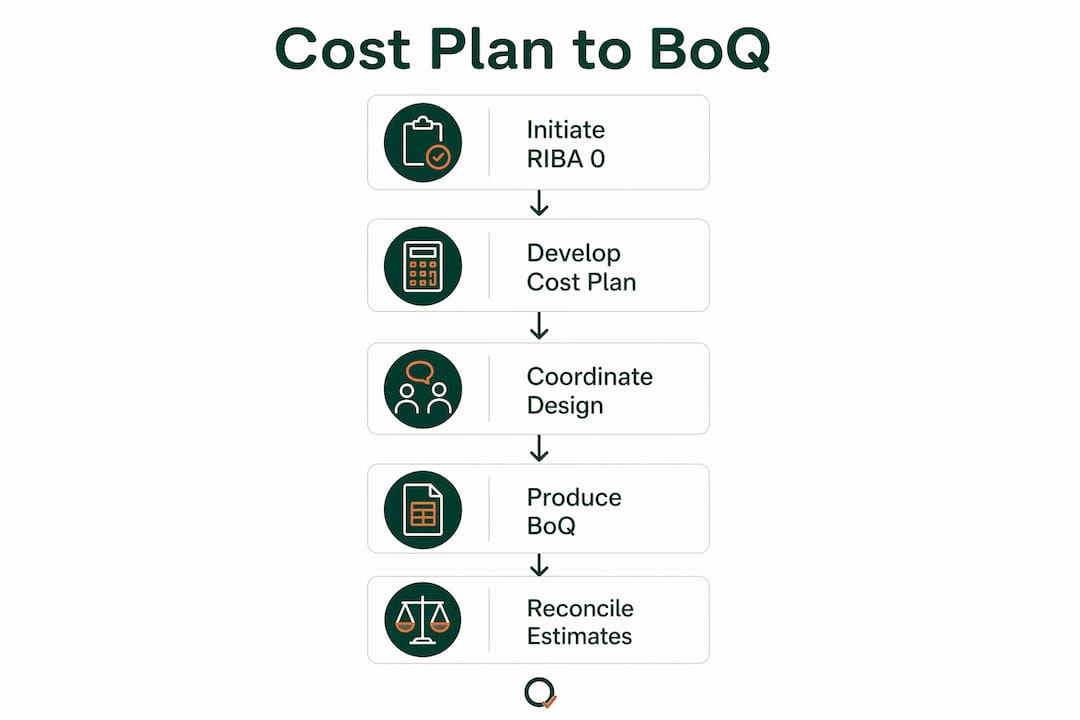
The preparation of a BoQ requires fully coordinated drawings and specifications. Without these, quantities cannot be measured reliably and the document loses its contractual integrity. This is why the BoQ follows the cost plan rather than replacing it during design development.
The BoQ serves several distinct functions:
- Tender pricing: contractors price identical quantities, enabling like-for-like comparison
- Contract baseline: the priced BoQ becomes the financial reference for the contract
- Variation valuation: changes to scope are valued against BoQ rates
- Interim valuations: work completed is measured against BoQ items for payment purposes
The functional difference between a cost plan and a BoQ is significant. A cost plan manages financial risk during design. A BoQ fixes the pricing basis for construction. Introducing a BoQ too early creates a false sense of certainty when the design is still fluid, which can lead to expensive variations later.
Pro Tip: Never commission a BoQ until the design team confirms that drawings are fully coordinated and the specification is complete. A BoQ measured from incomplete information is a liability, not an asset.
How is the transition from cost plan to BoQ formally reconciled?
Reconciliation is the formal process of comparing the Stage 4 pre-tender cost plan with the quantities and rates in the completed BoQ. This step is not optional. It is a professional control measure that confirms the two documents tell the same story about project scope and cost.
The reconciliation process follows a clear sequence:
- Align elemental categories: map NRM1 elements in the cost plan to the corresponding NRM2 work sections in the BoQ. Explicit mapping between NRM1 and NRM2 enables a structured comparison rather than a line-by-line hunt for discrepancies.
- Compare quantities: check that measured quantities in the BoQ match the approximate quantities used in the Stage 4 cost plan. Significant differences indicate either a measurement error or a scope change that was not captured in the cost plan.
- Compare rates: verify that unit rates in the BoQ are consistent with the cost plan allowances. Unexplained rate differences may reflect specification upgrades or market movement.
- Investigate variances: reconciliation must be treated as a control measure; discrepancies signal errors or scope issues, not just price fluctuations. Each variance should be categorised as a quantity difference, a rate difference, or a scope change.
- Update the cost plan: once variances are resolved, update the cost plan to reflect the BoQ position. This becomes the pre-tender estimate against which tender returns are assessed.
The reconciliation table below illustrates how variances are categorised in practice:
| Variance type | Likely cause | Action required |
|---|---|---|
| Quantity difference | Measurement error or scope change | Recheck drawings; update cost plan |
| Rate difference | Specification change or market movement | Confirm specification; adjust allowance |
| Item missing from BoQ | Omission during takeoff | Add item; reissue BoQ if pre-tender |
| Item missing from cost plan | Scope creep not captured | Raise change control; update baseline |
Pro Tip: Treat any divergence between the cost plan and the BoQ as a flag for detailed review. Accepting it as market volatility without investigation is how cost overruns begin.
Common pitfalls in the cost plan to BoQ transition
The transition from cost plan to BoQ is where many projects lose cost control. The errors are rarely dramatic. They accumulate quietly through poor process discipline.
The most frequent pitfalls include:
- Failing to update the cost plan at each RIBA stage, so the Stage 4 estimate reflects Stage 2 assumptions. Many project failures trace back to poorly updated cost plans that do not match the current design stage.
- Commissioning the BoQ before the design is coordinated, producing a document full of provisional sums and assumptions that undermine its contractual value.
- Misaligned assumptions between the cost plan and the BoQ, particularly around specification, provisional items, and excluded works. These misalignments make tender comparison unreliable.
- Ignoring reconciliation, which means the pre-tender estimate and the BoQ exist as separate documents with no verified relationship. This weakens the QS's ability to advise on tender returns.
- Poor change control during design development, allowing scope to drift without corresponding cost plan updates. By Stage 4, the accumulated drift can be substantial.
Applying a consistent measurement framework from elemental plan to BoQ reduces the risk of claims and contract variation disputes. The investment in process discipline at this stage pays dividends throughout the construction phase.
Pro Tip: Maintain a formal version log for every cost plan issue. Record the date, the RIBA stage, the reason for the update, and the agreed cost position. This log is your audit trail if a dispute arises.
Technology and best practices supporting the transition
Digital tools have materially changed how quantity surveyors manage the cost plan to BoQ workflow. Automated quantity takeoff removes much of the manual measurement burden, reducing the risk of human error and speeding up the production of BoQ-ready quantities from coordinated drawings.
The practical benefits of AI-assisted quantity takeoff in this context include:
- Faster measurement cycles, enabling QS teams to produce and update quantities as the design evolves rather than waiting for a single Stage 4 exercise
- Consistent classification, with quantities automatically mapped to NRM2 work sections, reducing the manual effort of NRM1-to-NRM2 alignment
- Traceable outputs, where every quantity links back to a specific drawing and revision, supporting version control and audit
- Tender comparison support, with structured BoQ data enabling like-for-like analysis of contractor returns
- Change management, where revised drawings trigger updated quantities, making scope changes visible immediately
Automated software tools improve accuracy and speed when reconciling cost plans and BoQs, supporting consistent tender comparison and change control. For SME QS practices, this capability was previously available only to larger firms with dedicated measurement teams. AI-driven platforms have changed that equation significantly. Professionals seeking to understand the wider benefits of quantity surveying software will find that the gains extend well beyond measurement speed alone.
Key takeaways
The most effective approach to the cost plan to BoQ transition is a structured, version-controlled process aligned to NRM1 and NRM2, with formal reconciliation at Stage 4 before tender issue.
| Point | Details |
|---|---|
| Cost plans are living documents | Update and version the cost plan at every RIBA stage to maintain its value as a control tool. |
| BoQ requires design maturity | Commission the BoQ only when drawings are fully coordinated and the specification is complete. |
| Reconciliation is mandatory | Compare Stage 4 cost plan estimates with BoQ quantities and rates; investigate every material variance. |
| NRM1 to NRM2 mapping reduces risk | Aligning elemental categories to work sections early prevents discrepancies and supports audit. |
| Technology accelerates accuracy | AI-assisted takeoff tools reduce measurement error and speed up the cost plan to BoQ workflow. |
The timing question nobody talks about honestly
The biggest mistake I see in practice is not a measurement error or a wrong rate. It is a timing error. Teams commission the BoQ too early, before the design is genuinely coordinated, and then spend weeks issuing addenda and provisional sum adjustments that erode the document's credibility with contractors.
The cost plan exists precisely to manage the period of uncertainty. It is designed to carry risk through assumptions and contingencies. The BoQ is not. When you force a BoQ onto an immature design, you are not creating certainty. You are creating a document that looks certain but is not, and that distinction matters enormously when a contractor submits a claim.
My honest view is that the reconciliation step is undervalued. Most QS teams treat it as an administrative task rather than a professional control. A well-executed reconciliation tells you whether your cost plan was accurate, whether the design changed without your knowledge, and whether the BoQ was measured correctly. That is three separate quality checks in one process. Skipping it is not efficiency. It is risk.
The professionals who manage this transition well share one habit: they treat the cost plan and the BoQ as two chapters of the same story, not two separate documents. Every update to one should prompt a review of the other. That discipline, more than any software tool, is what keeps projects on budget.
— Michael
Quantiflow: built for the cost plan to BoQ workflow
Quantiflow is an AI-powered quantity takeoff platform built specifically for UK quantity surveyors, builders, and architects managing the cost plan to BoQ transition. It reads PDF drawings, cross-references them automatically, and produces NRM2-aligned BoQ output that preserves your professional judgement rather than replacing it.
For SME QS practices, Quantiflow removes the manual measurement bottleneck that slows down Stage 4 workflows. Quantities are traceable to specific drawings and revisions, making reconciliation faster and your tender documentation more defensible. Plans start from £39 per month for the Solo tier, with Business at £149 per month and custom Enterprise pricing available. If you are ready to produce NRM2-compliant BoQs faster and with greater confidence, Quantiflow is built for exactly that workflow. Measured twice. Priced once.
FAQ
What is the difference between a cost plan and a BoQ?
A cost plan is an elemental financial estimate used to control budgets during design development, governed by NRM1. A BoQ is a measured, priced document produced at tender stage under NRM2, forming the contractual basis for pricing and variation valuation.
At which RIBA stage does a cost plan become a BoQ?
The transition occurs at RIBA Stage 4, where the design is sufficiently coordinated for detailed measurement. Estimate confidence tightens to ±5% at this stage, making it the appropriate point to commission a BoQ.
Why must cost plans be reconciled with the BoQ?
Reconciliation confirms that the Stage 4 pre-tender estimate and the BoQ reflect the same scope and cost position. Discrepancies signal errors or scope issues rather than simple market movement, and each variance requires investigation before tender issue.
What happens if the BoQ is produced too early?
A BoQ produced before the design matures creates false certainty and typically results in a high volume of provisional sums, addenda, and post-contract variations that increase cost and programme risk.
How does NRM2 differ from NRM1 in practice?
NRM1 provides the elemental framework for approximate cost estimates during design stages. NRM2 governs detailed measurement rules for BoQ preparation, requiring quantities to be measured in standard units from coordinated drawings to support auditability and contract administration.