
Planning conditions are the legally binding requirements attached to a planning permission that directly determine what a scheme costs to build and when it can start. For UK construction professionals, understanding how planning conditions affect building costs is not optional. Section 106 agreements, Community Infrastructure Levy charges, pre-commencement requirements, and affordable housing obligations can each add six figures to a project budget before a single foundation is poured. Miss one condition and you risk a stop-work order, costly rework, and a programme that slips by months.
What are the main types of planning conditions that affect construction costs?
Planning conditions fall into three broad categories, and each carries a different cost profile.
Pre-commencement conditions must be discharged before work begins. They typically require technical submissions such as drainage strategies, ecological surveys, or archaeological assessments. Pre-commencement conditions can delay a site start by months if teams underestimate the time needed to prepare and submit the required documents. That delay compounds consultant fees, holding costs, and finance charges simultaneously.

Prior-to-occupation conditions trigger at practical completion. These often include affordable housing transfers, public realm works, or highway adoption agreements. The cost is certain, but the timing creates a cash flow pinch precisely when a developer needs liquidity to repay construction finance.
Ongoing restrictive conditions govern how a building operates after occupation. Examples include restrictions on hours of use, limits on external plant, or requirements to maintain landscaping to an approved specification. These conditions rarely appear in early cost plans, yet they generate real expenditure over the building's life.
- Affordable housing obligations require a proportion of units to be transferred to a registered provider at a discounted price, reducing gross development value directly.
- Infrastructure contributions cover roads, schools, and open space, paid either as a financial sum or delivered in kind.
- Environmental mitigations include biodiversity net gain measures, sustainable drainage systems, and air quality monitoring.
- Heritage conditions specify materials, detailing, and methods on sensitive sites, often at a premium over standard specification.
Pro Tip: Read every condition on the decision notice before signing contracts. Conditions that appear administrative, such as a requirement to submit a construction management plan, can trigger third-party approvals that add weeks to your programme.
How do Section 106 agreements and Community Infrastructure Levy influence building costs?
Section 106 agreements and Community Infrastructure Levy are the two principal mechanisms through which local authorities extract financial contributions from development. Both affect scheme viability, but they work in fundamentally different ways.
Section 106 agreements
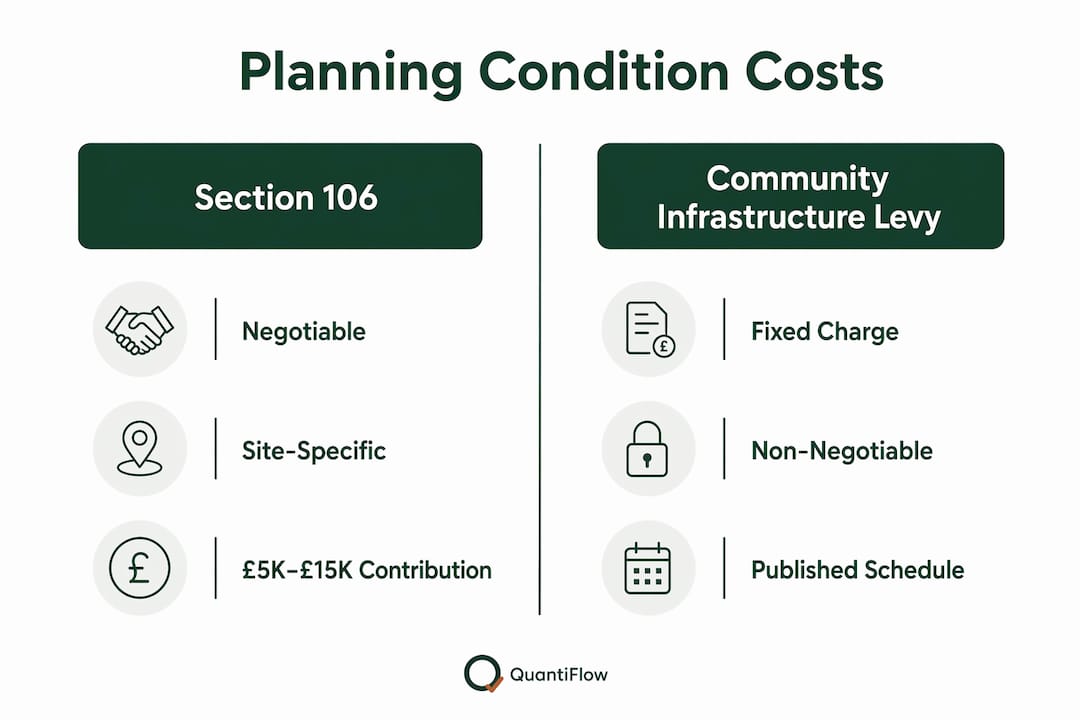
A Section 106 agreement is a negotiated legal obligation between the developer and the local planning authority, made under the Town and Country Planning Act 1990. Its content is site-specific and covers affordable housing, financial contributions to local infrastructure, and sometimes in-kind delivery of community facilities. Because S106 obligations are negotiated, their cost depends on the authority's priorities, the scale of the scheme, and the outcome of a formal viability assessment.
S106 financial contributions for smaller residential schemes typically range from £5,000 to £15,000 per dwelling. For schemes of 15–20 units in high-demand areas such as Surrey and Buckinghamshire, total contributions can exceed £100,000. That figure sits outside the construction contract but directly reduces the return available to fund it.
Affordable housing obligations carry the largest single cost within most S106 agreements. On a 20-unit scheme with a 30% affordable housing requirement, gross development value falls by roughly £900,000 if each affordable unit is discounted by £150,000 against market value. Lenders assess development viability against net GDV after all planning obligations, so high S106 costs reduce the maximum loan available and increase the equity a developer must commit.
Community Infrastructure Levy
CIL operates differently. It is a fixed, non-negotiable charge set by the local authority in a published charging schedule and applied per square metre of new floor space. CIL charges typically range between £100 and £300 per square metre. That predictability is useful for cost planning, but the charge applies regardless of scheme viability and must be paid at commencement or in instalments tied to programme milestones.
| Mechanism | Basis of calculation | Negotiable? | Typical range |
|---|---|---|---|
| Section 106 | Site-specific negotiation | Yes, subject to viability | £5,000–£15,000 per dwelling |
| Community Infrastructure Levy | Fixed per sqm charging schedule | No | £100–£300 per sqm |
| Affordable housing (S106) | Percentage of units at discounted value | Partially | Varies by authority |
A critical point that many cost plans miss: S106 and CIL liabilities often exceed what policy documents suggest because local authorities apply precedents from recent comparable decisions. Relying solely on the published policy text produces an underestimate. Benchmark obligations against recent permissions on similar sites in the same authority area.
What are the challenges in negotiating and discharging planning conditions?
Negotiating and discharging conditions is where projects most commonly lose time and money. The process is rarely as straightforward as submitting a form and waiting for approval.
Early engagement with planning officers before the decision notice is issued is the single most effective way to prevent costly conditions. A brief pre-decision discussion can remove a condition that would otherwise require an expensive Section 73 variation application to amend later. Section 73 applications carry their own fees, consultant costs, and programme risk, and they are not guaranteed to succeed.
Heritage and environmental constraints generate the most financially damaging surprises. Developing without detailed knowledge of local heritage policies can impose requirements such as bespoke cladding on Victorian-style buildings, adding approximately £80,000 per unit. That figure appears nowhere in a standard elemental cost plan unless the QS has read the local heritage design guide and priced accordingly.
The consequences of missing a condition obligation are severe:
- Stop-work orders halt the site immediately, triggering standing time for labour and plant.
- Enforcement notices require costly rectification works, sometimes including demolition of non-compliant elements.
- Programme overrun increases finance charges, which compound daily on development loans.
- Reputational damage with the local authority makes future applications harder to approve.
Unawareness of specific conditions among project team members is a leading cause of stop-work orders and expensive rework. The decision notice must be circulated to every party: the main contractor, subcontractors with relevant scope, the project manager, and the QS preparing the cost plan.
Pro Tip: Create a conditions register at the point of planning approval. Log every condition, its trigger event, the responsible party, the submission deadline, and the estimated cost of compliance. Review it at every project meeting.
How can construction professionals manage planning condition costs?
Managing the building cost implications of planning conditions requires deliberate action at each project stage, not a single review at planning approval.
1. Commission a viability assessment before committing to a site. A formal viability assessment models S106 obligations, CIL charges, affordable housing requirements, and abnormal costs against the projected GDV. It tells you whether the scheme is financially viable before you exchange contracts. Many professionals treat this as optional. It is not.
2. Research local authority precedents, not just policy. Policy documents state the authority's intentions. Recent decision notices reveal what they actually impose. Benchmarking S106 obligations against comparable local permissions gives a far more accurate cost forecast than reading the Local Plan alone.
3. Build a detailed conditions register and assign ownership. Every condition needs a named owner, a trigger date, and a cost estimate. Conditions without owners get missed. Missed conditions cause delays that cost more than the compliance work itself.
4. Model cash flow around condition payment triggers. CIL instalments and S106 payments fall at fixed programme milestones. Map them against your drawdown schedule so you are not caught short at commencement or occupation. Finance charges on a development loan are material; a missed payment milestone can trigger a default clause.
5. Use digital cost modelling to forecast planning-related expenditure. AI-enabled quantity takeoffs allow construction professionals to model the cost implications of planning conditions against measured drawings in real time. When a condition changes the specification, the cost impact updates immediately rather than requiring a manual remeasure.
Pro Tip: When preparing a Bill of Quantities for a scheme with significant planning obligations, create a dedicated preliminary section for condition compliance costs. Include discharge application fees, consultant submissions, ecological surveys, and any in-kind infrastructure works. These costs are real and they belong in the BoQ.
Understanding how builders price a project in the context of planning obligations is a core competency for any QS working on residential or mixed-use schemes in 2026.
Key takeaways
Planning conditions are a primary driver of cost variance on UK construction projects, and accurate forecasting of their financial impact is the difference between a viable scheme and one that fails at funding stage.
| Point | Details |
|---|---|
| S106 and CIL add material cost | S106 contributions range from £5,000–£15,000 per dwelling; CIL runs £100–£300 per sqm. |
| Affordable housing reduces GDV significantly | A 30% affordable housing requirement on a 20-unit scheme can cut GDV by roughly £900,000. |
| Pre-commencement conditions delay starts | Underestimating technical submissions can push a site start back by months, increasing finance costs. |
| Early engagement prevents costly conditions | Pre-decision discussions with planning officers can remove conditions that would otherwise require expensive S73 variations. |
| Conditions registers prevent stop-work orders | Assigning every condition a named owner and trigger date is the most reliable way to avoid enforcement action. |
Planning conditions and cost control: what I've learned from the sharp end
The most expensive mistake I see construction professionals make is treating planning conditions as an administrative formality. They read the headline permission, note the expiry date, and move on. The conditions schedule, sometimes 20 or 30 pages long, sits unread until a contractor asks why they cannot start groundworks.
The financial consequences are predictable. A pre-commencement condition requiring a contamination remediation strategy holds up a site start while the developer pays interest on a drawn-down loan. A heritage condition specifying handmade brick adds £40 per square metre to the external envelope with no corresponding increase in sale value. Neither cost appears in the original appraisal because nobody read the conditions carefully enough.
What I find equally frustrating is how rarely viability assessments are updated after planning approval. The S106 heads of terms agreed at outline stage often bear little resemblance to the obligations in the final agreement. By the time the QS is preparing the BoQ, the project is already carrying costs that were never in the budget.
The professionals who manage this well share one habit: they treat the conditions register as a live cost document, not a compliance checklist. Every condition has a price. Some are fixed, some are negotiable, and some depend entirely on how quickly you can get a planning officer on the phone. Knowing which is which, before you commit to a programme, is what separates a well-run scheme from an expensive one.
Technology is changing what is possible here. Platforms that connect measured drawings to cost data allow a QS to model the impact of a specification change driven by a heritage condition within minutes rather than days. That speed matters when a planning officer's response arrives on a Friday afternoon and the contractor is pricing on Monday morning.
— Michael
Quantiflow and the cost of planning conditions
Planning conditions change specifications. Changed specifications change quantities. Changed quantities change costs. That chain of events is where budgets slip, and it happens on almost every scheme with a complex conditions schedule.

Quantiflow automates NRM2-aligned quantity takeoffs directly from architectural drawings, so when a planning condition alters a material specification or adds a new element, the cost impact is visible immediately. Construction professionals use Quantiflow to produce structured, priceable BoQ output that captures condition-driven scope changes without manual remeasure. Plans start from £39 per month for solo practitioners. For teams managing multiple schemes with significant planning obligation costs, the Business plan at £149 per month delivers the speed and traceability that complex projects demand. Measured twice. Priced once.
FAQ
What are planning conditions in the UK?
Planning conditions are legally binding requirements attached to a planning permission by the local planning authority. They specify what must be done, when, and how, before, during, or after construction.
How do Section 106 agreements affect building costs?
Section 106 agreements impose negotiated financial contributions and affordable housing obligations that reduce gross development value and increase the equity a developer must commit to secure finance.
What is the difference between S106 and CIL?
Section 106 obligations are negotiated and site-specific; Community Infrastructure Levy is a fixed, non-negotiable charge calculated per square metre of new floor space using the local authority's published charging schedule.
Can planning conditions delay a construction programme?
Pre-commencement conditions require technical submissions that must be approved before work begins, and underestimating the time needed to discharge them can delay a site start by several months.
How can a QS account for planning condition costs in a BoQ?
A QS should create a dedicated preliminary section in the Bill of Quantities covering discharge application fees, consultant submissions, ecological surveys, and any in-kind infrastructure works required by the conditions schedule.