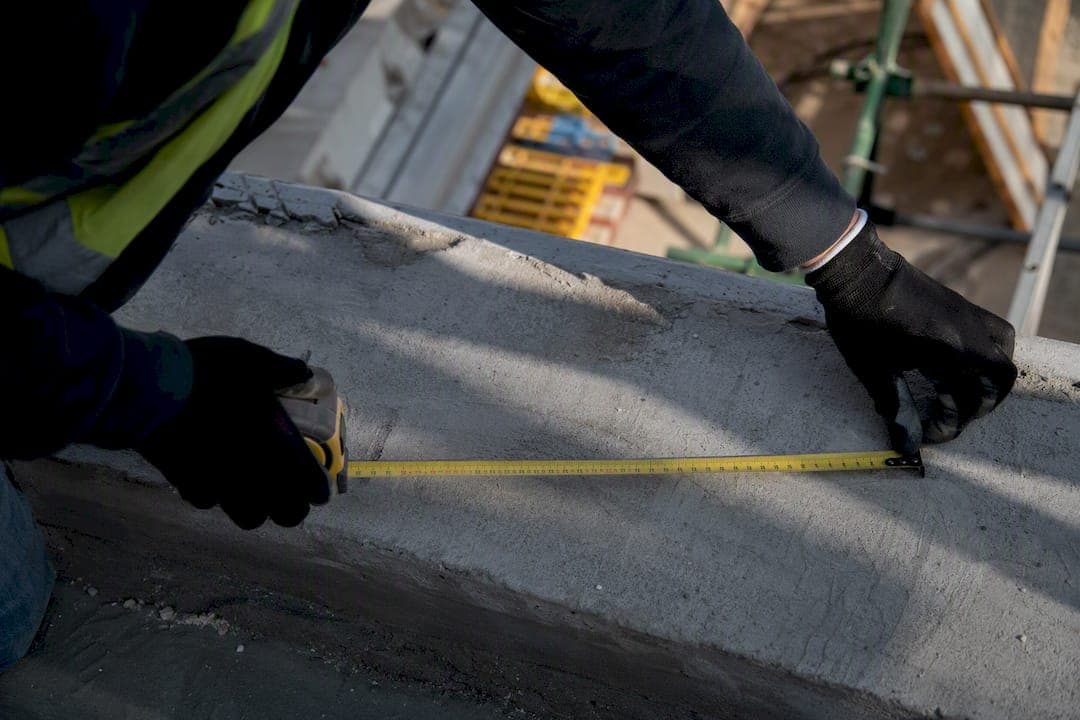
A deduction converts a gross measured quantity into a net quantity by excluding clearly specified items such as openings, voids, and reveals. Unless a measurement code or contract clause states otherwise, you deduct the full excluded area or volume rather than a partial figure. This single rule underpins quantity takeoff accuracy across plastering, brickwork, and finishing trades.
Two references anchor this practice. Measurement codes such as IS 1200 set out trade-specific deduction rules, while the International Vocabulary of Metrology (VIM) defines the calibration discipline that keeps your source drawings trustworthy before any deduction is applied.
- Gross measurement includes the full area or volume before exclusions.
- Net measurement is what remains after deducting specified openings or voids.
- Deduct in full unless a named exception (small openings, jambs) applies.
Pro Tip: Digital takeoff tools calibrated correctly can cut takeoff time by roughly 30 to 40 percent compared with manual measurement, but that saving only holds if your scale reference is right from the first sheet.
Key Takeaways
Applying deductions correctly requires a named measurement code, a documented rationale, and calibrated drawings before any quantity is converted from gross to net.
| Point | Details |
|---|---|
| Deduct in full by default | Exclude the entire opening or void unless a code names a specific exception. |
| Separate jambs from openings | Measure reveals and soffits as their own item, not folded into the deduction. |
| Calibrate before measuring | Verify scale on every sheet; recalibration errors distort every deduction downstream. |
| Reconcile across sheets | Cross-check elevation, schedule, and plan sheets to avoid double deductions. |
| Confirm ambiguous AI output | Automated takeoffs can underestimate area-based items, so confirm manually. |
Table of Contents
- What are the core rules for applying deductions in measurement?
- Trade-specific deduction rules for plastering and masonry
- How to calculate a deduction, step by step
- Common measurement pitfalls and how to catch them
- Applying deductions inside a digital takeoff workflow
- Why deduction discipline matters more than the software you use
- Sources
What are the core rules for applying deductions in measurement?
Gross measurement records the full extent of a wall, slab, or surface as drawn, ignoring any interruptions. Net measurement is what a quantity surveyor actually bills once openings, voids, and other excluded features are removed. You use gross figures for early-stage estimating and net figures for the priced Bill of Quantities, because the client pays for what gets built, not what gets left out.
The general deduction rule is straightforward: deduct any item the measurement code or contract identifies as excluded, in full, unless a specific exception applies. Where a contract nominates a nonstandard mode of measurement, that document governs over generic code guidance. Contracts silent on treatment default to the referenced code.
Common exceptions include:
- Small openings below a stated threshold, which some codes exempt from deduction entirely.
- Jambs and soffits, which are often measured separately as finished surfaces rather than deducted with the opening.
- Overlapping deductions, where two adjacent exclusions share an edge and must not be counted twice.
Document the rationale for every deduction directly against the BoQ line. A note explaining why a 400mm service duct was or wasn't deducted saves hours during a dispute months later.
Trade-specific deduction rules for plastering and masonry
Different trades apply different thresholds, and mixing them up is one of the most common quantity takeoff accuracy failures in practice.
-
Plastering deductions: Many practitioners work to a convention where openings below a certain size attract only a partial deduction, sometimes cited as a 50% reduction rather than a full one, particularly under IS 1200 practice notes. Larger openings are deducted in full, with jambs and soffits measured as extra plastered surface. National codes differ on the exact threshold, so always confirm against the code named in your contract before applying a percentage rule from memory.
-
Brick and blockwork: Rectangular openings are calculated using length multiplied by height multiplied by wall thickness, and the resulting volume is deducted in full in almost all standard modes of measurement. There's rarely a small-opening exemption in blockwork the way there sometimes is in plastering.
-
Doors and windows: Deduct the full opening from the wall or wall-finish quantity. Jambs, heads, and soffits are then measured separately as their own finished item, never folded back into the wall deduction. Watch for cases where a lintel bearing extends past the opening. That extra bearing length isn't part of the door or window deduction.
-
Exam-style rules mirror site practice: Training materials and professional exam questions tend to reflect the same thresholds used on live jobs, which makes them a reasonable sanity check when a contract is ambiguous.
How to calculate a deduction, step by step
The formula is simple in principle: net = gross − Σ(exclusions). The difficulty is never the arithmetic. It's correctly identifying every exclusion once, and only once.
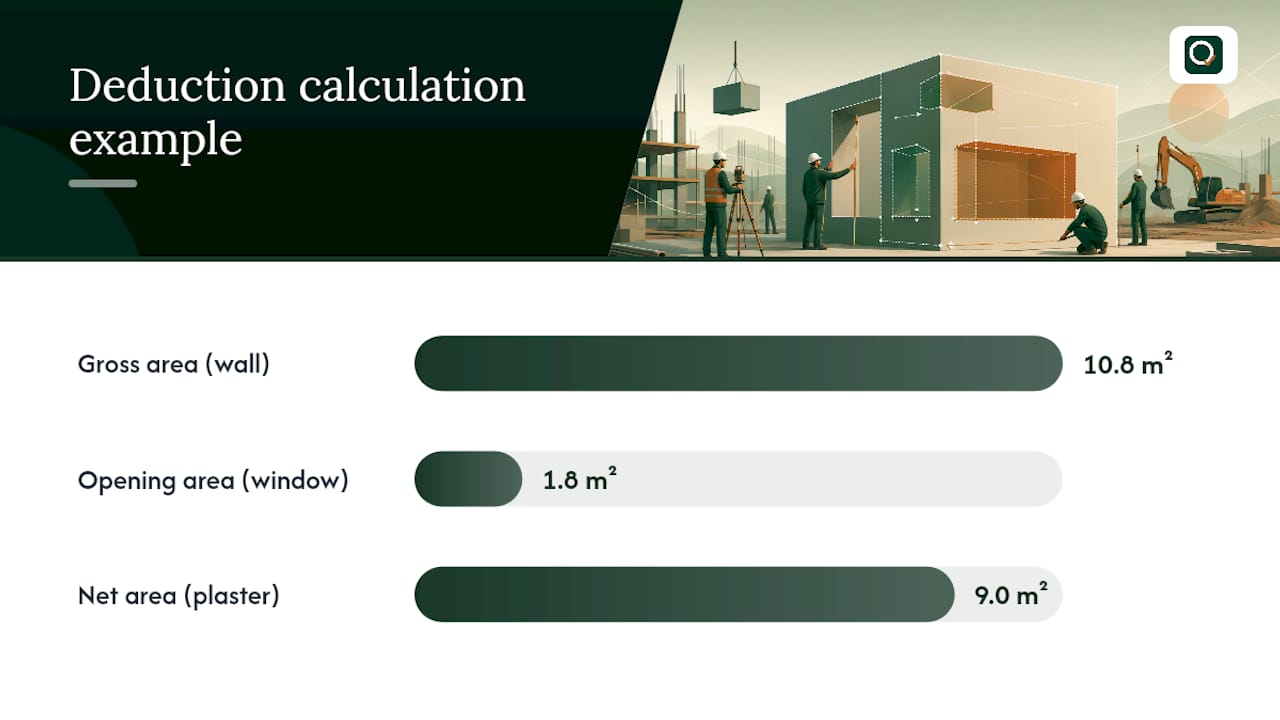
Worked plaster example: A wall measures 4.0m by 2.7m, giving a gross area of 10.8 square metres. A window opening measures 1.2m by 1.5m, or 1.8 square metres. If the opening exceeds your code's small-opening threshold, deduct it in full: 10.8 − 1.8 = 9.0 square metres net plaster. Jambs and soffits (say, a 0.15m reveal around the perimeter of the opening) are then measured separately and added back as their own item, typically at a different rate. In imperial terms, the same wall might read as 13ft 1in by 8ft 10in, but the deduction logic doesn't change with the unit.
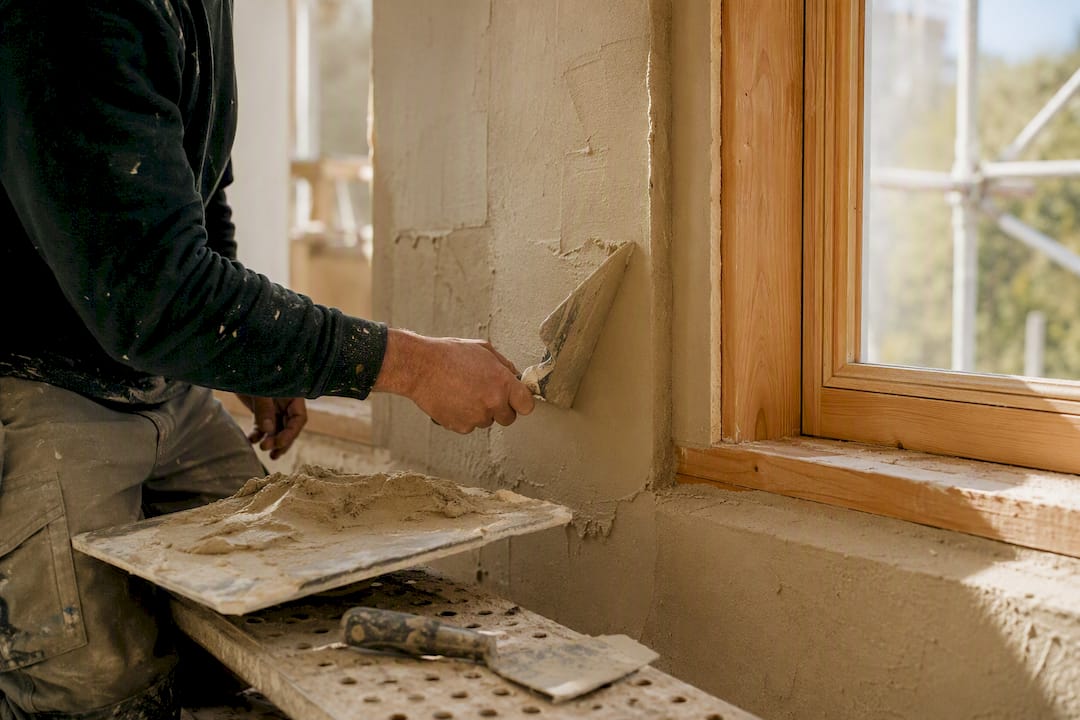
Worked blockwork example: An opening in a 215mm thick block wall measures 900mm wide by 2,100mm high. Volume deducted equals 0.9m × 2.1m × 0.215m, which comes to 0.406 cubic metres, removed from the gross wall volume.
Before you sign off any calculation, run this checklist:
- Confirm the drawing scale matches the calibration used in your takeoff tool.
- Check you're working from the latest sheet revision, not a superseded one.
- Verify no exclusion has been deducted twice across overlapping layers.
- Cross-check opening counts against the door and window schedule.
Common measurement pitfalls and how to catch them
Most deduction errors trace back to one of three causes: a miscalibrated scale, a double-counted exclusion, or an unreconciled drawing revision. The VIM's distinction between calibration and adjustment is worth borrowing here. Calibration means measuring and recording, adjustment means changing something to correct it, and you should never adjust a takeoff scale without first verifying what it currently reads.
Multi-sheet reconciliation causes a surprisingly large share of disputes. A window shown on the elevation sheet might not match the schedule on the joinery sheet, and if your takeoff pulls from both without cross-checking, you'll either double-deduct or miss the opening entirely.
- Recalibrate scale on every new sheet before measuring, not just at the start of the job.
- Keep an exclusions layer separate from the gross measurement layer so deductions are auditable on their own.
- Reconcile counts (doors, windows, penetrations) against the schedule before finalising the BoQ.
- Require a second sign-off on any deduction over a value threshold your practice sets.
Pro Tip: A layer-driven workflow, where gross area sits on one layer and tagged exclusions sit on another, makes multi-sheet reconciliation far less error-prone than working from a single flattened measurement.
Applying deductions inside a digital takeoff workflow
A typical digital workflow runs: import drawing, calibrate scale, mark gross area, flag exclusions, apply deductions, export BoQ. Guidance on structuring PDF layers for takeoff supports exactly this separation between gross and exclusion layers.
Automation speeds this up considerably, but AI-based platforms can systematically underestimate area-based quantities even when count-based items align well. That's precisely why Quantiflow preserves estimator override at every stage rather than auto-committing a deduction.
- Flag ambiguous openings for manual confirmation before export.
- Keep an audit trail on every deduction for later reconciliation.
Pro Tip: Treat AI-suggested deductions as a first draft, not a final figure, especially on irregular or splayed openings.
Why deduction discipline matters more than the software you use
The industry's instinct is to treat deduction rules as a solved problem, something you learned once during training and never revisit. That's the gap I'd flag first: codes like IS 1200 leave genuine room for interpretation on small openings, and contracts frequently nominate a mode of measurement without anyone checking whether it actually contradicts the default code. Most disputes over deductions aren't arithmetic errors. They're arguments about which rule should have applied.
The conventional advice, calibrate your scale and double-check your counts, is correct but incomplete. It says nothing about documenting why a deduction was or wasn't applied, which is the detail that actually resolves a dispute six months later. Evidence on AI-assisted takeoff backs this up: automation handles counts well but can misjudge area-based exclusions, meaning the judgement call still sits with the surveyor.
If you prioritise one thing, make it the audit trail. A correct deduction with no recorded rationale is barely more defensible than a wrong one.
— Michael
Sources
Three types of source carry weight in a deduction dispute or a professional write-up.
Where a contract is silent, follow the code it nominates first. If none is nominated, default to the recognised national code for that trade and record that choice in your working papers.