
Collaborative takeoff delivers faster, more accurate and auditable estimates by replacing scattered spreadsheets and lone-wolf measuring with a shared digital takeoff and a single source of truth. It works across both 2D and 3D/BIM workflows, and platforms like QuantiFlow are built to formalise that shared process. What follows is the practical workflow, QA guidance and feature checklist behind it.
TL;DR:
- Collaborative takeoff reduces errors and saves time by enabling multiple team members to work on the same shared digital file simultaneously.
- Proper setup, role assignment, and disciplined revision control are essential to prevent version confusion and maintain data integrity.
- Software supporting granular permissions, revision tracking, and parity between 2D and 3D/BIM measurements enhances collaboration effectiveness.
- Consistent, structured data exports with verified units and cost codes are crucial for accurate handover to estimating tools and model integrity.
- Implementing peer reviews, explicit tolerance thresholds, and audit logs ensures takeoff quality and defensibility in client or dispute scenarios.
Table of Contents
- What is collaborative takeoff and why does it matter?
- How do you run a collaborative takeoff step by step?
- What software features actually support collaboration?
- How do you keep takeoff data clean when handing it to estimating?
- What quality assurance keeps a collaborative takeoff defensible?
- What evidence supports these collaborative takeoff practices?
- A practitioner's take on what actually changes behaviour
- How QuantiFlow supports a collaborative takeoff workflow
- Sources
What is collaborative takeoff and why does it matter?
Collaborative takeoff is the practice of multiple people, an estimator, a quantity surveyor, a reviewer, working on the same set of measured quantities inside one cloud-hosted file, rather than passing PDF drawings and Excel sheets back and forth by email. Everyone sees the same measurements, the same annotations, and the same version, at the same time.
The alternative, still common in smaller practices, is the "send me your file" model. One person measures, emails a spreadsheet, someone else tweaks it, and nobody is entirely sure which version went into the final bid. That's where most estimating errors are born, not from bad measuring, but from bad handoffs.
The business case for fixing this is straightforward:
- Time saved. Windover Construction reported more than 30% savings on estimating time after moving to a connected, BIM-fed takeoff environment.
- Fewer missed items. Shared visibility means two sets of eyes catch what one might miss, particularly on complex mechanical or structural drawings.
- Reduced waste. Accurate quantities mean fewer contingency buffers built purely out of uncertainty.
- Clearer change control. When a drawing revision lands, everyone works from the same updated file instead of racing to catch up.
- Improved bid confidence. A defensible, traceable takeoff is easier to stand behind when a client queries a number.
Parity between 2D and 3D/BIM workflows matters here too. Teams shouldn't have to choose between traditional on-screen measuring and BIM-derived quantities. The strongest collaborative setups let both feed the same shared model, so a QS working from a 2D PDF and a colleague pulling data from a Revit export end up reconciling against one set of numbers, not two.
How do you run a collaborative takeoff step by step?
A collaborative takeoff process breaks down into five stages, each with its own discipline. Skipping the setup stage is the most common reason teams end up back in spreadsheet chaos within a fortnight.
- Set up the project and files properly. Agree naming conventions, layer structures and a central repository before anyone starts measuring. Use a consistent template for every project so reviewers know where to find rooms, elevations and specification notes without hunting. A practical guide to managing PDF layers is worth reading before your first shared session.
- Assign roles and permissions. The estimator measures, the reviewer checks tolerances and flags anomalies, the project manager signs off before pricing. Give each role only the access it needs, an estimator shouldn't be able to overwrite a locked, reviewed section.
- Run shared takeoff sessions properly. Live sessions with comments attached directly to drawing elements beat a follow-up phone call every time. Raise issues as trackable items, not verbal asides, so nothing gets lost between Monday's site meeting and Friday's bid deadline.
- Handle revisions with discipline. Use overlay comparisons to see exactly what changed between drawing issues, apply addenda formally, and take a version snapshot at each milestone rather than continuously overwriting the working file.
- Export and hand over cleanly. Structured quantities should flow directly into your Bill of Quantities and pricing tool, tagged by element and cost code, with no manual rekeying.
Pro Tip: Take an immutable snapshot the moment a takeoff is used to generate a priced bid, not just at project completion. If a client queries a figure eighteen months later, you need to reproduce exactly what was measured on that date, not what the file looks like today.
What software features actually support collaboration?
Vendor marketing tends to bury the features that matter under a pile of buzzwords. When evaluating group takeoff software, judge it against governance and concurrency, not the demo video.
- Concurrency and permission model. How many people can measure the same drawing simultaneously, and can you set granular permissions (view only, comment only, full edit) by role?
- Revision control and audit logs. Every change should carry a timestamp and a name attached. ConstructConnect's Takeoff platform advertises multi-user access and revision overlays as standard, and cites average customer time savings of a few hours per project, a reasonable proxy for what decent concurrency tooling is worth.
- Timestamped comments for forensics. On-Screen Takeoff's collaboration tools build in project comments and issue tracking specifically so ambiguities get resolved inside the takeoff file, not lost in a separate email thread.
- 2D and 3D/BIM measurement parity. The software should treat a manually measured 2D quantity and a BIM-extracted one with equal rigour, not as two different data classes.
- Integration capabilities. Look for direct export to spreadsheets, an API, or a native link to your estimating tool, so quantities don't need re-entering.
- Scalability. Project templates, a shared measurement library, and consistent performance on large, multi-hundred-page drawing sets separate tools built for teams from tools built for one person.
A detailed breakdown of takeoff software features for UK QS firms is a useful reference point when building your own shortlist.
How do you keep takeoff data clean when handing it to estimating?
The handover from takeoff to pricing is where good data quietly turns bad. Manual rekeying, mismatched units, and unsynchronised file versions cause more pricing errors than sloppy measuring ever does.
Choosing the right integration pattern depends on your stack. A direct API link into your estimating tool removes rekeying entirely and works well if both platforms support it. A structured export, CSV or Excel with fixed column headers, is the fallback, and it still beats copy-pasting numbers by hand. Whichever route you pick, consistency matters more than sophistication.
Mapping takeoff codes to estimating cost lines needs care too. Preserve the original unit of measurement and assembly structure all the way through. A quantity measured in linear metres for a skirting run shouldn't silently become an area figure by the time it reaches the BoQ, that kind of slip is exactly what tolerance checks exist to catch.
A clean handover checklist looks like this:
- Export in a structured, consistent format every time, not whatever the software defaults to.
- Tag every quantity with its cost code before export, not after.
- Confirm units and assembly groupings survive the transfer intact.
- Require a named sign-off before pricing begins, so accountability is clear if a number is later disputed.
Firms managing job costs alongside estimating often find a contractor-focused bookkeeping setup helps keep the link between measured quantities and actual project costs consistent, particularly when cost codes need to match across both systems.
What quality assurance keeps a collaborative takeoff defensible?
A takeoff that can't survive a client's follow-up question isn't finished, no matter how accurate the numbers are. Governance is what separates a defensible estimate from a lucky guess.
- Run a peer review on every takeoff before pricing. A second QS checking tolerances and cross-referencing drawing notes catches errors the original measurer is too close to see.
- Set explicit tolerance thresholds. Define what variance is acceptable between two independent measurements of the same element before flagging a discrepancy for resolution.
- Use audit logs as your first line of defence in disputes. Version history showing who changed what, and when, resolves most client queries without argument.
- Document professional judgement overrides explicitly. If an estimator adjusts a system-generated quantity based on site knowledge, record the reason at the point of change, not from memory weeks later.
Maintaining this level of rigour doesn't have to slow a team down. A structured audit-ready workflow built around fixed checkpoints, rather than ad hoc reviews, keeps governance and speed working together instead of against each other.
What evidence supports these collaborative takeoff practices?
The workflow described above isn't theoretical. QuantiFlow was built around exactly this problem: converting dense PDF drawings into structured, NRM2-aligned Bills of Quantities using AI-assisted cross-referencing, while keeping the quantity surveyor's professional judgement firmly in control of the output. Multi-role collaboration and audit logging are core to how the QuantiFlow platform is built, not bolted-on extras.
Michael, who writes QuantiFlow's practical guidance on takeoff workflows and QA processes, focuses on the operational detail that most software marketing skips over, permission structures, revision discipline, and what a defensible audit trail actually looks like in practice.
Industry case studies consistently point in the same direction:
- Cloud-based, BIM-connected takeoff environments report substantial estimator time savings on pilot projects.
- Vendors offering multi-user takeoff commonly cite time savings in the range of two to three hours per project.
- AI-assisted measurement speeds up initial scope generation, but every credible source is clear that human QA and professional judgement remain essential, not optional.
A practitioner's take on what actually changes behaviour
Most teams don't fail at collaborative takeoff because the software lacks features. They fail because nobody agreed the ground rules before the first shared session started. Two things fix more problems than any feature list.
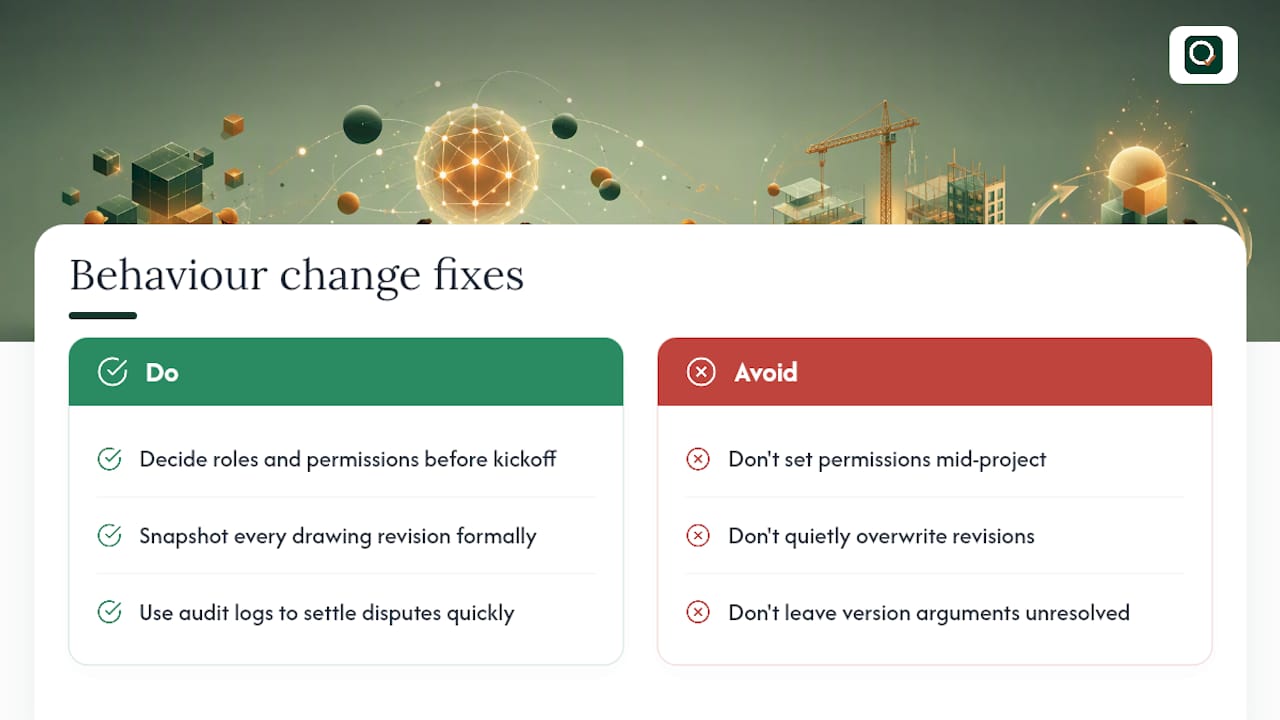
First, decide roles and permissions before the project kicks off, not halfway through when someone's overwritten someone else's reviewed section. Second, treat every drawing revision as an event that requires a formal snapshot, not a quiet overwrite. Teams that skip this step spend more time arguing about which version is correct than they ever saved by rushing the setup.
The friction usually isn't technical. It's habit. QSs who've measured solo for years resist a shared workspace not because it's harder, but because it feels like losing control of their own numbers. That resistance fades once the first dispute gets resolved in thirty seconds from an audit log instead of a week of email archaeology.
— Michael
How QuantiFlow supports a collaborative takeoff workflow
If the workflow above sounds like the standard you're aiming for, QuantiFlow is built to get you there without the manual rekeying and version chaos that undermines it. The platform's AI cross-referencing engine reads architectural PDFs and produces structured, NRM2-aligned quantities automatically, while multi-role collaboration means your estimator, reviewer and project manager work from one shared file with permissions that match the process described here, not a patchwork of emailed spreadsheets.
Every change is logged with a timestamp, so the audit trail exists by default rather than as an afterthought bolted on before a client query. Exports go straight into a structured Bill of Quantities, priced against a live UK rate library, ready for handover without a second round of data entry. Pricing is available in tiered subscription plans suitable for different team sizes. If you're ready to see how it fits your own takeoff process, visit the QuantiFlow site and start a trial.
Sources
- Windover Construction case study | Autodesk Takeoff
- On-Screen Takeoff: Collaboration tools | ConstructConnect help