AI in quantity surveying is best understood as a fast first pass, not a finished answer. It can read drawings, count elements, extract areas and lengths and draft a measured list in minutes. The quantity surveyor still checks that list against the drawings, the measurement rules and the contract, and signs it off. For a UK SME, the practical question is not whether to use AI, but how to use it so every figure stays traceable and defensible, and so the firm meets the RICS expectations that apply to AI use from March 2026.
This guide sets out where AI helps, what the published evidence says about accuracy, what drives poor results, and a review routine you can apply to any AI-produced take-off.
TL;DR
- AI supports measurement, document review and reporting. It does not replace the professional judgement behind a Bill of Quantities (BoQ), and RICS says that judgement cannot be fully automated.
- Evidence is mixed by element type: in one 2026 study of an automated take-off, counts matched closely, while areas were consistently under-measured.
- Output quality depends on input quality. Incomplete or inaccurate drawings and models produce wrong or missing quantities.
- Since 9 March 2026, RICS members and regulated firms working under its AI standard need a written reliability decision by a named surveyor, a risk register and advance written notice to clients.
- Treat every AI take-off as a draft: sample-check it, trace it to the drawing, then sign it off.
Table of Contents
- What "AI" means in quantity surveying
- Where AI helps most with take-offs
- What the evidence says about accuracy
- What drives good and bad results
- The RICS standard: what changed on 9 March 2026
- Data security and client confidentiality
- A review routine for any AI-produced take-off
- How the QS role is changing
- Where QuantiFlow fits
- FAQ
- Sources
What "AI" means in quantity surveying
The label covers several different technologies, and mixing them up leads to unrealistic expectations.
- Computer vision and geometry extraction read a drawing or model and identify walls, doors, windows, rooms and finishes, then measure them.
- Language models and document processing read contracts, specifications and tender documents, summarise them and pull out clauses or items.
- Predictive models trained on historic cost data suggest rates or flag outliers in early-stage estimates.
- Workflow automation carries measured data between drawings, spreadsheets and bills without retyping.
RICS describes the practical use in construction in its Responsible use of AI case study: AI tools are used to streamline cost planning and quantity take-off in early phases, automating repetitive work such as measuring floor areas, counting building elements and extracting quantities from plans. The stated benefits are saved time and fewer human errors, and the same case study is equally clear that qualified professionals must review and validate the final estimates.
Researchers at London South Bank University describe the same direction of travel. Their 2025 research presentation on the evolving QS role notes AI being used to extract quantities from 2D and 3D models, track scope changes and assess estimate maturity, and argues that QSs will need to be data-literate and work in a hybrid space where AI complements human intelligence.
Where AI helps most with take-offs
Measurement is the most mature use. Take-off is repetitive, rule-based and time-consuming, which suits software. The tasks where a draft from AI is most useful to a small team are:
- Counting: doors, windows, sanitaryware, sockets and similar items that appear as clear symbols.
- Areas and lengths on clean drawings: floor areas, wall lengths, skirting runs and plasterboard areas where the drawing is legible and to scale.
- Cross-referencing: checking that a door on the plan appears in the schedule, and that elevations and sections agree with plans.
- Reformatting: moving measured data into a structured bill rather than rebuilding it in a spreadsheet.
If you want a closer look at how quantities are derived in the first place, our guide to the role of drawings in quantity measurement covers what a drawing has to show before anything can be measured reliably, and the guide to BIM quantity extraction covers the model-based route.
What the evidence says about accuracy
Be cautious with headline figures. Percentages quoted in marketing often come from pilots, demonstrations or teaching exercises rather than live bids. A more useful reference is a 2026 methodological case study on a live commercial project in the United States, which compared an automated take-off against the contractor's own take-off across 29 line items.
The results are instructive because they differ by item type:
| Item type | Result in the study |
|---|---|
| Count-based items | Near-perfect alignment: 11 of 13 items identical |
| Area-based items | Consistent underestimation: 12 of 15 items lower (p = .027) |
| Overall | Small but statistically significant deviations |
The lesson for a UK QS is not that the tool failed. It is that errors were systematic rather than random, which is exactly what a sampling routine is designed to catch. If a tool tends to under-measure areas, a checked sample of area items will show it, and you can correct the whole group rather than hunting individual numbers.
No figure from one study transfers automatically to your drawings, your project type or your tool. Your own comparison on a past, fully measured job tells you more than any published percentage.
What drives good and bad results
Input quality
RICS's construction case study warns that AI take-off tools need high-quality inputs. If drawings or BIM models are incomplete or inaccurate, the AI may extract wrong quantities or miss important elements, which then flow into incorrect cost estimates. In practice, expect the best results from:
- vector PDFs exported directly from CAD rather than scans or photographs of printouts;
- drawings with a stated scale and consistent layer or line conventions;
- a coordinated set where plans, sections and schedules agree;
- the current revision, with superseded sheets removed.
Expect weaker results from poor scans, marked-up sets, drawings with overlapping annotations and one-off complex geometry. Where site measurements feed your quantities, for example earthworks or stockpiles, the way the survey data was captured matters in the same way, and a guide to measurements and analysis of aerial survey data shows what input quality means for measured outputs.
Incomplete information and method
The RICS guidance on AI in cost estimation, as reported in Construction Management in November 2026, says take-off tools can misread incomplete drawings and lack understanding of alternative construction methods. It also notes that a tool trained only on historic quotations can inherit their blind spots. A tool does not know that a detail is missing in the way an experienced QS does, so it may fill the gap silently.
Measured is not the same as priced
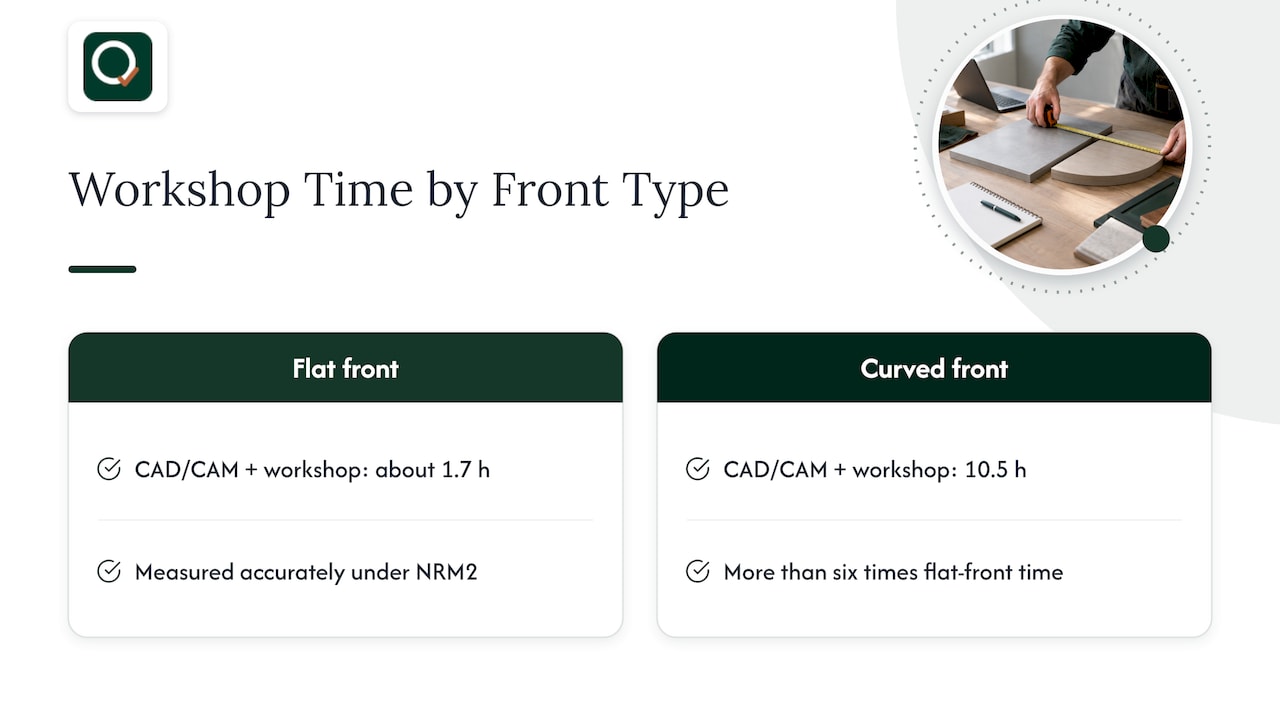
The same Construction Management article, by a trained architect who runs a joinery manufacturing business, gives a clear example. The firm estimated about 1.7 hours of combined CAD/CAM and workshop work for a flat lacquered cabinet front, against 10.5 hours for a curved one, more than six times as much. Both can be measured accurately under NRM2, the RICS rules of measurement for building works. NRM2 requires radii and concave or convex descriptions, but a radius alone cannot tell a workshop whether 32 curved components share one geometry.
An accurate quantity is therefore not automatically an accurately priced one. Deciding what the quantity means for cost, programme and risk is the surveyor's work, and it is the reason a draft BoQ needs a QS reading it with the specification and the project in mind.
The RICS standard: what changed on 9 March 2026
If you or your firm are RICS members or regulated by RICS, the Responsible use of artificial intelligence in surveying practice professional standard, published in September 2025, took effect on 9 March 2026. It applies to AI outputs that have a material impact on surveying services. A take-off feeding a tender price clearly qualifies.
The duties most relevant to a small QS practice are:
- A written assessment of whether AI is the most appropriate tool, considering data risks, the risk of erroneous output and bias.
- A risk register, reviewed at least quarterly.
- A written reliability decision about the AI output, prepared by or under the supervision of a named, appropriately qualified surveyor who accepts responsibility for it.
- Randomised dip sampling of outputs at regular intervals where AI is used at high volume.
- Advance written notice to clients when AI will be involved in the work.
The standard confirms what good practice already suggested: a figure you cannot explain or trace is hard to defend. Any tool you adopt should let you see where each quantity came from on the drawing, and keep a record of who reviewed and changed what.
RICS's October 2026 report on building a judgement layer for AI use in surveying adds a warning that matters for busy small teams. As AI systems become more accurate and familiar, professional scepticism can erode, leading to complacency and automation bias. It also notes that a completed automated check is not the same as professional scepticism. The more reliable a tool seems, the more deliberate your sampling needs to be.
Data security and client confidentiality
Before uploading a client's drawings, check three things:
- Your appointment terms and NDAs. Do they allow third-party processing of project information?
- Where the data is stored and how it is used. Read the tool's data terms, including whether your files can be used to train models.
- Personal data. Drawings, site documents and photographs can contain names, locations or other personal information, which brings UK GDPR duties into play.
PBC Today reported on 2 September 2026 that subcontractors can cause data breaches by running a photo of a site document, inspection record or sensor reading through an AI tool when it contains more than the intended data point, such as location details, other parties' commercial information or personal information about colleagues. The same applies to a drawing set that carries a client's commercial details in its title blocks or annotations.
Good record-keeping helps on the other side of the same coin. Keeping drawings, revisions, site photographs and reports in one organised place, for example in construction document management software, makes it easier to know which revision went into a tool and to show who accessed what.
A review routine for any AI-produced take-off
Use the same routine whichever tool produced the draft. It takes less time than measuring from scratch and gives you the evidence trail RICS expects.
- Confirm the inputs. Check that the drawing revision is current, the scale is correct and the set is coordinated before the tool runs.
- Check scope. Make sure every sheet was read and that nothing, such as a schedule or a detail sheet, was skipped.
- Sample by element type. Pick several items from each group: counts, linear items, areas and volumes. Re-measure them by hand. Given the pattern in the 2026 study above, give area items particular attention.
- Look for the unusual. Curved, sloping, non-standard or heavily annotated elements are where errors concentrate.
- Check against NRM2. Confirm that items are grouped, described and measured under the rules you are working to, including deductions and void thresholds.
- Reconcile. Compare totals with a quick independent check, such as gross internal area, elemental rates per square metre or a comparable past project.
- Record the decision. Note who reviewed it, what was sampled, what was corrected and the reliability decision, signed by the named surveyor.
- Price with judgement. Apply rates and allowances that reflect the actual construction method, access and risk, not just the quantity.
Our article on why UK QSs must audit every automated draft expands on this checking process.
How the QS role is changing
Surveyors are not being replaced by this technology. RICS's MODUS journal states that interpretation, professional judgement and compliance with RICS standards cannot be fully automated, and that AI should be seen as an assistant supporting informed, compliant decisions. The October 2026 judgement-layer report defines professional judgement as a combination of knowledge, skills, experience and professional scepticism, and says AI can produce information, analysis and draft conclusions but does not turn them into professional advice without it.
What changes is the balance of time. Less goes on counting and tracing lines; more goes on checking, interpreting, pricing and advising. For a small firm that can mean taking on more tenders with the same team, provided the review discipline holds. The LSBU researchers argue that this shift calls for data literacy and continuing professional development, so a sensible first step is to build review skills in your team before you scale up use.
For a wider view of the tool types available, see our overview of what AI for quantity surveyors delivers now and the benefits of quantity surveying software.
Where QuantiFlow fits
QuantiFlow reads construction drawings and produces a draft Bill of Quantities for a quantity surveyor to review and sign off. It is in development, and it is built around the review step described above, with the surveyor making the decisions. The planned plans are Solo at £69 per month and Business at £299 per month, with Enterprise available on request. You can see the plans on the QuantiFlow site.
FAQ
Will AI replace quantity surveyors?
No. RICS states that interpretation, professional judgement and compliance with its standards cannot be fully automated. AI can draft measurements and summaries, but a qualified surveyor remains responsible for the result. The role shifts toward review, interpretation and advice.
Can AI produce an accurate take-off from a PDF drawing?
It can produce a useful draft, and accuracy varies by element type and drawing quality. In a 2026 live-project study, counts matched closely while areas were consistently under-measured. Clean vector drawings give better results than scans, so every output needs a sampled check before sign-off.
Do I have to tell clients if I use AI?
If you are an RICS member or regulated firm, the RICS standard that took effect on 9 March 2026 requires you to tell clients in writing in advance when AI will be involved in work covered by the standard. Check the full standard and your appointment terms, and speak to RICS if your situation is unclear.
Is it safe to upload client drawings to an AI tool?
Only after you have checked your appointment terms and any NDAs, the tool's data terms and where the data is stored. Drawings and site documents can also contain personal data, which brings UK GDPR duties into play. Record the decision in your risk register.
Sources
- RICS: Responsible use of AI case study, construction
- RICS: Responsible use of artificial intelligence in surveying practice (September 2025)
- RICS: How to build a judgement layer for AI use in surveying (October 2026)
- RICS: MODUS (January 2026)
- London South Bank University: Artificial Intelligence and the Evolving Role of the Quantity Surveyor
- Methodological case study in commercial construction (2026)
- Construction Management: The work behind the drawing (November 2026)
- PBC Today: AI in construction, when it is the right tool for the job (2 September 2026)
- Measurements and analysis guide
- Construction document management software
Recommended
- Quantity surveying software benefits: 2026 guide for UK professionals
- SaaS for quantity surveyors: what UK QSs need to know
- AI for quantity surveyors: what it delivers now
- AI and quantity surveyor professional judgement in 2026
This article is for general information only and is not professional, legal or commercial advice. Quantity surveying decisions should be taken by a qualified professional with reference to the specific project, drawings and contract in question. Content is produced with AI assistance and reviewed before publication. QuantiFlow Ltd accepts no liability for reliance on it.