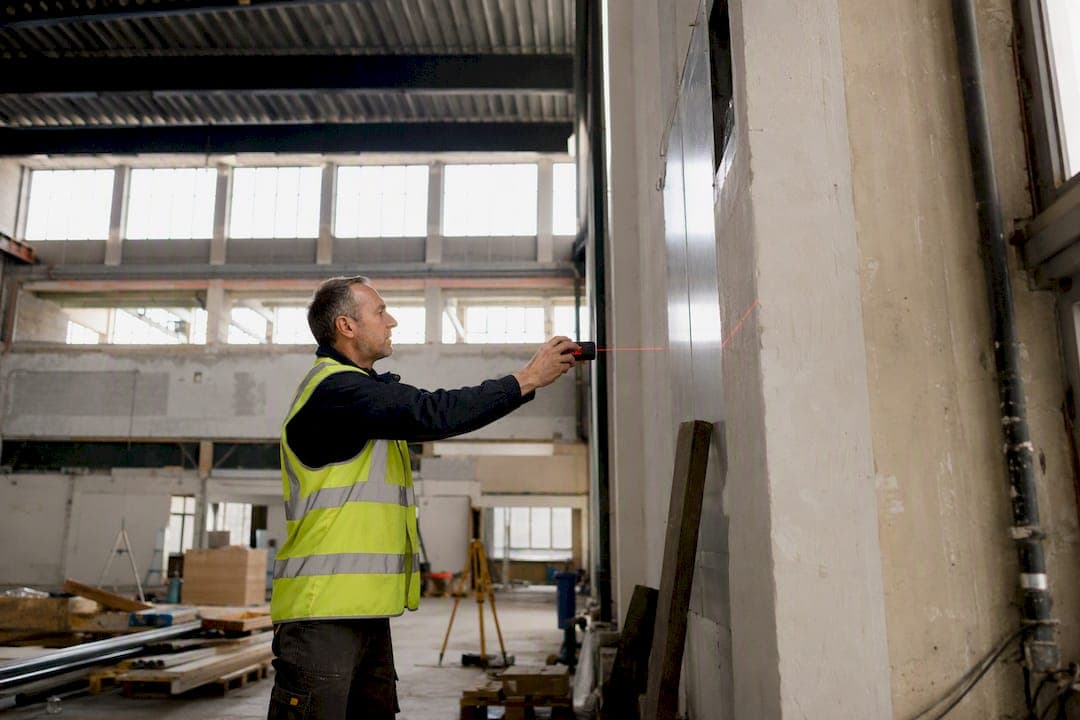
AI reliably speeds up takeoffs, sharpens early-stage cost estimates, and flags discrepancies across drawings, but it does not replace the quantity surveyor. Used in a hybrid workflow, where AI produces a first-pass measurement and a QS professional reviews and signs it off, tools can compress measurement time significantly and tighten estimate variance. RICS' own research confirms the appetite for this shift, provided the audit trail and professional judgement stay intact.
TL;DR:
- AI can achieve up to 60% time reduction in measurement and decrease early-stage estimate variance from ±30-40% to around ±15-20%.
- It excels at pattern recognition for repetitive, high-volume elements but struggles with ambiguous notes, bespoke items, and interpretation of design intent.
- AI workflows require structured, clean data, governance controls, and professional sign-off to ensure reliable and auditable results.
- Successful adoption depends on staged pilots, specific skill development in BIM, data curation, and validation, rather than full automation from the start.
- Hybrid tools like QuantiFlow enable QS teams to review, verify, and sign off AI-generated measurements, maintaining professional accountability while speeding processes.
Table of Contents
- What can AI actually do for quantity surveying today?
- How does AI fit into takeoff, BoQ and BIM workflows?
- What data and governance controls does AI need to be trustworthy?
- What skills and training does a QS team need for AI adoption?
- How do you roll out AI in a QS practice, step by step?
- How QuantiFlow supports hybrid AI takeoffs
- How will AI change the quantity surveying profession?
- Ready to trial AI takeoffs on your own drawings?
- Sources
What can AI actually do for quantity surveying today?
AI's real strength in quantity surveying is pattern recognition at scale. Computer vision models trained on architectural drawings can identify walls, openings, finishes, and structural elements across hundreds of pages faster than a person could scroll through them, let alone measure them manually.
Automated measurement is the most mature capability. Vision models extract quantities from PDFs, scanned drawings, and BIM exports by recognising geometry and cross-referencing repeated elements across sheets.
Cost estimation and predictive modelling work differently. Parametric estimating tools apply cost-per-unit rates to measured quantities, while machine learning models trained on a firm's own historical project data can forecast likely costs before full design information exists. The improvement is measurable: industry analysis shows early RIBA Stage 1 estimate variance narrowing from a traditional ±30 to 40% down to roughly ±15 to 20% once models are trained on clean, structured project history, a meaningful gain in confidence for early cost advice.
Where AI consistently struggles:
- Interpreting ambiguous or conflicting specification notes across drawing revisions
- Judging contractual entitlement, variations, or claims that hinge on interpretation rather than measurement
- Handling bespoke, one-off, or heavily customised items with no historical precedent in the training data
- Distinguishing design intent from drafting error without human confirmation
Pro Tip: Run AI takeoffs on the most repetitive, high-volume elements first, floors, walls, doors, standard finishes, before trusting it with anything bespoke. That is where the automation percentage is highest and the risk of error is lowest.
None of this makes the QS redundant. It shifts the job from measuring everything by hand to verifying, adjusting, and pricing what the model has already drafted.
How does AI fit into takeoff, BoQ and BIM workflows?
The workflow that actually works in practice is sequential, not automatic end-to-end. AI drafts, the QS decides.
- AI first-pass takeoff. The model reads the drawing set (PDF or BIM export) and produces a structured quantity schedule, flagging elements it is confident about and elements it is not.
- QS review and verification. The surveyor checks flagged items, corrects descriptions, reconciles anything that clashes with specification notes, and applies professional judgement to edge cases the model cannot resolve.
- Audit log and export. Every change is timestamped and traceable, then the verified quantities export into a priced Bill of Quantities or valuation document.
BIM integration adds another layer of reliability, but only if the model itself is built to a usable standard. AI takeoff tools generally need drawings or BIM exports at LOD 300 or above to extract dependable quantities. Below that, geometry is too approximate and descriptions too generic for the model to produce anything a QS can price with confidence. Firms working from IFC exports should also confirm that object classifications are consistent across the model, since inconsistent naming conventions are one of the most common reasons AI-generated takeoffs need heavy correction.
The payoff for getting this right is substantial. Case evidence from hybrid BIM and AI workflows shows measurement and valuation cycles compressing by roughly 40 to 60% compared with fully manual processes, largely because reconciliation between drawing revisions happens automatically rather than through manual cross-checking. Platforms like BuildCopilot illustrate this with prompt-based workflows for tender analysis and valuation drafting, extending the same hybrid principle beyond pure takeoff into wider QS documentation.
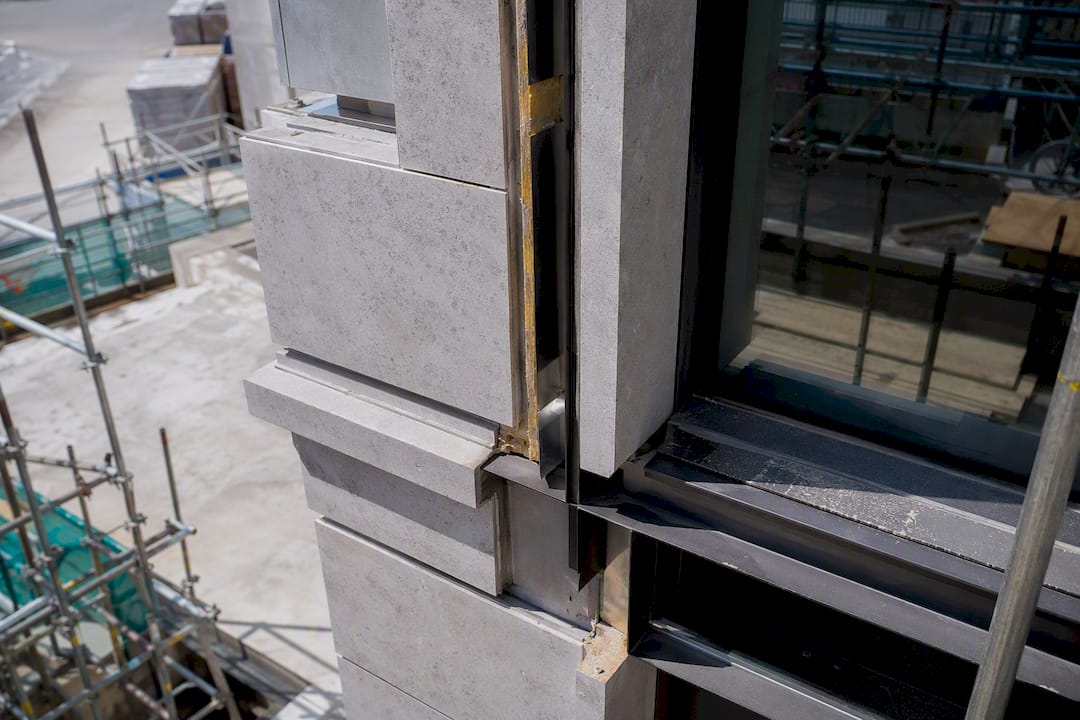
For teams working with visual progress records alongside measured quantities, pairing AI takeoff output with rendered or CGI visualisation of the scheme can help resolve ambiguous drawing sections before they reach the review stage, particularly on complex facades or bespoke junctions where a flat PDF leaves too much to interpretation.
What data and governance controls does AI need to be trustworthy?
An AI takeoff tool is only as reliable as the data it learns from, and most QS firms underestimate how much cleanup that requires before results are trustworthy.
Data prerequisites come first. Historical project data needs consistent coding (NRM2 or a comparable structure), standardised naming across drawing revisions, and ideally a common data environment where the current drawing set is the single source of truth rather than one of several conflicting versions circulating by email.
Governance controls turn a useful tool into an auditable one:
- Version control on every drawing set the AI processes, so outputs can be traced back to a specific revision
- A full audit trail showing what the model flagged, what the QS changed, and when
- An acceptable-use policy defining which outputs require mandatory human sign-off before pricing
- Periodic validation sampling, spot-checking a percentage of AI-generated quantities against manual measurement to catch model drift early
AI adoption succeeds when firms define narrow, measurable pilots and enforce a QS review gate before anything reaches a client-facing document. Skip the gate, and you inherit the model's mistakes at full scale.
Risk controls matter as much as data quality. Every AI-assisted BoQ should carry a clear sign-off point where a named QS professional accepts responsibility for the final figures, exactly as they would with a manually produced document. This is not bureaucratic overhead. It is the mechanism that keeps professional indemnity cover intact and keeps the firm, not the software vendor, accountable for the numbers a client relies on. Firms that skip this step tend to discover the gap only when a dispute forces them to explain how a figure was produced.
What skills and training does a QS team need for AI adoption?
The skills gap is real, and RICS' 2025 survey confirms it directly: 67% of QS and construction professionals agree AI will help deliver greater value, yet a substantial share of the same RICS report on AI in construction also report feeling overwhelmed and under-skilled to act on that belief.
Closing that gap does not require every QS to become a data scientist. It requires four specific competencies:
- BIM and IFC literacy, enough to understand what LOD a model was built to and where classification inconsistencies will trip up an AI takeoff
- Basic parametric modelling awareness, so estimators can sanity-check where a cost-per-unit rate came from rather than treating it as a black box
- Dataset curation skills, since someone on the team needs to own the job of keeping historical project data clean and consistently coded
- AI output validation, the discipline of knowing which flagged items need scrutiny and which can be trusted based on drawing quality
Training pathways work best when they stay pilot-focused rather than theoretical. Running a short, structured CPD session around one live pilot project teaches more than a generic course on "AI in construction." Vendor-led training on the specific tool in use, supplemented by internal mentoring from whoever ran the first pilot, tends to spread competence through a team faster than formal courses alone.
Change management matters just as much as the technical skills. Appoint a named AI champion within the practice, someone accountable for the pilot's outcomes. Set two or three measurable KPIs before you start, not after. And treat governance as part of the pilot, not something bolted on once the tool is already in daily use.
How do you roll out AI in a QS practice, step by step?
Rolling out AI in a quantity surveying practice works best as a staged trial with defined exit criteria at each stage, not a single leap from spreadsheets to full automation.
- Define the pilot scope. Pick one project type and one workflow stage, typically early-stage takeoff on a straightforward building. Set measurable success metrics upfront: time saved, estimate variance, error rate.
- Prepare the dataset. Clean and code the historical project data you will benchmark against. Inconsistent NRM2 coding at this stage undermines everything downstream.
- Select a category of tool. Decide whether you need a computer-vision takeoff tool, a parametric estimating platform, or both, based on which task the pilot targets.
- Run a controlled pilot. Process a real drawing set through the tool and have a QS complete the review and sign-off exactly as they would in production.
- Validate against a sample. Cross-check a meaningful sample of AI-generated quantities against manual measurement to confirm the accuracy band the tool claims.
- Iterate and define governance. Adjust the workflow based on where the model needed the most correction, then formalise the review gates and audit trail.
- Plan the scale-up. Extend to further project types only once the pilot metrics hold up across more than one job.
| Pilot metric | Baseline (manual) | Target after AI pilot |
|---|---|---|
| Takeoff time per drawing set | Full manual measurement time | 40 to 60% reduction |
| Early-stage estimate variance (RIBA Stage 1) | ±30 to 40% | ±15 to 20% |
| Measurement automation rate | Not applicable | high automation rates for core quantities |
| Description automation rate | Not applicable | 60% for NRM-compliant descriptions |
Keep the pilot narrow enough to measure properly. A practice that tries to automate every project type at once loses the ability to tell whether a problem came from the tool, the data, or the workflow around it.
How QuantiFlow supports hybrid AI takeoffs
QuantiFlow builds this hybrid model into the product rather than treating it as an afterthought. The platform reads PDF architectural drawings, extracts and cross-references quantities against an NRM2-aligned structure, and produces a measured, structured takeoff ready for pricing against a live UK rate library.
The file flow mirrors the workflow outlined above: upload the drawing set, review the AI-generated first-pass measurement, adjust or override any item that needs a professional's eye, and export the verified figures to a priced Bill of Quantities in PDF or Excel. Every change is logged, so the audit trail a QS needs for sign-off and professional accountability stays intact throughout, not bolted on afterwards.
Multi-role collaboration means a surveyor, builder, and architect can work from the same measured output rather than three separate interpretations of the same drawing set.
How will AI change the quantity surveying profession?
The direction of travel is fairly clear: routine measurement work shrinks, and the QS role tilts further towards advisory and strategic cost leadership. That shift is already visible in the RICS data, where two thirds of professionals expect AI to add real value, even as many admit they feel underprepared for it.
Both things can be true. AI genuinely improves estimate confidence and frees time that used to go into manual measurement. It also introduces new risks: model outputs are only as good as the historical data behind them, and overreliance on a tool that has not been validated against a firm's own project types is a fast route to a costly mistake.
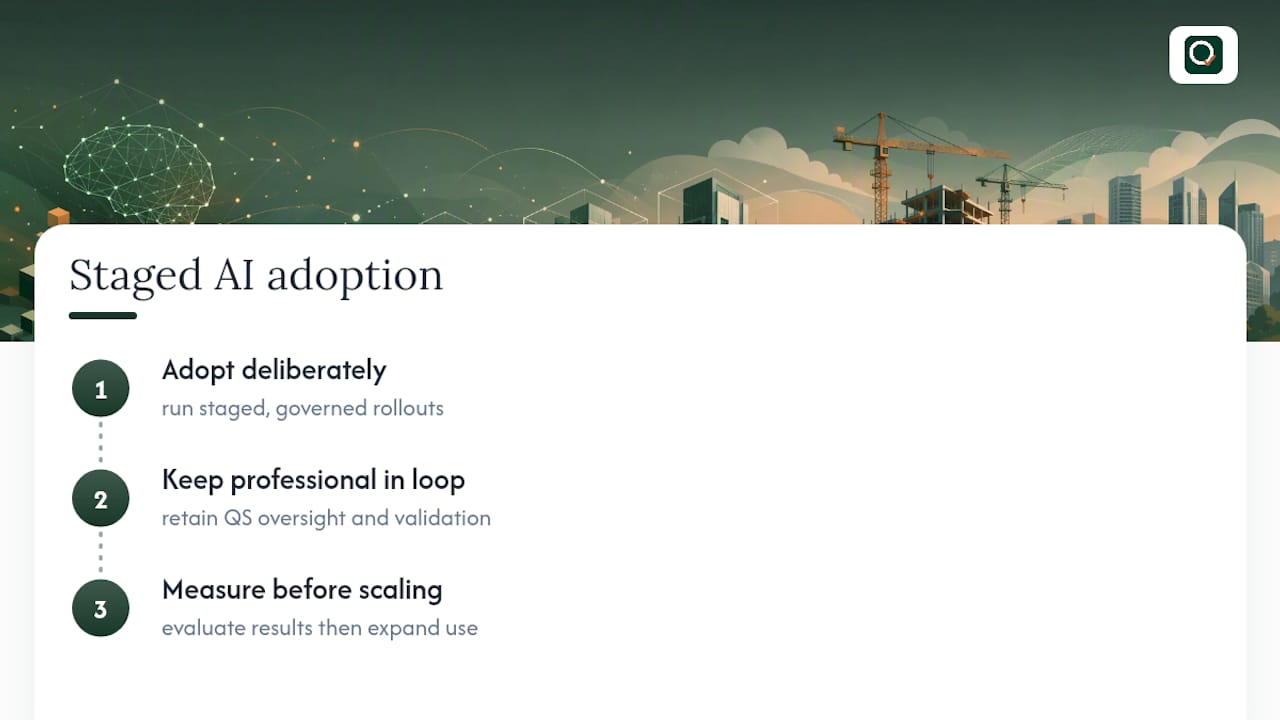
The Gartner Hype Cycle is a useful reminder here. New technology tends to overshoot expectations before settling into realistic, productive use, and quantity surveying's AI adoption curve looks no different. The firms that get the most value are the ones treating this as a staged, governed rollout rather than a switch to flip. RICS' own guidance points the same way: adopt deliberately, keep the professional in the loop, and measure the results before scaling further.
— Michael
Ready to trial AI takeoffs on your own drawings?
QuantiFlow gives QS teams the specific thing this article has been building towards: a first-pass AI takeoff that speeds up measurement without asking anyone to hand over sign-off to a black box. Every quantity extracted from your PDF drawing set stays fully editable, NRM2-aligned, and logged with a complete audit trail, so the professional judgement this article has stressed throughout stays exactly where it belongs, with you.
The workflow is built for exactly the pilot approach covered above: upload a real drawing set, review the AI-generated measurements, override anything that needs your judgement, and export a priced Bill of Quantities in PDF or Excel. Pricing runs from Solo at £39 a month through to Business at £149 a month, with custom Enterprise options for larger practices. If you are ready to see how a hybrid AI takeoff performs against your own project types, visit QuantiFlow to start a trial and measure the results for yourself.
Sources
RICS' 2025 report on artificial intelligence in construction, based on responses from more than 2,200 professionals, remains the clearest industry benchmark for where the profession stands on adoption and skills readiness. Microsoft's Gen-AI opportunity report sets out the wider productivity case for automation across professional services. Helium42's explainer on AI transforming cost management in UK construction provides the case-level detail behind the time-saving and accuracy figures cited throughout this piece. For product-specific detail on hybrid AI takeoffs, see QuantiFlow's estimating tools guide.
- RICS artificial intelligence in construction report 2025
- AI for Quantity Surveying: How Artificial Intelligence Is Transforming Cost Management in UK Construction