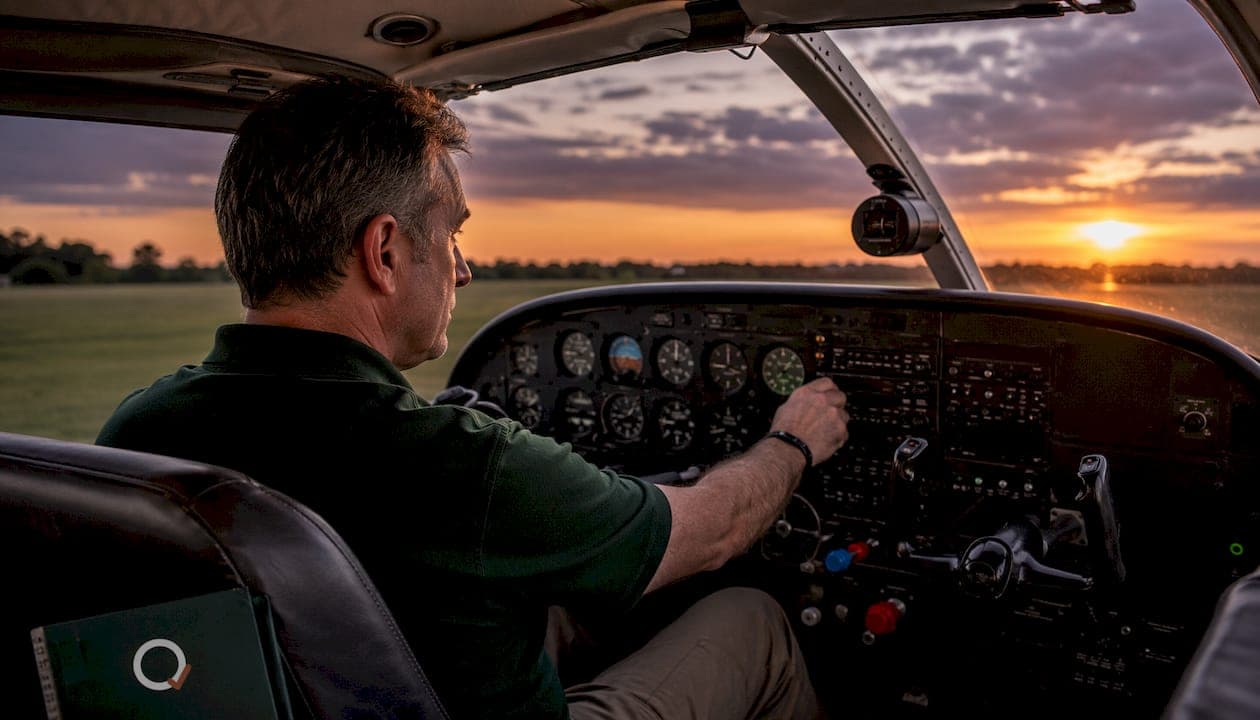
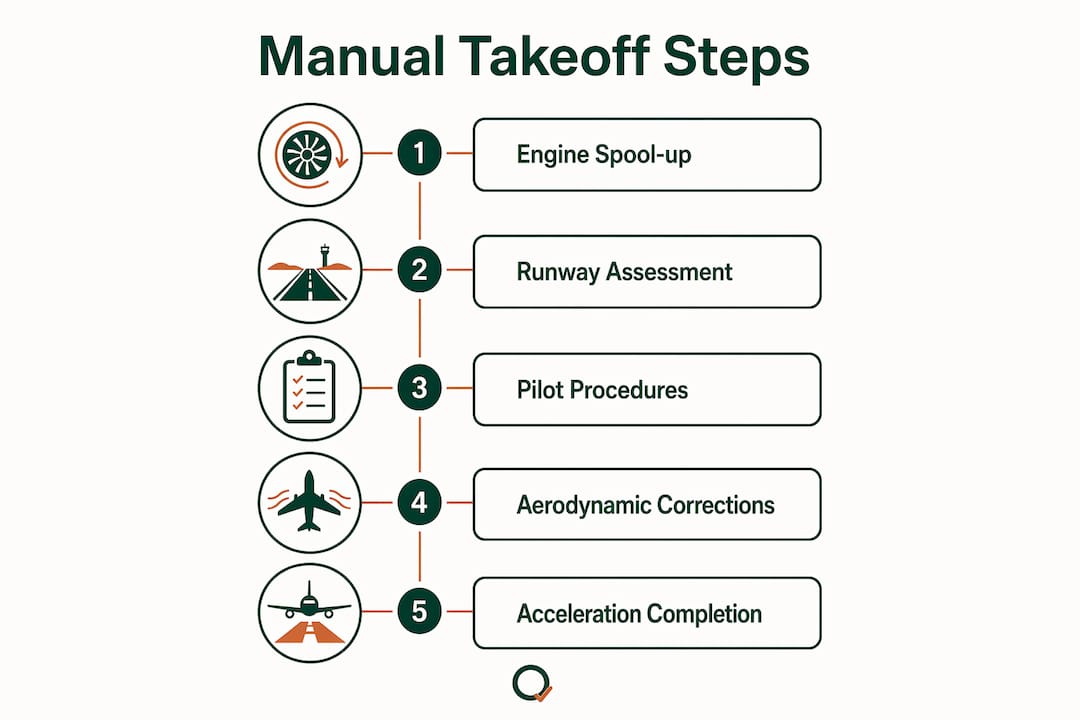
Manual airplane takeoff takes longer than automated procedures for several compounding reasons, not just one. Engine spool-up on gas turbine engines demands careful, gradual thrust application before the aircraft can accelerate. Runway surface conditions, from wet grass to contaminated tarmac, increase friction and extend the ground roll. Pilots must work through sequential checklists, coordinate with air traffic control, and actively counteract aerodynamic forces such as torque and P-factor throughout the roll. Each of these factors adds time individually. Together, they explain why manual takeoff duration consistently exceeds what automated systems achieve.
-
- Gas turbine engines require gradual spool-up and pilot monitoring before reaching full thrust
- Soft or contaminated surfaces increase rolling friction, lengthening the ground roll
- Pre-takeoff checklists, ATC coordination, and configuration checks add procedural time
- Torque, P-factor, and crosswind corrections demand continuous rudder input, reducing acceleration efficiency
- Lack of standardised procedures creates variability between pilots, widening the time range further
1. How engine spool-up time slows the start of every manual takeoff
The first bottleneck in any manual takeoff is the engine itself. Gas turbine engines operate at very high RPMs during takeoff thrust, but they do not get there instantly. Spool-up from low idle to full takeoff power takes several seconds, and a pilot cannot simply slam the throttle forward and expect a clean result.
- Idle to takeoff thrust transition. Advancing the throttle too rapidly risks compressor stall or engine instability. Pilots increase thrust gradually, monitoring engine gauges throughout.
- Engine parameter checks during spool-up. Before releasing the brakes, the pilot confirms that oil pressure, exhaust gas temperature, and RPM are all within limits. Any anomaly requires aborting before the roll begins.
- Stabilisation period. Many procedures require holding on the brakes while thrust stabilises at a set power level, adding several seconds before the ground roll even starts.
- Asymmetric thrust awareness. On multi-engine aircraft, pilots must confirm both engines have spooled to matching thrust before releasing. A mismatch causes immediate yaw on brake release.
- Manual throttle management throughout the roll. Unlike automated systems, which can precisely sequence engine acceleration, a pilot must continuously adjust thrust by feel and instrument reference, particularly as aerodynamic loads change with speed.
Automated takeoff systems manage this sequence with far greater precision and speed. The manual approach is not inefficient by design; it is thorough by necessity.
2. How runway and surface conditions extend the ground roll
Surface conditions are one of the most variable factors affecting manual takeoff duration. A dry, paved runway offers the lowest rolling friction, but pilots rarely operate in ideal conditions every time.
- Wet or contaminated surfaces increase the coefficient of rolling friction considerably. Wet runway surfaces significantly increase rolling friction, directly extending the distance needed to reach rotation speed.
- Soft or grass surfaces slow acceleration further. Soft, wet surfaces can diminish an aircraft's ability to reach takeoff speed within the expected distance, requiring pilots to reassess runway length margins before committing to the roll.
- Temperature and density altitude. Hot days reduce air density, which means the wings need a higher ground speed to generate sufficient lift. The ground roll lengthens accordingly, and pilots must account for this in their performance calculations before lining up.
- Wind direction and strength. A headwind reduces the ground speed needed to achieve flying speed, shortening the roll. A tailwind does the opposite, sometimes dramatically. Pilots must factor wind into their go/no-go decision and adjust expected roll distances.
- Runway slope and condition assessment. Before initiating the roll, a pilot visually and procedurally assesses the surface. Any uncertainty about condition, contamination, or length requires additional time for judgement and calculation.
Each of these variables demands a manual assessment that an automated system handles algorithmically. The pilot's job is to synthesise all of them in real time, which takes time.
Pro Tip: Always cross-check your aircraft's Pilot's Operating Handbook performance charts against actual runway condition reports before calculating your ground roll distance. Manufacturers' figures assume dry, paved surfaces unless stated otherwise.
3. What pilot procedural steps add to manual takeoff time
The procedural overhead of a manual takeoff is substantial, and it exists for good reason. Pilots perform thorough checks and communication protocols that add time before the aircraft ever begins to move.
- Pre-takeoff checklist. Covering flight controls, engine instruments, fuel state, flap setting, trim position, and avionics. Each item requires a deliberate check and confirmation, not a glance.
- ATC communication and clearance. The pilot must request and receive takeoff clearance, read it back correctly, and confirm the active runway. Busy airspace or a complex clearance can add minutes to the process.
- Runway alignment and configuration. Taxiing onto the runway centreline, setting the heading indicator, confirming flap position, and releasing the parking brake all happen in sequence before thrust is applied.
- Continuous monitoring during the roll. Throughout acceleration, the pilot monitors airspeed, engine instruments, and directional control simultaneously. Any deviation from expected performance triggers a decision: continue or abort.
- Rotation decision and technique. At the correct rotation speed (Vr), the pilot applies back pressure on the elevator at a controlled rate. Too fast causes excessive pitch and potential stall; too slow delays lift-off. The FAA Airplane Flying Handbook notes that excessive and rapid changes in pitch attitude result in proportionate changes in torque effects, making the aircraft harder to control.
- Post-lift-off configuration. After becoming airborne, the pilot manages gear retraction, power adjustments, and climb attitude while maintaining situational awareness. Each action is manual and sequential.
The FAA reports that approximately one in five general aviation accidents occur during takeoff and departure climbs, with more than half resulting from pilot error. That statistic reflects exactly how demanding this phase is, and why the procedural steps exist in the detail they do.
Pro Tip: Use a printed or electronic checklist for every takeoff, even on familiar routes. Memory alone introduces the same fatigue-driven errors that extend manual processes in any high-stakes field.
4. How aerodynamic forces and torque slow manual takeoff acceleration
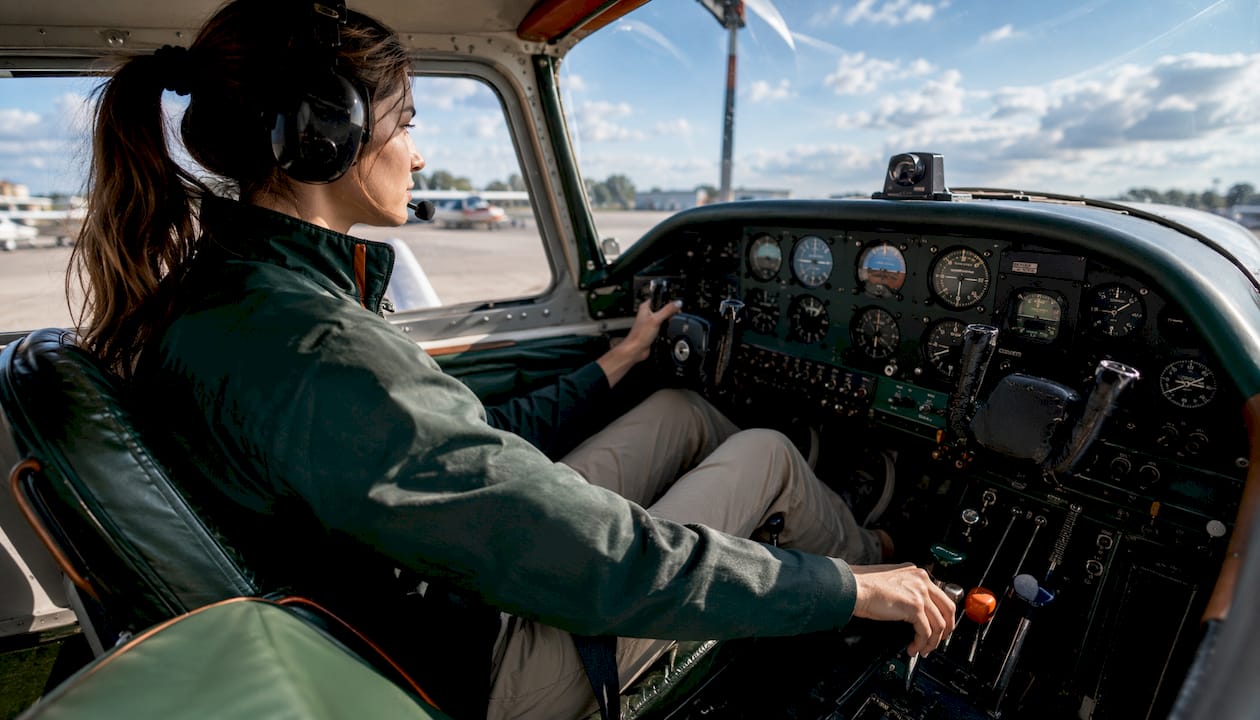
Physical forces act on the aircraft from the moment the throttle advances, and pilots must counteract them throughout the roll. These corrections are not optional; they are what keeps the aircraft on the runway centreline.
Torque and P-factor cause a yawing tendency to the left on most single-engine aircraft with clockwise-rotating propellers. The pilot applies right rudder to counteract this, but the required input changes continuously as airspeed and engine power vary during the roll. That constant adjustment absorbs attention and, critically, introduces small inefficiencies in the acceleration profile.
| Aerodynamic force | Effect during takeoff roll | Pilot correction required |
|---|---|---|
| Torque | Rolling tendency opposite to propeller rotation | Aileron and rudder input |
| P-factor | Asymmetric disc loading causing yaw | Right rudder on most aircraft |
| Gyroscopic precession | Pitch/yaw forces during rotation | Anticipatory control input |
| Crosswind | Lateral drift and weathercocking | Upwind aileron, rudder correction |
| Ground effect | Reduced induced drag near the surface | Pitch management to avoid premature lift-off |
Crosswind conditions add another layer. The pilot must hold upwind aileron to prevent the windward wing from lifting prematurely, while simultaneously managing rudder for directional control and throttle for thrust. Automated systems handle these corrections with sensor-driven precision and no reaction lag. A human pilot, however skilled, cannot match that response speed across multiple simultaneous inputs.
5. How lack of standardisation extends manual takeoff times
The most underappreciated reason why manual takeoff takes long is procedural inconsistency. Different pilots interpret the same checklist differently, apply thrust at different rates, and make different judgements about when conditions are acceptable. That variability compounds across every phase of the takeoff.
The bottleneck in manual processes is often the non-standardised, inconsistent approach to interpreting procedures and data, causing wide variability in the time taken from one operator to the next.
Research into automated processing of complex technical documents confirms that manual processes requiring professional synthesis across fragmented inputs consistently extend duration, because the human must cross-reference, interpret, and reconcile information that an automated system would handle in a single pass. Aviation is no different. A pilot synthesising weather data, performance charts, ATC instructions, and real-time instrument readings is doing exactly that kind of multi-source reconciliation, and it takes time.
| Factor | Manual takeoff | Automated takeoff |
|---|---|---|
| Engine spool-up management | Gradual, pilot-monitored | Precisely sequenced by system |
| Procedural consistency | Varies by pilot experience | Standardised every time |
| Aerodynamic correction | Continuous manual input | Sensor-driven, near-instantaneous |
| Error detection | Requires pilot attention | Flagged automatically |
| Response to surface conditions | Judgement-based | Algorithm-driven |
Design changes illustrate the standardisation problem clearly. When a procedure is updated, pilots must individually absorb and apply the change. There is no automatic delta management. One pilot may integrate the update immediately; another may rely on memory and apply the old procedure for several flights. Automated systems, by contrast, apply updates uniformly from the moment they are deployed.
The parallel to construction quantity takeoffs is direct. Manual takeoffs on mid-size commercial projects commonly take 8–20 hours depending on complexity, while AI-assisted processes with human review typically finish in 2–5 hours. The speed gap exists for the same reason it exists in aviation: automation removes the variability, fatigue, and sequential bottlenecks that manual processes carry by nature. For professionals exploring how quantity surveying software addresses these same inefficiencies, the underlying logic is identical.
Students and early-career professionals studying these dynamics will find that engineering software tools increasingly bridge the gap between manual skill-building and automated efficiency, in aviation simulation and construction estimation alike.
How Quantiflow removes the manual bottleneck in construction takeoffs

The same factors that slow manual airplane takeoffs — sequential steps, human variability, and the absence of standardised workflows — slow manual quantity takeoffs in construction. Quantiflow addresses this directly. Built for UK quantity surveyors, builders, and architects, Quantiflow's AI cross-references architectural drawings and produces NRM2-aligned Bills of Quantities automatically, preserving professional judgement where it matters while removing the repetitive, time-consuming groundwork.
Measured twice. Priced once. See how Quantiflow works and find out how much time your next takeoff could save.
Key takeaways
Manual airplane takeoff takes longer than automated procedures because pilots must sequentially manage engine spool-up, surface conditions, procedural checklists, aerodynamic corrections, and non-standardised workflows, each adding time that automation eliminates.
| Point | Details |
|---|---|
| Engine spool-up adds delay | Gas turbine engines require several seconds to reach takeoff thrust, demanding pilot monitoring before the roll begins. |
| Surface conditions extend the roll | Wet or soft surfaces increase rolling friction, lengthening the ground distance needed to reach rotation speed. |
| Procedural steps are non-negotiable | Checklists, ATC coordination, and configuration checks add structured time that cannot be safely skipped. |
| Aerodynamic forces require constant correction | Torque, P-factor, and crosswind effects demand continuous rudder and aileron input throughout the ground roll. |
| Standardisation gaps widen the time range | Variability between pilots in procedure interpretation and execution means manual takeoff duration is rarely consistent. |