
Cost reporting from measured quantities is the process of converting physically measured work volumes into financial data to monitor and control construction project costs. In UK construction, this practice sits at the heart of effective project financial control, linking the Bill of Quantities (BoQ) to real expenditure at every stage. RICS guidelines and NRM2 provide the measurement framework that underpins this process, giving project managers and financial controllers a structured basis for tracking spend against installed work. Without this linkage, cost reports become little more than accounting summaries with no connection to physical progress on site.
What prerequisites are needed for cost reporting from measured quantities?
Reliable cost reporting starts with the right inputs. Three documents form the foundation: a structured BoQ, a unit rate database, and validated measurement data from drawings, site records, or BIM models.
The BoQ is the single most important baseline document. Cost reporting begins with a structured BoQ that codes all procurement and expenses directly to BoQ line items, enabling real-time financial tracking and variance control. That coding structure is what allows every purchase order and invoice to be traced back to a specific work package.

Unit rate databases feed the financial side of the equation. Each rate must be built up from first principles through rate analysis, which is the detailed price build-up behind each BoQ item. Rate analysis must account for wastage allowances that significantly shift final cost estimates if ignored. Typical wastage figures include 2% for cement, 2.5% for steel, 3% for aggregate, and 5% for bricks. Ignoring these percentages produces unit rates that understate true costs before a single element is built.
Measurement data sources vary by project stage and complexity:
- Drawings and PDFs: the most common source for pre-contract takeoffs, requiring manual or AI-assisted extraction
- Site measurements: physical dimensions recorded during construction for progress valuation
- BIM and IFC models: 3D model data that can be extracted automatically for quantity verification
- Variation orders: approved scope changes that must update the BoQ baseline before costs are committed
Software integration ties these sources together. Without a system that links measured quantities to cost codes and the general ledger, financial controllers cannot produce meaningful variance reports. The table below summarises the key inputs and their function.
| Input | Function in cost reporting |
|---|---|
| Bill of Quantities | Provides the coded baseline for all cost allocation |
| Unit rate database | Converts measured quantities into financial values |
| Site and drawing measurements | Supplies the physical quantity data for each BoQ item |
| BIM/IFC model data | Automates quantity extraction and supports earned value calculations |
| Variation orders | Keeps the BoQ current with approved scope changes |
How do you produce a cost report from measured quantities?
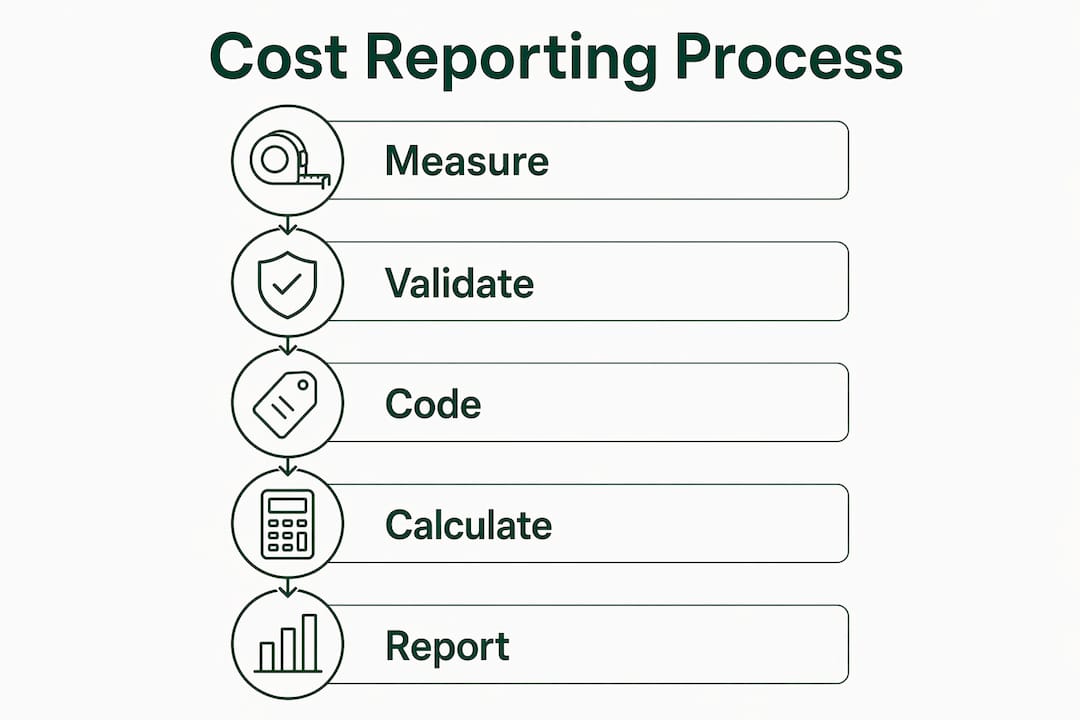
The process follows six stages, each building on the last. Skipping any stage introduces errors that compound through the report.
-
Validate your quantity takeoffs. Every measured quantity must be checked against the source drawing or model before it enters the BoQ. Errors at this stage propagate into every downstream calculation. NRM2-aligned takeoffs provide a consistent measurement methodology that reduces ambiguity between surveyors.
-
Map quantities to BoQ line items. Each measured element must be assigned to the correct BoQ code. This mapping is what connects physical work to financial tracking. Accurate cost reporting integrates the project schedule, BoQ, and unit price databases, applying Earned Value Method indicators to detect cost variances early.
-
Apply unit rates to produce cost values. Multiply validated quantities by the appropriate unit rates, including wastage allowances and overheads. This step produces the estimated cost for each BoQ item, which becomes the budget baseline for that work package.
-
Integrate procurement and expenditure data. Every purchase order, invoice, and site expense must be coded to a BoQ item. Every purchase order and invoice should be mapped to a specific BoQ item for informative cost accumulation. Without this linkage, costs accumulate in the general ledger with no work package context.
-
Apply Earned Value Management indicators. Calculate BCWS (Budgeted Cost of Work Scheduled), BCWP (Budgeted Cost of Work Performed), and ACWP (Actual Cost of Work Performed) for each BoQ section. OpenBIM-based reporting extracts quantities directly from 3D models, linking them with schedule and cost data for near real-time performance monitoring. The variance between BCWP and ACWP tells you whether you are over or under budget for the work actually completed.
-
Update for variation orders and contingencies. Approved variations must be added to the BoQ before the next reporting cycle. Contingency drawdowns should be tracked separately so that the core budget baseline remains visible.
Pro Tip: Track installed physical quantities alongside financial spend. If 60% of concrete is installed but 75% of the concrete budget is consumed, you have a productivity problem, not just a cost problem. Physical quantity tracking enables early productivity issue identification that financial-only reporting misses entirely.
How does measurement uncertainty affect cost reporting accuracy?
Measurement uncertainty is the confidence range around any measured quantity, and it affects every cost report that uses physical measurements for financial decisions. Project managers often treat a measured dimension as an exact figure. It is not. Every measurement carries uncertainty introduced by instrument resolution, calibration status, environmental conditions, and operator technique.
ISO/IEC 17025 requires all calibration certificates to include uncertainty for traceability and validity. This requirement exists because a quantity used without its uncertainty range can produce a pass or fail decision that is statistically unjustified. In construction, that translates directly into disputed payment certificates and contested milestone completions.
The practical consequence for cost reporting is significant. UK professional standards require accounting for measurement uncertainty when quantities gate critical project milestones or payment thresholds, to avoid costly disputes. ISO 9001:2015 and ISO/IEC 17025 both emphasise guard bands or decision rules rather than raw quantities for conformity calls.
Common sources of measurement uncertainty in construction include:
- Instrument calibration drift: total stations and laser distance meters require periodic recalibration
- Drawing interpretation differences: two surveyors measuring from the same PDF can produce different quantities
- Environmental factors: temperature and humidity affect physical measurements on site
- Model extraction errors: BIM quantity extraction depends on the accuracy of the underlying model geometry
Quantities gating pass/fail calls should never be used raw. Adjust them using guard bands derived from uncertainty estimates. A measured quantity without its uncertainty range is not a reliable basis for a payment decision or a milestone sign-off.
Professional practice recommends tracing every quantity used for payment or conformity decisions to its measurement uncertainty. This reduces disputes and lowers project risk at contract closeout.
What are the common challenges in quantity-based cost reporting?
The most frequent failure in quantity-based cost reporting is the absence of a live link between purchase orders and BoQ items. Without this linkage, costs accumulate without work package context, delaying overspending detection until it is too late to recover. Financial controllers often discover budget breaches at month-end rather than at the point of commitment.
A second common problem is treating the BoQ as a static document. A dynamic BoQ should reflect every approved change order and contractor billing evaluation. Projects that freeze the BoQ at contract award and then manage variations outside the document lose the ability to compare actual spend against a meaningful baseline.
Other challenges include:
- Unreconciled variation orders: scope changes that are instructed verbally or informally before being formally valued distort both the quantity baseline and the cost report
- Delayed site measurement updates: progress valuations based on last month's installed quantities produce cost reports that lag behind actual site conditions
- Inconsistent coding between systems: when the BoQ coding structure does not match the general ledger chart of accounts, reconciliation becomes a manual exercise prone to error
- Earned value calculated on spend alone: financial controllers who calculate BCWP from invoices rather than installed quantities overstate progress and understate risk
Pro Tip: Set a weekly cut-off for site measurement updates and enforce it. A cost report based on quantities that are two weeks old is not a cost report. It is a historical document with limited value for current decision-making.
Scope changes are the single biggest threat to BoQ integrity. Every variation order should trigger an immediate update to the relevant BoQ line items, with the revised quantities and rates agreed before work proceeds. Projects that allow variations to accumulate and are valued retrospectively at closeout consistently produce final account disputes.
Key takeaways
Accurate cost reporting from measured quantities requires a live, coded link between physical work volumes, BoQ line items, and actual expenditure at every stage of the project.
| Point | Details |
|---|---|
| BoQ as the cost backbone | Code every purchase order and invoice to a specific BoQ item to enable meaningful variance analysis. |
| Rate analysis matters | Include wastage allowances for materials in every unit rate to avoid systematic undercosting. |
| Track quantities, not just spend | Compare installed physical quantities against budget quantities to identify productivity issues early. |
| Account for measurement uncertainty | Apply guard bands to quantities used for payment or milestone decisions to reduce contract disputes. |
| Keep the BoQ dynamic | Update the BoQ for every approved variation order before the next reporting cycle, not at closeout. |
Why I think most cost reports fail before the data is even entered
The projects I have seen struggle most with cost reporting share one characteristic: they treat the BoQ as a tendering document rather than a live financial control tool. Once the contract is signed, the BoQ gets filed and the finance team starts tracking costs in a spreadsheet or accounting system with no reference to measured quantities at all. By the time anyone notices a budget problem, the project is already committed to the overspend.
The shift that makes the biggest difference is integrating AI quantity takeoffs into the measurement workflow from the outset. When quantities are extracted automatically from drawings and mapped directly to BoQ codes, the link between physical work and financial data exists from day one. There is no manual re-entry step where errors creep in.
BIM and OpenBIM data take this further. Integrating BIM quantity data with scheduling and costing systems allows project controls to detect productivity and cost discrepancies in near real-time. That capability changes the nature of the cost report from a backward-looking summary into a forward-looking control instrument.
The measurement uncertainty point is the one most project managers underestimate. I have seen payment disputes run for months because a measured quantity used for a milestone payment was right at the boundary of the acceptance criterion, and neither party had documented the uncertainty range. Applying guard bands is not bureaucratic overhead. It is the difference between a clean final account and an arbitration.
My recommendation is straightforward: link your quantities to your costs at the point of measurement, update the BoQ with every variation, and never use a raw measured quantity for a payment decision without understanding its confidence range.
— Michael
How Quantiflow supports quantity-based cost reporting
Accurate cost reporting depends on accurate quantities. That is where most projects lose time and money, in the gap between a PDF drawing and a priced BoQ line item.

Quantiflow automates NRM2-aligned quantity takeoffs directly from architectural drawings, producing structured BoQ output that is ready to price and link to your cost management system. The AI cross-references drawings to catch discrepancies before they reach your cost report, while preserving the quantity surveyor's professional judgement at every step. Plans start from £39 per month for solo practitioners, rising to £149 per month for business teams, with custom Enterprise options available. If you want quantities that are traceable, consistent, and ready for cost reporting workflows, Quantiflow is built for exactly that purpose.
FAQ
What is cost reporting from measured quantities?
Cost reporting from measured quantities is the process of converting physically measured work volumes into financial data, using a coded BoQ and unit rates to track actual spend against budgeted costs at every project stage.
Why is the BoQ central to measured quantity cost reporting?
The BoQ provides the coded structure that links every purchase order, invoice, and site measurement to a specific work package, making variance analysis and overspend detection possible in real time.
How does measurement uncertainty affect payment certificates?
Quantities used for payment decisions carry an inherent confidence range. ISO/IEC 17025 and ISO 9001:2015 require guard bands to be applied to boundary measurements, reducing the risk of disputed certificates and contract claims.
What is the difference between tracking spend and tracking installed quantities?
Tracking spend shows how much money has been committed or paid. Tracking installed quantities shows how much physical work has been completed. Comparing the two through Earned Value Management reveals productivity problems that financial tracking alone cannot detect.
How often should a BoQ be updated during a project?
The BoQ should be updated for every approved variation order before the next reporting cycle. Leaving variations to accumulate and be valued retrospectively at closeout is the most common cause of final account disputes in UK construction.