
A prime cost sum, or PC sum, is a supply-only allowance inserted into a bill of quantities for materials or goods whose exact quality, pattern or price cannot be fixed at tender stage. It excludes fixing labour, preliminaries, overheads and profit under NRM2, and once the actual cost is verified, that figure replaces the estimate and the contract sum moves up or down to match.
TL;DR:
- Prime cost sums are supply-only allowances for materials with uncertain prices or suppliers, explicitly excluding installation, overheads, and profit.
- Accurate description and clear verification procedures are essential in contract documents to prevent disputes and ensure proper pricing adjustments.
- Contractors should submit supplier quotations before procurement to allow early price queries and avoid cost overruns at final account.
- Using provisional sums instead of PC sums is advisable when full scope or quality specifications are still uncertain, reducing mispricing risk.
- Inaccurate PC sums can cause cash flow spikes and reduce contingency reserves, making ongoing market review and prompt client updates crucial.
Table of Contents
- What is a prime cost sum? The NRM2 definition and examples
- Prime cost sums versus provisional sums: the distinction that matters
- How prime cost sums are priced and adjusted in practice
- Drafting and risk management: clauses and pitfalls to avoid
- Preparing BoQs and tender instructions that handle PC sums correctly
- When to avoid prime cost sums and better alternatives
- Impact of inaccuracies in PC sums on project budgeting and cash flow management
- Guidance on updating PC sums during contract variations or changes
- Best practices for communicating PC sum details to clients and subcontractors
- Sources
- FAQ
What is a prime cost sum? The NRM2 definition and examples
RICS defines a PC sum in NRM2 as a supply-only rate inserted where the precise quality or source of materials or goods is not known at the time the bill of quantities is prepared. The definition is narrow by design. NRM2 explicitly excludes fixing and installation, ancillary materials, subcontractor design fees, subcontractor preliminaries, and any overheads or profit belonging to either the subcontractor or the main contractor.
Two examples make the scope clear:
- Supply-only ceramic wall tiles, priced in NRM2's own worked example at £50/m² for the tiles alone, with fixing measured and priced separately.
- Supply-only door furniture, such as locks and ironmongery, priced at around £120 per door, again excluding the labour to fit it.
In a bill of quantities, each entry should read as a discrete PC sum item with its own description and unit, clearly flagged as supply-only, so nobody downstream mistakes it for a fully inclusive rate. Getting that description right at drafting stage saves a great deal of argument at final account.
Prime cost sums versus provisional sums: the distinction that matters
Confusing these two terms is one of the most persistent errors in UK contract administration, and it is worth being precise about the difference before pricing anything.
- A provisional sum covers work or services that cannot be accurately defined or priced at tender, including labour, and it may relate to an entire undefined scope of works rather than a single item.
- A PC sum covers a known item whose price is not yet fixed — the QS knows exactly what is being bought (a sanitaryware suite, a set of ironmongery), only not yet from whom or at what rate.
- The practical test is simple: if you can name the item but not the supplier or exact cost, it is a PC sum. If you cannot yet define the scope at all, it is a provisional sum.
Designing Buildings sets out this distinction clearly, and it has real consequences for pricing: contractors pricing a PC sum need only add attendances and mark-up, while pricing a provisional sum requires them to allow for risk on an undefined scope. When appraising returned tenders, check that every contractor has applied the correct logic to each sum rather than treating them interchangeably. A related explainer on provisional sums in a bill of quantities sets out the appraisal checks in more depth.
How prime cost sums are priced and adjusted in practice
The PC sum in the tender document is only ever a placeholder. Once the actual supplier and price are known, the contract sum is adjusted to reflect the verified figure, and that adjustment needs a paper trail.
- Supplier quotations and invoices are the standard evidence used to substantiate the actual cost against the original allowance.
- Formal instruction from the contract administrator should authorise the procurement before the contractor commits to a supplier, particularly where the final price is likely to exceed the PC allowance.
- Overheads and profit are typically recoverable by the contractor on top of the verified cost, but only at the percentage or method agreed in the contract, not an arbitrary figure applied after the fact.
Adjustments usually surface first in interim valuations as provisional figures, then get finalised in the final account once every invoice is in. Contractors are generally expected to notify the contract administrator promptly if actual costs are tracking above the original PC allowance, rather than saving the surprise for completion.
Pro Tip: Ask contractors to submit supplier quotations for PC sum items before instructing procurement, not after. It gives you a chance to query the price while there's still room to negotiate, rather than reconciling an invoice you've already been committed to.
Drafting and risk management: clauses and pitfalls to avoid
PC sums and provisional sums are not statutory terms. Their meaning in any given contract depends entirely on how the parties define them, and Lexology's commentary on this point is unambiguous: where the contract is silent or vague, interpretation falls back on custom and inferred intention, which is a poor place to be when a dispute lands on a QS's desk.
A well-drafted contract should specify, for every PC sum:
- What the sum covers and, just as importantly, what it explicitly excludes.
- The verification procedure for confirming actual cost, including what evidence is acceptable.
- Attendance allowances, stated as either a percentage or a fixed sum.
- The mark-up method for overheads and profit, agreed before tender rather than negotiated afterwards.
- The instruction process required before the contractor procures the item.
When appraising tender returns, watch for contractors who have priced the PC sum figure itself but left attendances or mark-up blank, assuming they will be added later. That gap is where disputes over "reasonable" cost tend to start.
Preparing BoQs and tender instructions that handle PC sums correctly
Getting a PC sum entry right at BoQ stage is largely about discipline in the description, not complexity in the arithmetic.
- Write a specific description. Name the item, its general specification, and the fact that the rate is supply-only. A provisional quantity can be included where the number of units is not yet finalised.
- Choose how attendances will be priced. You have two realistic options. A detailed allowance breaks out the cost of unloading, storage and coordination as a separate line, which is transparent but takes longer to prepare and check. A stated percentage of the PC sum is quicker to apply but can hide inconsistent assumptions between contractors if it is not defined precisely. C-Link's guidance on pricing attendances recommends being explicit about which method applies, rather than leaving it to the contractor's discretion.
- Appraise tenders systematically. Confirm that every contractor has priced attendances against each PC sum, flagged any exclusions from the base rate, and applied a consistent mark-up method across the bill. Inconsistent mark-ups between contractors' returns are the most common reason recommended award prices need adjusting after tender.
- Adjust the recommended price once you have normalised each return to the same basis, so you are comparing genuinely equivalent figures rather than being misled by a low headline PC sum hiding an unpriced attendance.
Pro Tip: If two tenders quote wildly different totals for the same PC sum item, check attendances before you check the supplier rate. It is almost always the missing variable, not the material cost itself.
A structured approach to entering these figures into a bill of quantities is covered in more detail in Quantiflow's guide to BoQ pricing, which sets out how allowances should be structured for consistent comparison.
When to avoid prime cost sums and better alternatives
PC sums are useful when genuinely necessary, but they are not the default. Industry practitioners have moved away from nominated subcontractor arrangements precisely because they introduce financial uncertainty into the final account and complicate settlement.
Risk rises when a PC sum is used to disguise a specification decision that has simply been deferred, or where a client insists on a nominated supplier late in design. In both cases, the QS is carrying pricing risk that could have been designed out.
Three practical alternatives are worth considering before defaulting to a PC sum:
- Finalise the specification before tender. If the choice of tile, sanitaryware or ironmongery can realistically be settled two or three weeks earlier in the programme, a firm rate removes the uncertainty entirely.
- Obtain supplier quotations pre-tender. Even an indicative quotation gathered before the bill is issued gives contractors a firmer figure to price against.
- Use a provisional sum instead, where the real issue is an undefined scope of work rather than an unknown supply price. Trying to squeeze an undefined scope into a PC sum only masks the wrong kind of uncertainty.
Explaining this trade-off to a client is usually straightforward: a PC sum buys design flexibility now, at the cost of price certainty later. Most clients will accept that trade consciously once it is put to them in those terms, rather than discovering it at final account.
Impact of inaccuracies in PC sums on project budgeting and cash flow management
An inaccurate PC sum does not just create a line-item discrepancy. It ripples through the whole financial model of a project. If the original allowance was set too low, either through poor market knowledge or an overly optimistic estimate, the shortfall surfaces as a cost overrun that has to be absorbed somewhere, usually against a contingency that was earmarked for something else.
Cash flow is the more immediate casualty. Interim valuations rely on PC sum figures being reasonably close to reality, because the contractor is being paid against those allowances month by month. When the verified cost comes in significantly higher than the original sum, the adjustment often lands as a lump correction in a later valuation rather than being smoothed across the programme, which can create a cash flow spike that catches a client's finance team off guard.
There is a second-order effect on contingency drawdown. Projects typically hold contingency against genuine risk, not against poor initial pricing of known items. When PC sum inaccuracies eat into that contingency early, the project has less headroom left for the risks contingency was actually meant to cover, such as unforeseen ground conditions or design changes.
The practical response is to revisit PC sum allowances against current market pricing at regular intervals, not just at tender, and to flag any material variance to the client as soon as it is known rather than waiting for the final account. A QS who updates the cost plan the moment a supplier quotation lands, rather than at the next scheduled report, gives the client far more useful notice.
Guidance on updating PC sums during contract variations or changes
Variations are the point where PC sum figures most often drift from reality, because a change in specification, quantity or supplier frequently accompanies a broader design change instructed under the contract's variation clause.
The starting principle is straightforward: any instruction that alters the scope, specification or quantity behind a PC sum should be treated as a variation in its own right, valued using the same mechanism as any other variation under the contract, whether that is the contract's own valuation rules or fair market rates where no rate exists. The PC sum allowance in the original bill should not simply be replaced quietly; the change and its financial effect should be recorded formally.
In practice, that means logging three things whenever a PC sum item changes: the instruction that triggered the change, the revised specification or quantity, and the updated cost evidence supporting the new figure. Skipping any one of these three tends to be exactly where disputes originate at final account, because there is no clear record of what was authorised, by whom, and against what evidence.

Where a variation increases the scope covered by a PC sum, for instance switching from a mid-range sanitaryware suite to a higher specification one, the adjustment should also revisit attendances and mark-up, not just the supply cost. A larger or heavier item can change the attendance allowance even where the percentage mark-up stays the same. Contract administrators should require contractors to resubmit their attendance pricing alongside any revised PC sum figure triggered by a variation, rather than assuming the original attendance allowance still applies.
Best practices for communicating PC sum details to clients and subcontractors
Most PC sum disputes trace back to a communication gap rather than a genuine disagreement over figures. The item, the exclusion, or the adjustment mechanism was understood differently by each party, and nobody noticed until the invoice arrived.
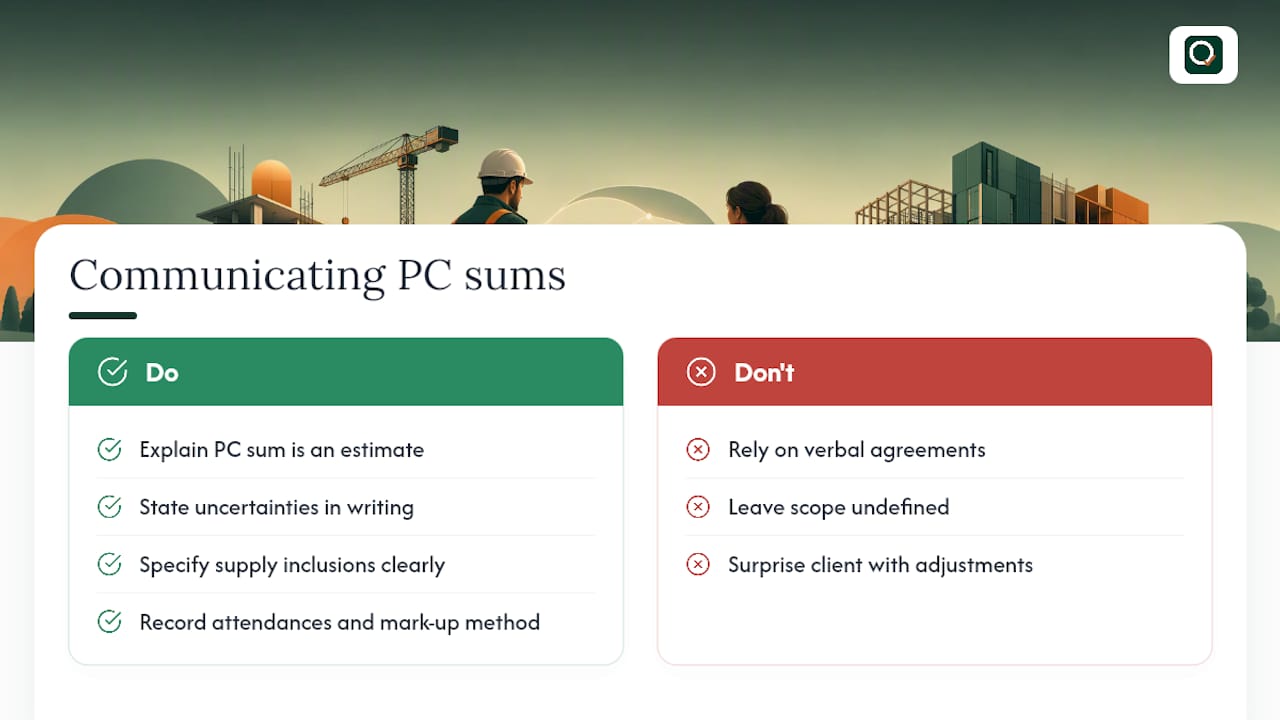
With clients, the priority is setting expectations early: a PC sum is an estimate, not a fixed price, and the final figure could move in either direction once the actual supplier and cost are confirmed. Framing this at the outset, ideally in the same conversation where the specification is discussed, avoids the client experiencing a PC sum adjustment as a surprise cost increase months later. It helps to state plainly, in writing, which items in the cost plan carry this kind of uncertainty and which are firm.
With subcontractors and the main contractor, clarity centres on scope and mark-up. Every PC sum instruction should state explicitly what is included in the supply-only figure, what attendances are expected, and how overheads and profit will be recovered, so there is no room for a contractor to interpret the allowance differently from how the QS intended it. Putting this in the tender documentation, rather than relying on a verbal understanding carried over from a pre-tender meeting, is the difference between a smooth valuation and a contested one.
A short written note attached to each PC sum entry in the bill of quantities, summarising these points in plain language, costs little to produce and tends to save considerably more time at final account than it takes to write.
Tools that generate structured draft bills of quantities from architectural drawings can help keep PC sum descriptions consistent across a project, though the specification, verification and sign-off remain firmly the quantity surveyor's responsibility. Quantiflow is being developed for exactly this kind of drafting support: it reads construction drawings and produces a draft bill of quantities for a quantity surveyor to review and sign off, leaving the professional judgement on items like PC sums where it belongs.
Sources
For the formal definition and exclusions, RICS NRM2 remains the primary reference. For legal drafting and dispute risk, Lexology's commentary on provisional sums and prime costs sets out why contract wording carries so much weight. For practitioner-level explanations and worked examples, Designing Buildings and C-Link's guidance on pricing attendances are both worth bookmarking. Quantity surveyors who also manage downstream asset handover may find a field service and facilities management platform such as Curcle useful for tracking PC-specified items once installed.
- New rules of measurement (NRM2) — RICS
- The difference between a prime cost sum and a provisional sum — Designing Buildings
- Prime cost sums and cost reimbursable construction contracts — LexisNexis
- Prime cost sums - C-Link
FAQ
What are prime cost sums?
A prime cost sum is a supply-only allowance for materials or goods where the exact price or supplier is not known at tender stage, excluding fixing labour, preliminaries, overheads and profit under NRM2.
What is a prime cost in a building contract?
In a building contract, a prime cost is a placeholder figure inserted into the bill of quantities for a known item, such as sanitaryware or ironmongery, that gets replaced with the verified actual cost once a supplier and price are confirmed.
What is a provisional sum?
A provisional sum is an allowance for work or services, potentially including labour, that cannot be accurately defined or priced at the time the bill of quantities is prepared, unlike a PC sum which covers a known, defined item.
How much is a builder's hourly rate?
Hourly rates vary widely by trade, region and project complexity, and no single UK-wide figure is reliably published, so quantity surveyors should price labour against current local market rates or recognised cost databases rather than a generic hourly figure.
Recommended
- Risk allowances in BoQs: the UK QS guide
- NRM2 explained: the RICS standard for measuring building works
- Keep Tender Quantities Within ±5%: NRM2 Workflow for UK QS
- Provisional sums in BoQ: a practical guide for QSs
This article is for general information only and is not professional, legal or commercial advice. Quantity surveying decisions should be taken by a qualified professional with reference to the specific project, drawings and contract in question. Content is produced with AI assistance and reviewed before publication. QuantiFlow Ltd accepts no liability for reliance on it.