
A preamble in a BoQ is the set of measurement and pricing rules that determines what each unit rate must include, so get it wrong and tenders become non-comparable. It sits at the front of the bill, usually before the measured works sections, and it governs how every rate below it should be read.
When a preamble is vague or missing detail, two things go wrong repeatedly. First, contractors price the same item differently: one includes attendance and testing in the rate, another excludes them and expects a variation later. Second, evaluators reject or query bids because rates cannot be compared on a like-for-like basis, delaying award and eating into programme.
- A missing reference to the specification version leads two tenderers to price against different drawing revisions.
- An unclear "included elsewhere" note lets one contractor omit scaffolding costs entirely, undercutting rivals who priced it properly.
Both scenarios stem from the same root cause: the preamble failed to state its rules with enough precision.
Key Takeaways
Preambles set the pricing rules that make unit rates comparable across tenders, and vague wording is the single largest cause of unbalanced pricing and disputed valuations.
| Point | Details |
|---|---|
| Reference measurement standards | Cite RICS NRM and specific drawing/specification revisions rather than generic references. |
| State inclusions and exclusions | Define exactly what each unit rate covers, including attendance, OH&P, and testing. |
| Audit with a fixed sequence | Reconcile totals, trace included-elsewhere notes, and normalise prelims before comparing bids. |
| Flag ambiguous wording early | Query nil rates, "by others" entries, and conditional notes before they become disputes. |
| Automate takeoff, not judgement | Quantiflow cross-references drawings during takeoff so preamble references match measured quantities, while the surveyor retains final say on wording and rate build-up. |
Table of Contents
- What does a preamble in a BoQ typically contain?
- How do preambles change where cost sits in a tender?
- Drafting preambles that actually hold up under scrutiny
- What should a BoQ audit checklist cover?
- Common risk flags to watch for in preamble wording
- A sample preamble clause worth adapting
- What I've learned reviewing priced bills for years
- A faster way to keep preambles and quantities aligned
- Sources
What does a preamble in a BoQ typically contain?
A complete preamble references a measurement standard, usually RICS NRM (New Rules of Measurement), and states the unit notation used throughout the bill. Without this anchor, tenderers guess at how items should be measured and priced, and guesses rarely align.
The preamble also defines what each unit rate must cover. Does the rate for supplying and fixing a door include ironmongery, or is that measured separately? Does it include attendance by other trades? These inclusion and exclusion statements are the backbone of a fair tender.
Beyond rates, a well-drafted preamble should:
- Cite the exact drawing numbers and specification revision used for measurement, not a general reference to "the drawings."
- State how provisional sums, preliminaries, overheads and profit (OH&P), and dayworks should be priced or excluded from unit rates.
- Cross-reference items measured elsewhere in the bill using precise section and item numbers, not vague phrases.
- Confirm whether rates are gross (inclusive of OH&P) or net, with OH&P added separately.
Pro Tip: Never write "refer to drawings" alone. State the drawing number and revision letter explicitly, for example "Drawing A-101 Rev C" — tenderers pricing against an outdated revision is one of the most common causes of post-award disputes.
Preambles should also confirm the BoQ is to be read alongside the specification and other contract documents, not in isolation. That single sentence resolves more ambiguity than almost any other clause in the document.
How do preambles change where cost sits in a tender?
The preamble decides whether overheads and profit are recovered inside individual unit rates or added as a separate percentage against the whole bill. That single choice changes how a contractor structures every price in the document, and it explains why two tenders with similar-looking totals can carry very different risk.
Misallocation happens in predictable places. Attendance on nominated subcontractors gets buried in one rate and omitted from another. Testing and commissioning costs appear in the mechanical services section for one tenderer and get missed entirely by a second. Temporary works, if the preamble does not state where they sit, end up split unevenly across the bill.
Programme assumptions matter too. If the preamble does not state the assumed contract duration or sequencing, time-related preliminaries become impossible to compare fairly across bids.
When reviewing priced bills, watch for these signals:
- A rate that looks unusually low relative to comparable tenders, often indicating an excluded cost recovered elsewhere.
- Preliminaries that seem disproportionate to the measured works value, suggesting front-loading.
- Provisional sums priced at face value with no allowance for attendance, which usually means the contractor missed the requirement.
Ambiguity in preambles is a leading cause of unbalanced pricing during tendering, according to industry commentary on contract risk. Contractors under commercial pressure will exploit loose wording, deliberately or otherwise, to shift risk without it showing in the headline total.
Drafting preambles that actually hold up under scrutiny
Copy-pasting a preamble from a previous project is the single fastest way to introduce risk into a new tender. Ground conditions differ, contract forms differ, and the measurement convention used on the last job may not match this one. Tailoring the wording to the specific site, form of contract, and NRM edition in use is not optional diligence, it is the job.
A short checklist before issuing:
- Confirm every drawing reference in the preamble matches the actual drawing register issued with the tender.
- Check the specification revision cited matches the version used to prepare quantities.
- State explicitly whether the contract form is NEC4, JCT, or a bespoke employer's form, since interpretation rules differ between them.
- Replace vague phrases like "as required" with a specific reference to a clause, drawing, or specification clause number.
Pro Tip: If a clause could apply equally to any building on any site, delete it. A preamble earns its place by being specific to this project, not by sounding thorough.
This is where automation genuinely helps rather than replaces judgement. Quantiflow's takeoff engine cross-references drawings against the measured quantities it produces, flagging where a stated drawing revision does not match what has actually been measured. The surveyor still decides what goes in the preamble and how each rate should be built up. The software simply makes it harder to issue a bill referencing the wrong drawing set, which is one of the most common and entirely avoidable errors in preamble drafting.
What should a BoQ audit checklist cover?
Reviewing a priced bill against its preamble is a distinct skill from producing the bill in the first place, and it rewards a systematic approach. A structured reconciliation process catches the gaps that a quick read-through misses.
- Reconcile page totals against the summary and grand total, checking arithmetic before anything else.
- Trace every "included elsewhere" and nil-rated entry back to the item where it claims to be priced, confirming the value is actually there.
- Normalise preliminaries across tenderers by checking the assumed programme duration and method statement each has used.
- Map every provisional sum against the preamble's stated treatment of attendance and OH&P recovery.
- Draft clarification requests that cite the exact BoQ page, item number, and preamble clause in question, so the contractor's response closes the query rather than opening three more.
Experienced reviewers scan for included-elsewhere notes and nil entries first, because these hide scope gaps more often than any other single wording pattern.
Common risk flags to watch for in preamble wording
Certain phrases in a preamble or priced bill should trigger closer scrutiny every time. A nil rate against a substantial item usually means the cost has been recovered elsewhere, and the reviewer's job is to find where. "Included elsewhere" without a page and item reference is functionally unverifiable.
- "By others" without naming who those others are or which package covers the work.
- Conditional notes such as "subject to site access" that are not aligned with the tender's stated access arrangements.
- Programme or access assumptions buried in prelims rather than stated in the preamble itself.
In strict tender environments, a conditional note that conflicts with the tender rules can disqualify a bid outright, which is exactly why preambles need to align tightly with the form of contract. When in doubt, request clarification in writing: "Please confirm the priced value and BoQ reference for the item stated as included elsewhere in Section 4, Item 12."
A sample preamble clause worth adapting
For net pricing, add: "OH&P shall be entered separately against each section and shall not be included within measured rates." For gross pricing, the alternative reads: "All rates are deemed to include a due proportion of overheads and profit; no separate addition will be permitted."
Both variants work provided the drawings and specification versions are named precisely, not referenced generically.
What I've learned reviewing priced bills for years
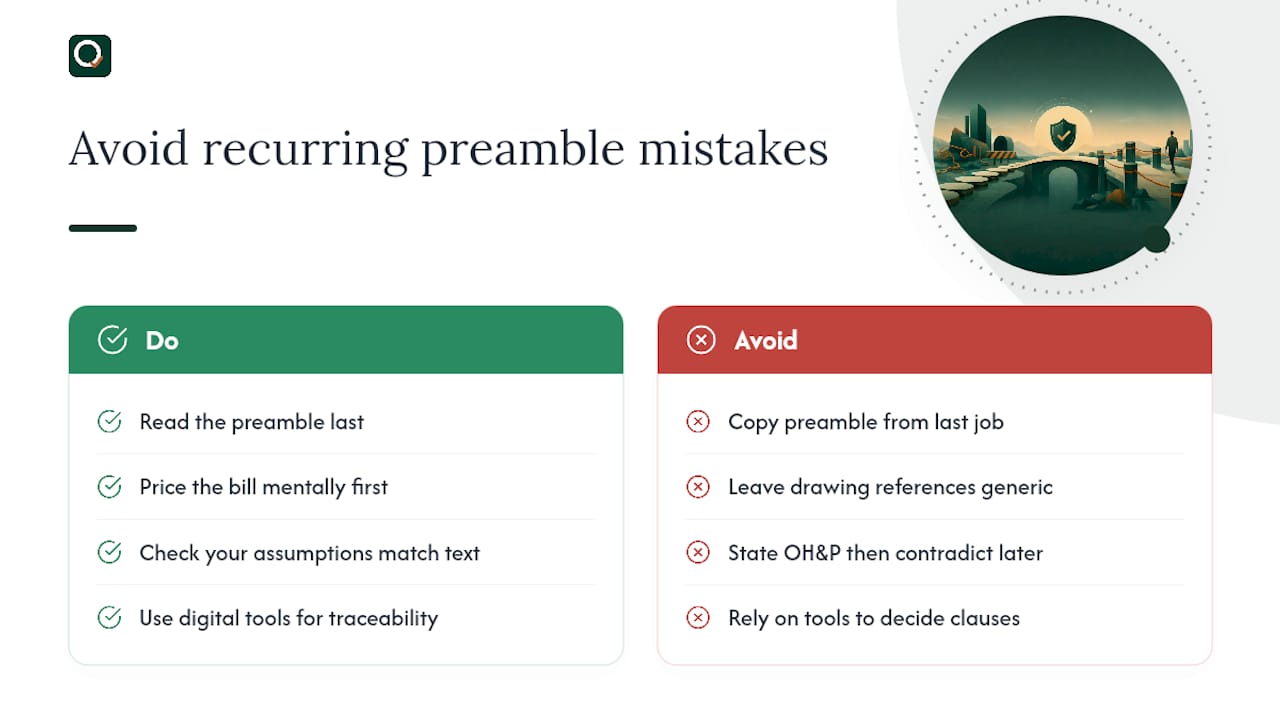
The same mistakes recur across projects: preambles copied from the last job, drawing references left generic, and OH&P treatment stated once and then contradicted three sections later. Most disputes trace back to one of these three, not to genuinely novel scope problems.
Digital tools help enormously with traceability, catching a mismatched drawing reference before it reaches tender, but they cannot decide what a clause should say. That judgement remains yours. My one piece of advice for busy QSs: read the preamble last, after pricing the bill yourself mentally, and check whether your own assumptions match what it actually states.
— Michael
A faster way to keep preambles and quantities aligned
Producing a tender-ready BoQ by hand means manually cross-checking every drawing reference against every measured item, a task that eats hours and still leaves room for the version-mismatch errors covered above. Quantiflow closes that gap by extracting quantities directly from PDF architectural drawings and cross-referencing them automatically, so the drawing revision named in your preamble matches what has actually been measured.

It suits SME quantity surveyors, builders, and architectural practices who need NRM2-aligned takeoffs without adding headcount, and it keeps your professional judgement at the centre of every rate build-up rather than replacing it. Pricing runs from Solo at £39/month through to Business at £149/month, with custom Enterprise terms for larger practices. If drawing-to-BoQ traceability is where your current process breaks down, see how Quantiflow's takeoff engine works and check whether it fits your next tender.
Sources
- Bill of Quantities explained: How to read a priced BoQ (Rate QS Insights)
- Preambles in Bill of Quantities explained (Scribd)
- Bill of quantities preamble definition (Chase Estimating blog)